Salmos 80
LXX2012: Septuagint in British/International English 2012 · Toque num versículo para ver as referências cruzadas.
(81) For the end, a Psalm for Asaph, concerning the wine presses.
Hear Us, O Shepherd of Israel
1Rejoice you⌃ in God our helper; shout aloud to the God of Jacob.
2Take a psalm, and produce the timbrel, the pleasant lute with the harp.
3Blow the trumpet at the new moon, in the glorious day of your feast.
4For this is an ordinance for Israel, and a statute of the God of Jacob.
5He made it to be a testimony in Joseph, when he came forth out of the land of Egypt: he heard a language which he understood not.
6He removed his back from burdens: his hands slaved in making the baskets.
7You did call upon me in trouble, and I delivered you; I heard you in the secret place of the storm: I proved you at the water of Strife. Pause.
8Hear, my people, and I will speak to you, O Israel; and I will testify to you: if you will listen to me;
9there shall be no new god in you; neither shall you worship a strange god.
10For I am the Lord your God, that brought you out of the land of Egypt: open your mouth wide, and I will fill it.
11But my people listened not to my voice; and Israel gave no heed to me.
12So I let them go after the ways of their own hearts: they will go on in their own ways.
13If my people had listened to me, if Israel had walked in my ways,
14I should have put down their enemies very quickly, and should have laid my hand upon those that afflicted them.
15The Lord's enemies should have lied to him: but their time shall be for ever.
16And he fed them with the fat of wheat; and satisfied them with honey out of the rock.
Você sabia?
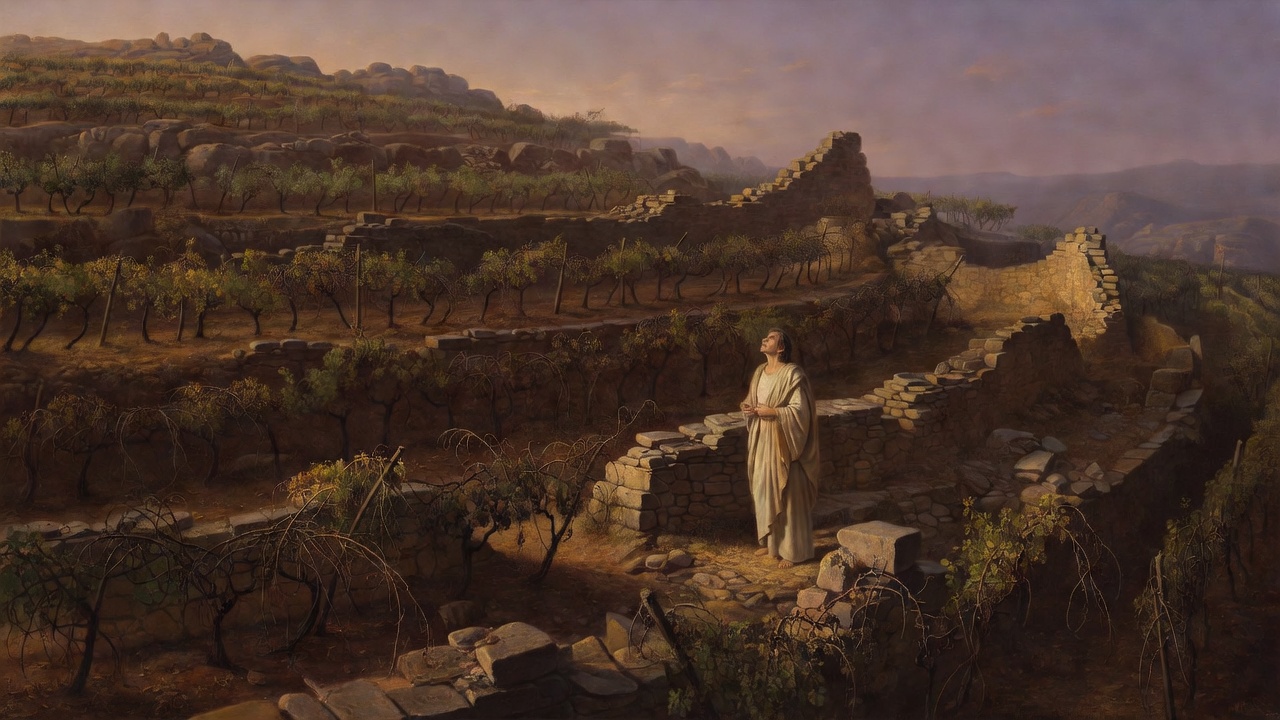
Uma oração pela videira devastada
- O salmo menciona especificamente Efraim, Benjamim e Manassés, tribos estreitamente ligadas pela descendência de Raquel por meio de José e Benjamim. Durante as peregrinações no deserto, essas três tribos ficavam acampadas e marchavam juntas no lado ocidental do tabernáculo.Fontes: Benjamin (patriarch) · Manasseh (son of Joseph) · o próprio texto bíblico
- O autor utiliza uma ampla alegoria comparando a nação de Israel a uma videira retirada do Egito e replantada em Canaã. O cântico lamenta que os muros de proteção da vinha tenham sido derrubados, deixando a planta frutífera exposta a animais selvagens e a transeuntes.Fontes: Egypt · o próprio texto bíblico
- Este poema faz parte de uma coleção específica que vai dos Salmos 73 a 83 atribuída a Asafe. O registro bíblico descreve Asafe como um líder dos músicos levitas na época do rei Davi, cuja guilda ou descendência deu continuidade à sua tradição no culto do templo.Fontes: Asaph (Levite) · o próprio texto bíblico
Notas escritas com auxílio de IA a partir de fontes abertas (Theographic Bible Metadata, CC BY-SA 4.0; Easton’s Bible Dictionary, domínio público) e revisadas antes de publicar.
Lugares deste capítulo
- Egypt · 30.129, 31.308 · versículo 8
- Euphrates · Hoje: Euphrates River · 31.004, 47.442 · versículo 11
- Great Sea · Hoje: Mediterranean Sea · 31.805, 34.170 · versículo 11
Só aparecem lugares com identificação de alta confiança (90% ou mais segundo as fontes acadêmicas reunidas pelo OpenBible). Mapa da época: DARE (Digital Atlas of the Roman Empire), CC BY 4.0; mapa atual: © colaboradores do OpenStreetMap; lugares: OpenBible.info (CC BY 4.0).
Créditos e licença desta tradução
LXX2012: Septuagint in British/International English 2012
The Septuagint with Apocrypha, translated from Greek to English by Sir Lancelot C. L. Brenton and published in 1885, with some language updates (British/International English)
Public Domain
Language: English
Dialect (if applicable): British
Language in English: English
Translation by: Sir Lancelot Charles Lee Breton
LXX2012: Septuagint in English 2012, British/International English Edition
This is a translation of the Old Testament and Apocrypha/Deuterocanon from Hebrew to Greek to 19th Century British English, with some updates of spelling and word usage to contemporary British/International English. The original English translation was done by Sir Lancelot Charles Lee Brenton and published by Samuel Bagster & Sons, Ltd., in London in 1851. It has entered the Public Domain due to the passage of sufficient time. In the process of scanning and typing the text, the original poetry and prose formatting, as well as peripheral material like introductions and notes, have been omitted.
This edition of the Septuagint has some language updates. Brenton's word order and punctuation has been mostly retained, meaning that quotation marks are not used, and sentences within quotes may not start with capital letters, as was standard usage in 1851. Names transliterated from Greek to those transliterated from Hebrew in the common English Bibles often differ. These language updates are dedicated to the Public Domain by the author of those edits, Michael Paul Johnson. Therefore this edition may be freely copied, published, etc.
Before considering making changes to the text of this work, I recommend that you consult with God, because this is really His Book.
If you find errors in the text, please report them so that we can correct them.
Donations to help with the expenses of operating this web site and thus help others have free access to the Word of God may be made to us, but are not required. Please see http://MLJohnson.org/partner/ for more about that.
Títulos de seção adaptados da Berean Standard Bible (domínio público); não fazem parte do texto bíblico desta tradução.
Fonte: http://ebible.org/eng-uk-lxx2012/ · eBible.org