Josué 4
LXX2012: Septuagint in British/International English 2012 · Toque num versículo para ver as referências cruzadas.
Twelve Stones from the Jordan
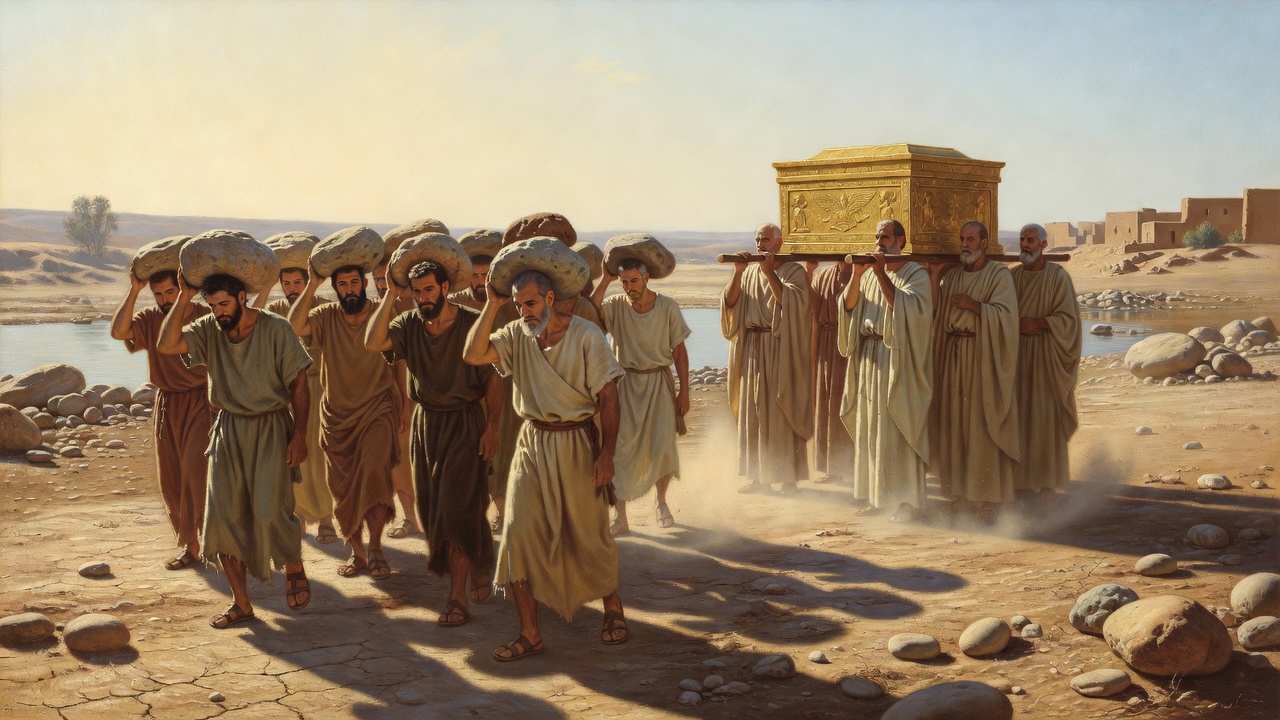
1And when the people had completely passed over Jordan, the Lord spoke to Joshua, saying, 2Take men from the people, one of each tribe, 3and charge them; and you⌃ shall take out of the midst of Jordan twelve fit stones, and having carried them across together with yourselves, place them in your camp, where you⌃ shall encamp for the night. 4And Joshua having called twelve men of distinction amongst the children of Israel, one of each tribe, 5said to them, Advance before me in the presence of the Lord into the midst of Jordan, and each having taken up a stone from thence, let him carry it on his shoulders, according to the number of the twelve tribes of Israel: 6that these may be to you continually for an appointed sign, that when your son asks you in future, saying, What are these stones to us? 7then you may explain to your son, saying, The river Jordan was dried up from before the ark of the covenant of the Lord of the whole earth, when it passed it: and these stones shall be for a memorial for you for the children of Israel for ever. 8And the children of Israel did so, as the Lord commanded Joshua; and they took up twelve stones out of the midst of Jordan, (as the Lord commanded Joshua, when the children of Israel had completely passed over,) and carried these stones with them into the camp, and laid them down there. 9And Joshua set also other twelve stones in Jordan itself, in the place that was under the feet of the priests that bore the ark of the covenant of the Lord; and there they are to this day. 10And the priests that bore the ark of the covenant stood in Jordan, until Joshua had finished all that the Lord commanded him to report to the people; and the people hasted and passed over. 11And it came to pass when all the people had passed over, that the ark of the covenant of the Lord passed over, and the stones before them. 12And the sons of Ruben, and the sons of Gad, and the half tribe of Manasse passed over armed before the children of Israel, as Moses commanded them. 13Forty thousand armed for battle went over before the Lord to war, to the city of Jericho. 14In that day the Lord magnified Joshua before all the people of Israel; and they feared him, as they did Moses, as long as he lived. 15And the Lord spoke to Joshua, saying, 16Charge the priests that bear the ark of the covenant of the testimony of the Lord, to go up out of Jordan. 17And Joshua charged the priests, saying, Go up out of Jordan. 18And it came to pass when the priests who bore the ark of the covenant of the Lord were gone up out of Jordan, and set their feet upon the land, that the water of Jordan returned impetuously to its place, and went as before over all its banks.
The Camp at Gilgal
19And the people went up out of Jordan on the tenth day of the first month; and the children of Israel encamped in Galgala in the region eastward from Jericho. 20And Joshua set these twelve stones which he took out of Jordan, in Galgala, 21saying, When your sons ask you, saying, What are these stones? 22Tell your sons, that Israel went over this Jordan on dry land, 23when the Lord our God had dried up the water of Jordan from before them, until they had passed over; as the Lord our God did to the Red Sea, which the Lord our God dried up from before us, until we passed over. 24That all the nations of the earth might know, that the power of the Lord is mighty, and that you⌃ might worship the Lord our God in every work.
Você sabia?
Doze pedras memoriais e a travessia do Jordão
- O capítulo descreve dois conjuntos distintos de doze pedras: um recolhido do leito do rio por doze representantes de cada tribo e erguido no acampamento em Gilgal, e outro colocado por Josué diretamente no meio do Jordão, onde os sacerdotes permaneceram. Esses monumentos foram concebidos como memoriais educativos permanentes para as futuras gerações.Fontes: o próprio texto bíblico · Gilgal
- Cumprindo as instruções dadas originalmente por Moisés, cerca de 40.000 guerreiros armados das tribos de Rúben, Gade e da meia tribo de Manassés marcharam na vanguarda de Israel nas campinas de Jericó, embora suas próprias terras ficassem a leste do Jordão.Fontes: o próprio texto bíblico · Reuben · Gad · Manasseh (son of Joseph)
- A travessia do Jordão é apresentada diretamente como equivalente à travessia do Mar Vermelho sob a liderança de Moisés. O povo chegou à margem ocidental no décimo dia do primeiro mês, estabelecendo seu acampamento em Gilgal, na fronteira leste de Jericó.Fontes: o próprio texto bíblico · Gilgal · Jericho · Red Sea
Notas escritas com auxílio de IA a partir de fontes abertas (Theographic Bible Metadata, CC BY-SA 4.0; Easton’s Bible Dictionary, domínio público) e revisadas antes de publicar.
Lugares deste capítulo
- Jordan · Hoje: Jordan River · 31.761, 35.558 · versículos 1, 3, 5, 7, 8, 9, 10, 12, 16, 17, 18, 19, 20, 22, 23
- Jericho · Hoje: Tell es Sultan · 31.872, 35.445 · versículos 13, 19
Só aparecem lugares com identificação de alta confiança (90% ou mais segundo as fontes acadêmicas reunidas pelo OpenBible). Mapa da época: DARE (Digital Atlas of the Roman Empire), CC BY 4.0; mapa atual: © colaboradores do OpenStreetMap; lugares: OpenBible.info (CC BY 4.0).
Créditos e licença desta tradução
LXX2012: Septuagint in British/International English 2012
The Septuagint with Apocrypha, translated from Greek to English by Sir Lancelot C. L. Brenton and published in 1885, with some language updates (British/International English)
Public Domain
Language: English
Dialect (if applicable): British
Language in English: English
Translation by: Sir Lancelot Charles Lee Breton
LXX2012: Septuagint in English 2012, British/International English Edition
This is a translation of the Old Testament and Apocrypha/Deuterocanon from Hebrew to Greek to 19th Century British English, with some updates of spelling and word usage to contemporary British/International English. The original English translation was done by Sir Lancelot Charles Lee Brenton and published by Samuel Bagster & Sons, Ltd., in London in 1851. It has entered the Public Domain due to the passage of sufficient time. In the process of scanning and typing the text, the original poetry and prose formatting, as well as peripheral material like introductions and notes, have been omitted.
This edition of the Septuagint has some language updates. Brenton's word order and punctuation has been mostly retained, meaning that quotation marks are not used, and sentences within quotes may not start with capital letters, as was standard usage in 1851. Names transliterated from Greek to those transliterated from Hebrew in the common English Bibles often differ. These language updates are dedicated to the Public Domain by the author of those edits, Michael Paul Johnson. Therefore this edition may be freely copied, published, etc.
Before considering making changes to the text of this work, I recommend that you consult with God, because this is really His Book.
If you find errors in the text, please report them so that we can correct them.
Donations to help with the expenses of operating this web site and thus help others have free access to the Word of God may be made to us, but are not required. Please see http://MLJohnson.org/partner/ for more about that.
Títulos de seção adaptados da Berean Standard Bible (domínio público); não fazem parte do texto bíblico desta tradução.
Fonte: http://ebible.org/eng-uk-lxx2012/ · eBible.org