Jó 29
LXX2012: Septuagint in British/International English 2012 · Toque num versículo para ver as referências cruzadas.
Job’s Former Blessings
1And Job continued and said in his parable, 2Oh that I were as in months past, wherein God preserved me! 3As when his lamp shone over my head; when by his light I walked through darkness. 4As when I steadfastly pursued my ways, when God took care of my house. 5When I was very fruitful, and my children were about me; 6when my ways were moistened with butter, and the mountains flowed for me with milk. 7When I went forth early in the city, and the seat was placed for me in the streets. 8The young men saw me, and hid themselves: and all the old men stood up. 9And the great men ceased speaking, and laid their finger on their mouth. 10And they that heard me blessed me, and their tongue clave to their throat. 11For the ear heard, and blessed me; and the eye saw me, and turned aside. 12For I saved the poor out of the hand of the oppressor, and helped the fatherless who had no helper. 13Let the blessing of the perishing one come upon me; yes, the mouth of the widow has blessed me. 14Also I put on righteousness, and clothed myself with judgement like a mantle. 15I was the eye of the blind, and the foot of the lame. 16I was the father of the helpless; and I searched out the cause which I knew not. 17And I broke the jaw teeth of the unrighteous; I plucked the spoil out of the midst of their teeth. 18And I said, My age shall continue as the stem of a palm tree; I shall live a long while. 19My root was spread out by the water, and the dew would lodge on my crop. 20My glory was fresh in me, and by bow prospered in his hand. 21Men heard me, and gave heed, and they were silent at my counsel. 22At my word they spoke not again, and they were very gland whenever I spoke to them. 23As the thirsty earth expecting the rain, so they waited for my speech. 24Were I to laugh on them, they would not believe it; and the light of my face has not failed. 25I chose out their way, and sat chief, and lived as a king in the midst of warriors, as one comforting mourners.
Você sabia?
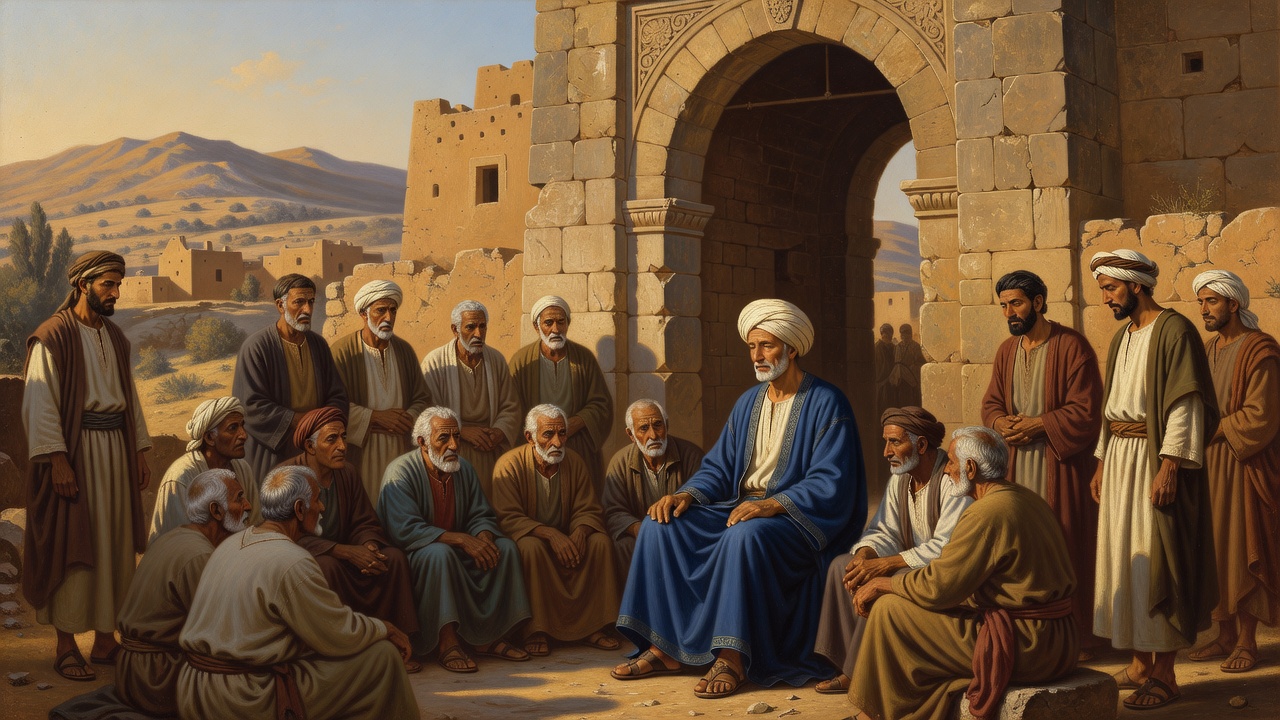
Jó recorda sua antiga honra
- Na Antiguidade, o portão da cidade e a praça pública funcionavam como o centro da liderança comunitária, das assembleias e das decisões judiciais. Jó relembra que se sentava ali como conselheiro e chefe honrado, onde os jovens se afastavam, os anciãos se levantavam em respeito e os nobres silenciavam para ouvir suas orientações.Fontes: o próprio texto bíblico
- Jó descreve sua antiga retidão em termos de justiça social e proteção ativa aos vulneráveis. Ele atuava como defensor e amparo dos pobres, dos órfãos, das viúvas, dos cegos, dos coxos e dos estrangeiros, ao mesmo tempo em que reprimia os opressores.Fontes: o próprio texto bíblico
- Jó é identificado como um patriarca árabe que residia na terra de Uz. Neste capítulo, ele recorda com profunda saudade o período anterior às suas súbitas calamidades, quando seus filhos estavam reunidos ao seu redor e sua casa desfrutava de grande prosperidade e da amizade com Deus.Fontes: Job · o próprio texto bíblico
Notas escritas com auxílio de IA a partir de fontes abertas (Theographic Bible Metadata, CC BY-SA 4.0; Easton’s Bible Dictionary, domínio público) e revisadas antes de publicar.
Créditos e licença desta tradução
LXX2012: Septuagint in British/International English 2012
The Septuagint with Apocrypha, translated from Greek to English by Sir Lancelot C. L. Brenton and published in 1885, with some language updates (British/International English)
Public Domain
Language: English
Dialect (if applicable): British
Language in English: English
Translation by: Sir Lancelot Charles Lee Breton
LXX2012: Septuagint in English 2012, British/International English Edition
This is a translation of the Old Testament and Apocrypha/Deuterocanon from Hebrew to Greek to 19th Century British English, with some updates of spelling and word usage to contemporary British/International English. The original English translation was done by Sir Lancelot Charles Lee Brenton and published by Samuel Bagster & Sons, Ltd., in London in 1851. It has entered the Public Domain due to the passage of sufficient time. In the process of scanning and typing the text, the original poetry and prose formatting, as well as peripheral material like introductions and notes, have been omitted.
This edition of the Septuagint has some language updates. Brenton's word order and punctuation has been mostly retained, meaning that quotation marks are not used, and sentences within quotes may not start with capital letters, as was standard usage in 1851. Names transliterated from Greek to those transliterated from Hebrew in the common English Bibles often differ. These language updates are dedicated to the Public Domain by the author of those edits, Michael Paul Johnson. Therefore this edition may be freely copied, published, etc.
Before considering making changes to the text of this work, I recommend that you consult with God, because this is really His Book.
If you find errors in the text, please report them so that we can correct them.
Donations to help with the expenses of operating this web site and thus help others have free access to the Word of God may be made to us, but are not required. Please see http://MLJohnson.org/partner/ for more about that.
Títulos de seção adaptados da Berean Standard Bible (domínio público); não fazem parte do texto bíblico desta tradução.
Fonte: http://ebible.org/eng-uk-lxx2012/ · eBible.org