Jó 25
LXX2012: Septuagint in British/International English 2012 · Toque num versículo para ver as referências cruzadas.
Bildad: Man Cannot Be Righteous
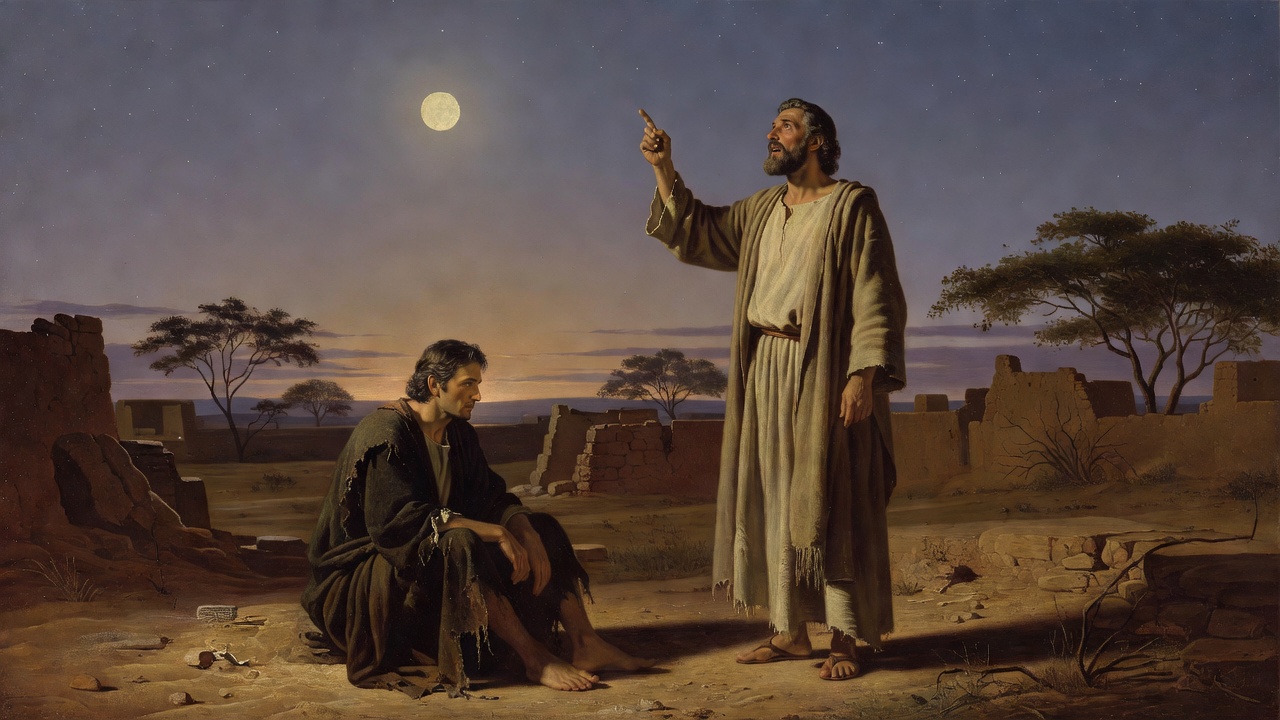
1Then Baldad the Sauchite answered and said, 2What beginning or fear is his—even he that makes all things in the highest? 3For let none think that there is a respite for robbers: and upon whom will there not come a snare from him? 4For how shall a mortal be just before the Lord? or who that is born of a woman shall purify himself? 5If he gives an order to the moon, then it shines not; and the stars are not pure before him. 6But alas! man is corruption, and the son of man a worm.
Você sabia?
O discurso final de Bildade
- Bildade é identificado como suíta, uma designação provavelmente ligada a Suá, uma região na Arábia associada aos descendentes de Abraão e Quetura.Fontes: Bildad · o próprio texto bíblico
- Este capítulo representa o terceiro e último discurso de Bildade, encerrando os debates formais entre Jó e seus três amigos com uma reflexão breve e severa que contrasta a pequenez humana com a majestade divina.Fontes: Bildad · o próprio texto bíblico
Notas escritas com auxílio de IA a partir de fontes abertas (Theographic Bible Metadata, CC BY-SA 4.0; Easton’s Bible Dictionary, domínio público) e revisadas antes de publicar.
Créditos e licença desta tradução
LXX2012: Septuagint in British/International English 2012
The Septuagint with Apocrypha, translated from Greek to English by Sir Lancelot C. L. Brenton and published in 1885, with some language updates (British/International English)
Public Domain
Language: English
Dialect (if applicable): British
Language in English: English
Translation by: Sir Lancelot Charles Lee Breton
LXX2012: Septuagint in English 2012, British/International English Edition
This is a translation of the Old Testament and Apocrypha/Deuterocanon from Hebrew to Greek to 19th Century British English, with some updates of spelling and word usage to contemporary British/International English. The original English translation was done by Sir Lancelot Charles Lee Brenton and published by Samuel Bagster & Sons, Ltd., in London in 1851. It has entered the Public Domain due to the passage of sufficient time. In the process of scanning and typing the text, the original poetry and prose formatting, as well as peripheral material like introductions and notes, have been omitted.
This edition of the Septuagint has some language updates. Brenton's word order and punctuation has been mostly retained, meaning that quotation marks are not used, and sentences within quotes may not start with capital letters, as was standard usage in 1851. Names transliterated from Greek to those transliterated from Hebrew in the common English Bibles often differ. These language updates are dedicated to the Public Domain by the author of those edits, Michael Paul Johnson. Therefore this edition may be freely copied, published, etc.
Before considering making changes to the text of this work, I recommend that you consult with God, because this is really His Book.
If you find errors in the text, please report them so that we can correct them.
Donations to help with the expenses of operating this web site and thus help others have free access to the Word of God may be made to us, but are not required. Please see http://MLJohnson.org/partner/ for more about that.
Títulos de seção adaptados da Berean Standard Bible (domínio público); não fazem parte do texto bíblico desta tradução.
Fonte: http://ebible.org/eng-uk-lxx2012/ · eBible.org