Jeremias 24
LXX2012: Septuagint in British/International English 2012 · Toque num versículo para ver as referências cruzadas.
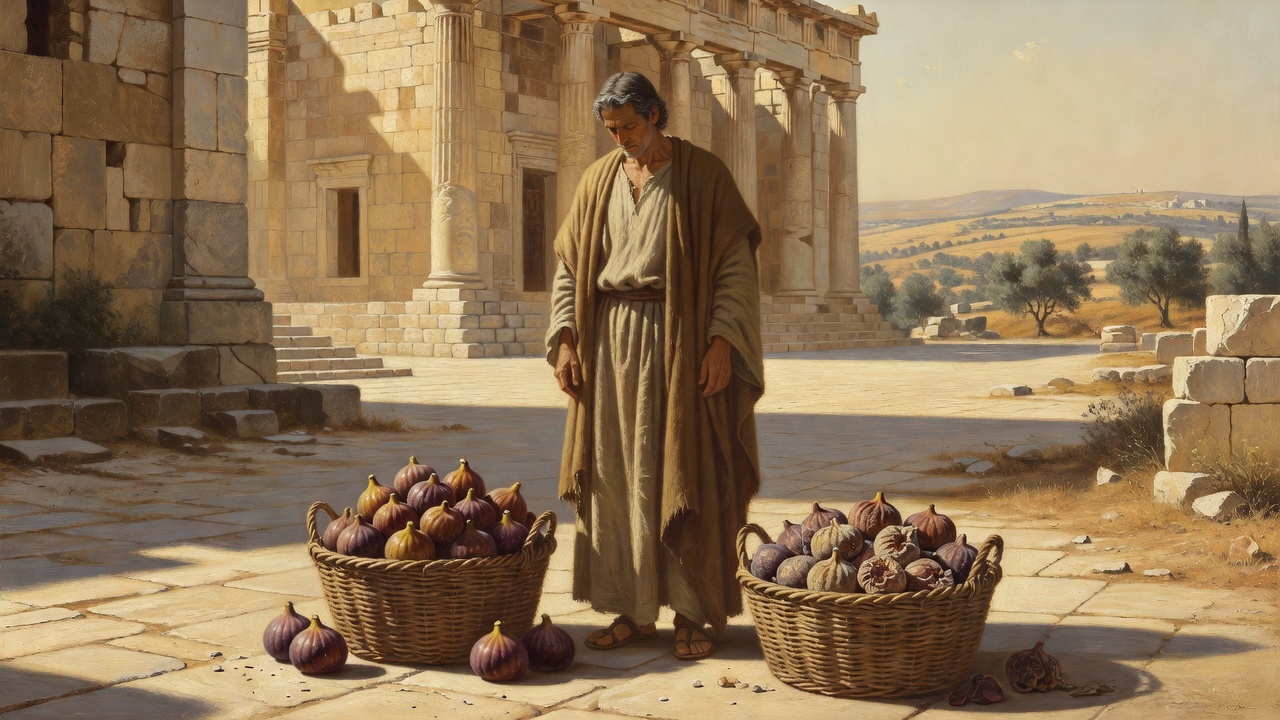
The Good and Bad Figs
1The Lord showed me two baskets of figs, lying in front of the temple of the Lord, after Nabuchodonosor king of Babylon had carried captive Jechonias son of Joakim king of Juda, and the princes, and the artificers, and the prisoners, and the rich men out of Jerusalem, and had brought them to Babylon. 2The one basket was full of very good figs, as the early figs; and the other basket was full of very bad figs, which could not be eaten, for their badness. 3And the Lord said to me, What see you, Jeremias? and I said, Figs; the good figs, very good; and the bad, very bad, which can’t be eaten, for their badness. 4And the word of the Lord came to me, saying, 5Thus says the Lord, the God of Israel; As these good figs, so will I acknowledge the Jews that have been carried away captive, whom I have sent forth out of this place into the land of the Chaldeans for good. 6And I will fix my eyes upon them for good, and I will restore them into this land for good: and I will build them up, and not pull them down; and I will plant them, and not pluck them up. 7And I will give them a heart to know me, that I am the Lord: and they shall be to me a people, and I will be to them a God: for they shall turn to me with all their heart. 8And as the bad figs, which can’t be eaten, for their badness; thus says the Lord, So will I deliver Sedekias king of Juda, and his nobles, and the remnant of Jerusalem, them that are left in this land, and the dwellers in Egypt. 9And I will cause them to be dispersed into all the kingdoms of the earth, and they shall be for a reproach, and a proverb, and an object of hatred, and a curse, in every place whither I have driven them out. 10And I will send against them famine, and pestilence, and the sword, until they are consumed from off the land which I gave them.
Você sabia?
Os Dois Cestos de Figos
- Jeremias recebeu esta visão depois que o rei Nabucodonosor da Babilônia deportou o rei Jeconias (também chamado de Joaquim), juntamente com as autoridades, artesãos e ferreiros de Jerusalém. Nabucodonosor estabeleceu então Zedequias como rei sobre a população restante em Judá.Fontes: o próprio texto bíblico · Jehoiachin · Zedekiah · Nebuchadnezzar
- Na visão diante do templo, o cesto de figos excelentes e temporãos simboliza os exilados levados para a Babilônia. O Senhor promete preservá-los, dar-lhes um coração para conhecê-lo e trazê-los de volta à sua terra.Fontes: o próprio texto bíblico
- Em contrapartida, o cesto de figos podres e intragáveis simboliza o rei Zedequias, os seus oficiais e o remanescente que permaneceu em Judá ou fugiu para o Egito. Em vez de encontrarem segurança, são advertidos de que enfrentariam desgraça, fome, peste e zombaria entre as nações.Fontes: o próprio texto bíblico · Zedekiah · Egypt
Notas escritas com auxílio de IA a partir de fontes abertas (Theographic Bible Metadata, CC BY-SA 4.0; Easton’s Bible Dictionary, domínio público) e revisadas antes de publicar.
Lugares deste capítulo
- Babylon · 32.543, 44.422 · versículo 1
- Jerusalem · 31.777, 35.234 · versículos 1, 8
- Chaldea · 30.962, 46.104 · versículo 5
- Egypt · 30.129, 31.308 · versículo 8
Só aparecem lugares com identificação de alta confiança (90% ou mais segundo as fontes acadêmicas reunidas pelo OpenBible). Mapa da época: DARE (Digital Atlas of the Roman Empire), CC BY 4.0; mapa atual: © colaboradores do OpenStreetMap; lugares: OpenBible.info (CC BY 4.0).
Créditos e licença desta tradução
LXX2012: Septuagint in British/International English 2012
The Septuagint with Apocrypha, translated from Greek to English by Sir Lancelot C. L. Brenton and published in 1885, with some language updates (British/International English)
Public Domain
Language: English
Dialect (if applicable): British
Language in English: English
Translation by: Sir Lancelot Charles Lee Breton
LXX2012: Septuagint in English 2012, British/International English Edition
This is a translation of the Old Testament and Apocrypha/Deuterocanon from Hebrew to Greek to 19th Century British English, with some updates of spelling and word usage to contemporary British/International English. The original English translation was done by Sir Lancelot Charles Lee Brenton and published by Samuel Bagster & Sons, Ltd., in London in 1851. It has entered the Public Domain due to the passage of sufficient time. In the process of scanning and typing the text, the original poetry and prose formatting, as well as peripheral material like introductions and notes, have been omitted.
This edition of the Septuagint has some language updates. Brenton's word order and punctuation has been mostly retained, meaning that quotation marks are not used, and sentences within quotes may not start with capital letters, as was standard usage in 1851. Names transliterated from Greek to those transliterated from Hebrew in the common English Bibles often differ. These language updates are dedicated to the Public Domain by the author of those edits, Michael Paul Johnson. Therefore this edition may be freely copied, published, etc.
Before considering making changes to the text of this work, I recommend that you consult with God, because this is really His Book.
If you find errors in the text, please report them so that we can correct them.
Donations to help with the expenses of operating this web site and thus help others have free access to the Word of God may be made to us, but are not required. Please see http://MLJohnson.org/partner/ for more about that.
Títulos de seção adaptados da Berean Standard Bible (domínio público); não fazem parte do texto bíblico desta tradução.
Fonte: http://ebible.org/eng-uk-lxx2012/ · eBible.org