Jeremias 2
LXX2012: Septuagint in British/International English 2012 · Toque num versículo para ver as referências cruzadas.
Israel Has Forsaken God
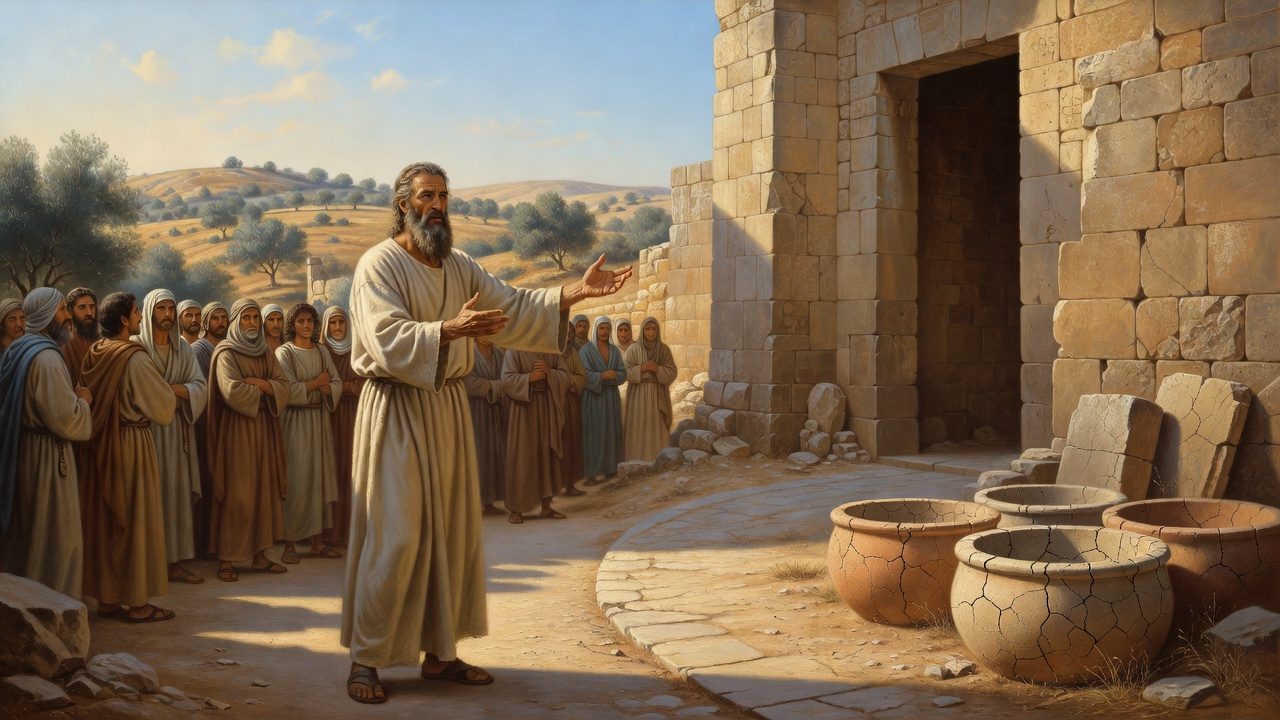
1And he said, Thus says the Lord, 2I remember the kindness of your youth, and the love of your espousals, 3in following the Holy One of Israel, says the Lord, Israel was the holy people to the Lord, and the first fruits of his increase: all that devoured him shall offend; evils shall come upon them, says the Lord. 4Hear the word of the Lord, O house of Jacob, and every family of the house of Israel. 5Thus says the Lord, What trespass have your fathers found in me, that they have revolted far from me, and gone after vanities, and become vain? 6And they said not, Where is the Lord, who brought us up out of the land of Egypt, who guided us in the wilderness, in an untried and trackless land, in a land which no man at all went through, and no man lived there? 7And I brought you to Carmel, that you⌃ should eat the fruits thereof, and the good thereof; and you⌃ went in, and defiled my land, and made my heritage an abomination. 8The priests said not, Where is the Lord? and they that held by the law knew me not: the shepherds also sinned against me, and the prophets prophesied by Baal, and went after that which profited not. 9Therefore I will yet plead with you, and will plead with your children's children. 10For go to the isles of the Chettians, and see; and send to Kedar, and observe accurately, and see if such things have been done; 11if the nations will change their gods, though they are not gods: but my people have changed their glory, for that from which they shall not be profited. 12The heaven is amazed at this, and is very exceedingly horror-struck, says the Lord. 13For my people has committed two faults, and evil ones: they have forsaken me, the fountain of water of life, and hewn out for themselves broken cisterns, which will not be able to hold water.
The Consequence of Israel’s Sin
14Is Israel a servant, or a home-born slave? why has he become a spoil? 15The lions roared upon him, and uttered their voice, which have made his land a wilderness: and his cities are broken down, that they should not be inhabited. 16Also the children of Memphis and Taphnas have known you, and mocked you. 17Has not your forsaking me brought these things upon you? says the Lord your God. 18And now what have you to do with the way of Egypt, to drink the water of Geon? and what have you to do with the way of the Assyrians, to drink the water of rivers? 19Your apostasy shall correct you, and your wickedness shall reprove you: know then, and see, that your forsaking me has been bitter to you, says the Lord your God; and I have taken no pleasure in you, says the Lord your God. 20For of old you have broken your yoke, and plucked asunder your bands; and you have said, I will not serve you, but will go upon every high hill, and under every shady tree, there will I indulge in my fornication. 21Yet I planted you a fruitful vine, entirely of the right sort: how are you a strange vine turned to bitterness! 22Though you should wash yourself with nitre, and multiply to yourself soap, still you are stained by your iniquities before me, says the Lord.
Israel’s Unfaithfulness
23How will you say, I am not polluted, and have not gone after Baal? behold your ways in the burial-ground, and know what you have done: her voice has howled in the evening: 24she has extended her ways over the waters of the desert; she was hurried along by the lusts of her soul; she is given up to them, who will turn her back? none that seek her shall be weary; at the time of her humiliation they shall find her. 25Withdraw your foot from a rough way, and your throat from thirst: but she said I will strengthen myself: for she loved strangers, and went after them. 26As is the shame of a thief when he is caught, so shall the children of Israel be ashamed; they, and their kings, and their princes, and their priests, and their prophets. 27They said to a stock, You are my father; and to a stone, You have begotten me: and they have turned their backs to me, and not their faces: yet in the time of their afflictions they will say, Arise, and save us. 28And where are your gods, which you made for yourself? will they arise and save in the time of your affliction? for according to the number of your cities were your gods, O Juda; and according to the number of the streets of Jerusalem they sacrificed to Baal. 29Therefore do you⌃ speak to me? you⌃ all have been ungodly, and you⌃ all have transgressed against me, says the Lord. 30In vain have I struck your children; you⌃ have not received correction: a sword has devoured your prophets as a destroying lion; yet you⌃ feared not. 31Hear you⌃ the word of the Lord: thus says the Lord, Have I been a wilderness or a dry land to Israel? therefore has my people said, We will not be ruled over, and will not come to you any more? 32Will a bride forget her ornaments, or a virgin her girdle? but my people has forgotten me days without number. 33What fair device will you yet employ in your ways, so as to seek love? it shall not be so; moreover you have done wickedly in corrupting your ways; 34and in your hands has been found the blood of innocent souls; I have not found them in holes, but on every oak. 35Yet you said, I am innocent: only let his wrath be turned away from me. Behold, I will plead with you, whereas you say, I have not sinned. 36For you have been so exceedingly contemptuous as to repeat your ways; but you shall be ashamed of Egypt, as you were ashamed of Assur. 37For you shall go forth thence also with your hands upon your head; for the Lord has rejected your hope, and you shall not prosper in it.
Você sabia?
A devoção esquecida de Israel
- Em Jeremias 2:10, o profeta contrasta Chipre (Quitim), no mar Mediterrâneo a oeste, com Quedar, que representava as tribos árabes nômades a leste, no deserto da Arábia. Ao citar esses extremos geográficos opostos, o texto destaca que nem mesmo as nações vizinhas abandonavam seus deuses tradicionais.Fontes: o próprio texto bíblico · Cyprus · Kedar
- As referências a Mênfis (Nofe) e ao beber das águas do Nilo e do Eufrates destacam a dependência política instável de Judá em relação ao Egito e à Assíria. Jeremias compara a confiança nessas potências estrangeiras a abandonar uma fonte de água viva para cavar cisternas rachadas.Fontes: o próprio texto bíblico · Memphis · Egypt · Assyria
- A repreensão por seguir os 'baalins' utiliza o plural para os cultos locais de Baal, a principal divindade masculina dos fenícios. O culto a Baal infiltrou-se repetidamente em Israel e Judá, sendo frequentemente praticado no alto de colinas e sob árvores frondosas.Fontes: o próprio texto bíblico · Baal
Notas escritas com auxílio de IA a partir de fontes abertas (Theographic Bible Metadata, CC BY-SA 4.0; Easton’s Bible Dictionary, domínio público) e revisadas antes de publicar.
Lugares deste capítulo
- Jerusalem · 31.777, 35.234 · versículo 2
- Egypt · 30.129, 31.308 · versículos 6, 18, 36, 37
- Cyprus · 35.000, 33.000 · versículo 10
- Kedar · 29.811, 39.868 · versículo 10
- Memphis · 29.849, 31.253 · versículo 16
- Tahpanhes · Hoje: Tell Defenneh · 30.861, 32.171 · versículo 16
- Assyria · 36.359, 43.153 · versículos 18, 36
- Euphrates · Hoje: Euphrates River · 31.004, 47.442 · versículo 18
- Nile · Hoje: Nile River · 31.465, 30.367 · versículo 18
- Valley of Hinnom · Hoje: Hinnom Valley · 31.769, 35.228 · versículo 23
Só aparecem lugares com identificação de alta confiança (90% ou mais segundo as fontes acadêmicas reunidas pelo OpenBible). Mapa da época: DARE (Digital Atlas of the Roman Empire), CC BY 4.0; mapa atual: © colaboradores do OpenStreetMap; lugares: OpenBible.info (CC BY 4.0).
Créditos e licença desta tradução
LXX2012: Septuagint in British/International English 2012
The Septuagint with Apocrypha, translated from Greek to English by Sir Lancelot C. L. Brenton and published in 1885, with some language updates (British/International English)
Public Domain
Language: English
Dialect (if applicable): British
Language in English: English
Translation by: Sir Lancelot Charles Lee Breton
LXX2012: Septuagint in English 2012, British/International English Edition
This is a translation of the Old Testament and Apocrypha/Deuterocanon from Hebrew to Greek to 19th Century British English, with some updates of spelling and word usage to contemporary British/International English. The original English translation was done by Sir Lancelot Charles Lee Brenton and published by Samuel Bagster & Sons, Ltd., in London in 1851. It has entered the Public Domain due to the passage of sufficient time. In the process of scanning and typing the text, the original poetry and prose formatting, as well as peripheral material like introductions and notes, have been omitted.
This edition of the Septuagint has some language updates. Brenton's word order and punctuation has been mostly retained, meaning that quotation marks are not used, and sentences within quotes may not start with capital letters, as was standard usage in 1851. Names transliterated from Greek to those transliterated from Hebrew in the common English Bibles often differ. These language updates are dedicated to the Public Domain by the author of those edits, Michael Paul Johnson. Therefore this edition may be freely copied, published, etc.
Before considering making changes to the text of this work, I recommend that you consult with God, because this is really His Book.
If you find errors in the text, please report them so that we can correct them.
Donations to help with the expenses of operating this web site and thus help others have free access to the Word of God may be made to us, but are not required. Please see http://MLJohnson.org/partner/ for more about that.
Títulos de seção adaptados da Berean Standard Bible (domínio público); não fazem parte do texto bíblico desta tradução.
Fonte: http://ebible.org/eng-uk-lxx2012/ · eBible.org