Jeremias 18
LXX2012: Septuagint in British/International English 2012 · Toque num versículo para ver as referências cruzadas.
The Potter and the Clay
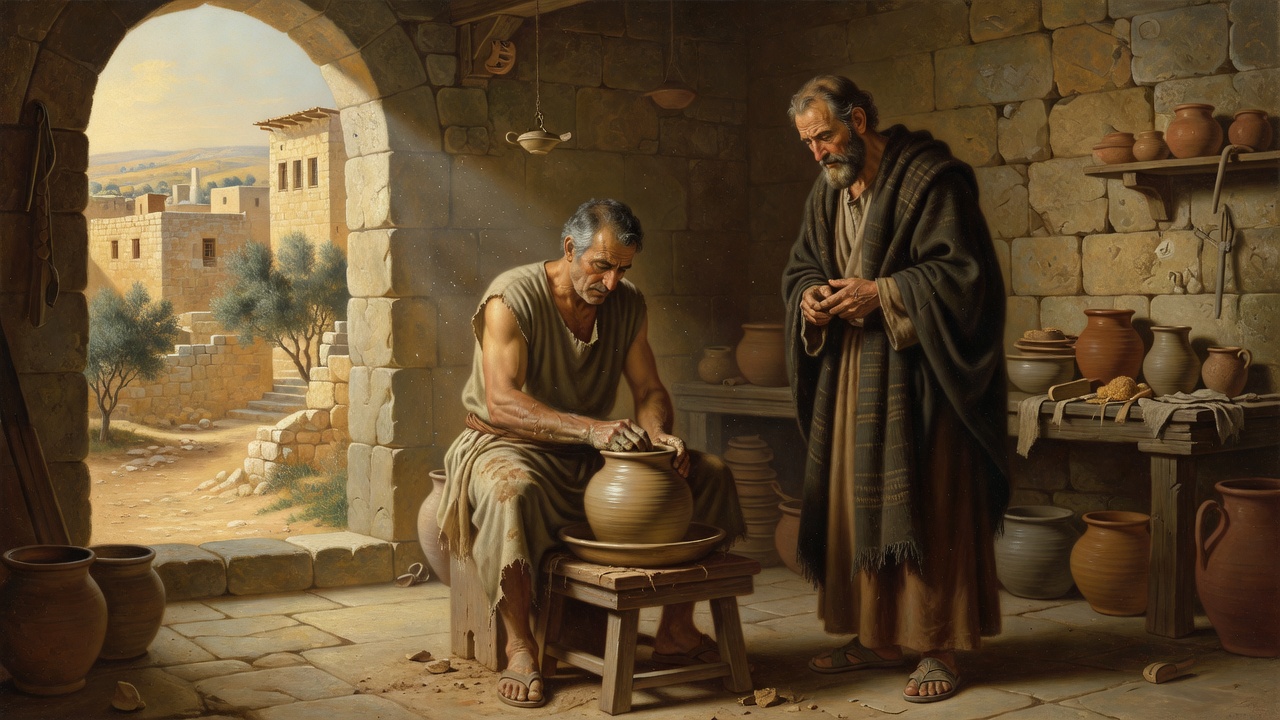
1The word that came from the Lord to 2Jeremias, saying, Arise, and go down to the potter's house, and there you shall hear my words. 3So I went down to the potter's house, and behold, he was making a vessel on the stones. 4And the vessel which he was making with his hands fell: so he made it again another vessel, as it seemed good to him to make it. 5And the word of the Lord came to me, saying, 6Shall I not be able, O house of Israel, to do to you as this potter? behold, as the clay of the potter are you⌃ in my hands. 7If I shall pronounce a decree upon a nation, or upon a kingdom, to cut them off, and to destroy them; 8and that nation turn from all their sins, then will I repent of the evils which I purposed to do to them. 9And if I shall pronounce a decree upon a nation and kingdom, to rebuild and to plant it; 10and they do evil before me, so as not to listen to my voice, then will I repent of the good which I spoke of, to do it to them. 11And now say to the men of Juda, and to the inhabitants of Jerusalem, Behold, I prepare evils against you, and devise a device against you: let every one turn now from his evil way, and amend your practices. 12And they said, We will quit ourselves like men, for we will pursue our perverse ways, and we will perform each the lusts of his evil heart. 13Therefore thus says the Lord; Enquire now amongst the nations, who has heard such very horrible things as the virgin of Israel has done? 14Will fertilising streams fail to flow from a rock, or snow fail from Libanus? will water violently impelled by the wind turn aside? 15For my people have forgotten me, they have offered incense in vain, and they fail in their ways, leaving the ancient tracks, to enter upon impassable paths; 16to make their land a desolation, and a perpetual hissing; all that go through it shall be amazed, and shall shake their heads. 17I will scatter them before their enemies like an east wind; I will show them the day of their destruction.
Another Plot against Jeremiah
18Then they said, Come, and let us devise a device against Jeremias; for the law shall not perish from the priest, nor counsel from the wise, nor the word from the prophet. Come, and let us strike him with the tongue, and we will hear all his words. 19Hear me, O Lord, and hear the voice of my pleading. 20Forasmuch as evil is rewarded for good; for they have spoken words against my soul, and they have hidden the punishment they meant for me; remember that I stood before your face, to speak good for them, to turn away your wrath from them. 21Therefore do you deliver their sons to famine, and gather them to the power of the sword: let their women be childless and widows; and let their men be cut off by death, and their young men fall by the sword in war. 22Let there be a cry in their houses: you shall bring upon them robbers suddenly: for they have formed a plan to take me, and have hidden snares for me. 23And you, Lord, know all their deadly counsel against me: account not their iniquities guiltless, and blot not out their sins from before you: let their weakness come before you; deal with them in the time of your wrath.
Você sabia?
O Oleiro e o Barro
- Na casa do oleiro, Jeremias observa um artesão remodelar na roda um vaso estragado para transformá-lo em outro recipiente. A passagem usa essa imagem para ilustrar a autoridade divina e o julgamento condicional: se uma nação advertida se arrepende do mal, o desastre é evitado, mas se pratica o mal, a bênção pretendida é retida.Fontes: o próprio texto bíblico
- A profecia contrasta o abandono de Deus por parte de Israel com a constância da natureza, questionando se a neve do Líbano algum dia desaparece de suas encostas rochosas. A cordilheira do Líbano, cujo nome significa branco, destacava-se por seus cumes elevados e suas fontes de águas frescas.Fontes: Lebanon · o próprio texto bíblico
- A conspiração contra Jeremias foi motivada por opositores que presumiam segurança religiosa, afirmando que a instrução jamais faltaria ao sacerdote, o conselho ao sábio ou a palavra ao profeta. A mensagem de ruína proclamada por Jeremias desafiava diretamente essa confiança institucional.Fontes: Jeremiah · o próprio texto bíblico
Notas escritas com auxílio de IA a partir de fontes abertas (Theographic Bible Metadata, CC BY-SA 4.0; Easton’s Bible Dictionary, domínio público) e revisadas antes de publicar.
Lugares deste capítulo
- Jerusalem · 31.777, 35.234 · versículo 11
- Lebanon · 33.540, 35.584 · versículo 14
- Mount Hermon · 33.400, 35.850 · versículo 14
Só aparecem lugares com identificação de alta confiança (90% ou mais segundo as fontes acadêmicas reunidas pelo OpenBible). Mapa da época: DARE (Digital Atlas of the Roman Empire), CC BY 4.0; mapa atual: © colaboradores do OpenStreetMap; lugares: OpenBible.info (CC BY 4.0).
Créditos e licença desta tradução
LXX2012: Septuagint in British/International English 2012
The Septuagint with Apocrypha, translated from Greek to English by Sir Lancelot C. L. Brenton and published in 1885, with some language updates (British/International English)
Public Domain
Language: English
Dialect (if applicable): British
Language in English: English
Translation by: Sir Lancelot Charles Lee Breton
LXX2012: Septuagint in English 2012, British/International English Edition
This is a translation of the Old Testament and Apocrypha/Deuterocanon from Hebrew to Greek to 19th Century British English, with some updates of spelling and word usage to contemporary British/International English. The original English translation was done by Sir Lancelot Charles Lee Brenton and published by Samuel Bagster & Sons, Ltd., in London in 1851. It has entered the Public Domain due to the passage of sufficient time. In the process of scanning and typing the text, the original poetry and prose formatting, as well as peripheral material like introductions and notes, have been omitted.
This edition of the Septuagint has some language updates. Brenton's word order and punctuation has been mostly retained, meaning that quotation marks are not used, and sentences within quotes may not start with capital letters, as was standard usage in 1851. Names transliterated from Greek to those transliterated from Hebrew in the common English Bibles often differ. These language updates are dedicated to the Public Domain by the author of those edits, Michael Paul Johnson. Therefore this edition may be freely copied, published, etc.
Before considering making changes to the text of this work, I recommend that you consult with God, because this is really His Book.
If you find errors in the text, please report them so that we can correct them.
Donations to help with the expenses of operating this web site and thus help others have free access to the Word of God may be made to us, but are not required. Please see http://MLJohnson.org/partner/ for more about that.
Títulos de seção adaptados da Berean Standard Bible (domínio público); não fazem parte do texto bíblico desta tradução.
Fonte: http://ebible.org/eng-uk-lxx2012/ · eBible.org