Isaías 62
LXX2012: Septuagint in British/International English 2012 · Toque num versículo para ver as referências cruzadas.
Zion’s Salvation and New Name
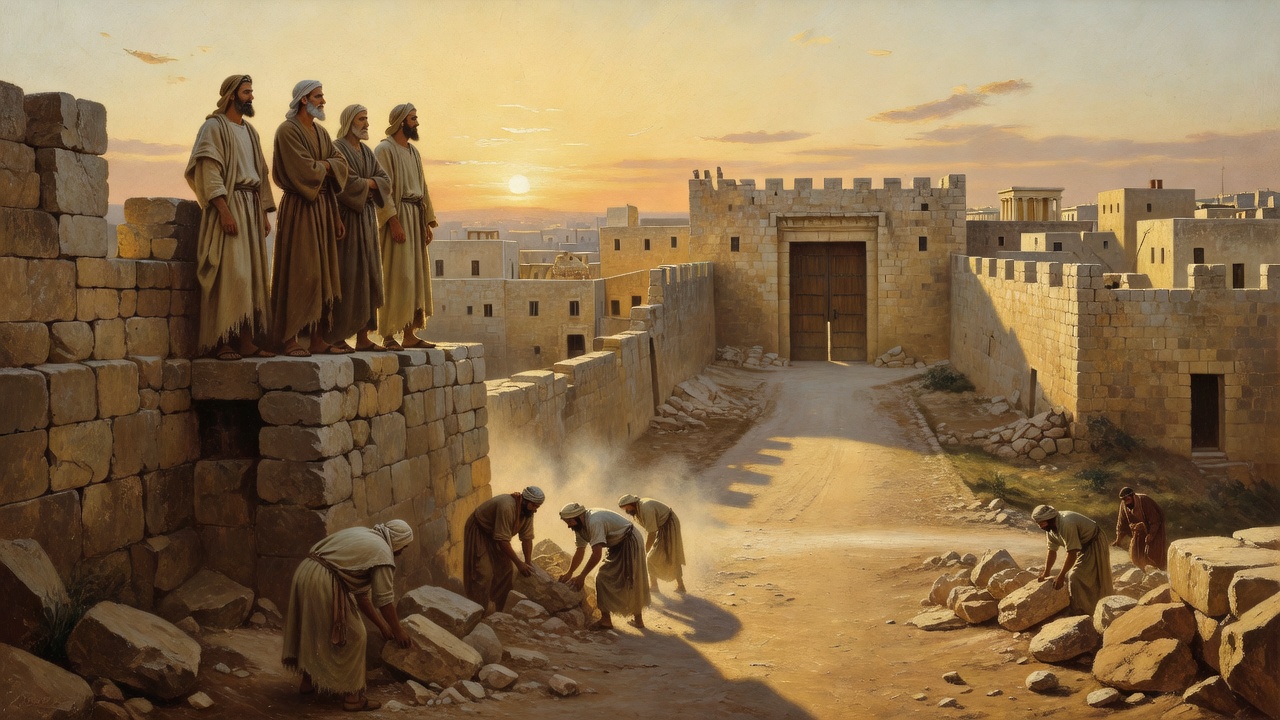
1For Sion's sake I will not hold my peace, and for Jerusalem's sake I will not rest, until her righteousness go forth as light, and my salvation burn as a torch. 2And the Gentiles shall see your righteousness, and kings your glory: and one shall call you by a new name, which the Lord shall name. 3And you shall be a crown of beauty in the hand of the Lord, and a royal diadem in the hand of your God. 4And you shall no more be called Forsaken; and your land shall no more be called Desert: for you shall be called My Pleasure, and your land Inhabited: for the Lord has taken pleasure in you, and your land shall be inhabited. 5And as a young man lives with a virgin, so shall your sons dwell in you: and it shall come to pass that as a bridegroom will rejoice over a bride, so will the Lord rejoice over you. 6And on your walls, O Jerusalem, have I set watchmen all day and all night, who shall never cease making mention of the Lord. 7For there is none like you, when he shall have established, and made Jerusalem a praise on the earth. 8For the Lord has sworn by his glory, and by the might of his arm, I will no more give your corn and your provisions to your enemies; nor shall strangers any more drink your wine, for which you have laboured. 9But they that have gathered them shall eat them, and they shall praise the Lord; and they that have gathered the grapes shall drink thereof in my holy courts. 10Go through my gates, and make a way for my people; and cast the stones out of the way; lift up a standard for the Gentiles. 11For behold, the Lord has proclaimed to the end of the earth, say you⌃ to the daughter of Sion, Behold, your Saviour has come to you, having his reward and his work before his face. 12And one shall call them the holy people, the redeemed of the Lord: and you shall be called a city sought out, and not forsaken.
Você sabia?
A restauração e o novo nome de Jerusalém
- Neste capítulo, Jerusalém e Sião recebem a promessa de novos nomes simbólicos que refletem uma profunda mudança de condição. Em vez de ser chamada de Desamparada ou Desolada, a cidade e sua terra recebem nomes como Hefzibá (meu prazer nela) e Beulá (casada), retratando a restauração por meio da imagem de uma alegre celebração de casamento.Fontes: o próprio texto bíblico · Jerusalem · Zion
- O poema descreve atalaias posicionados continuamente sobre os muros de pedra de Jerusalém, mantendo vigília dia e noite. O papel deles vai além da guarda militar comum, pois são convocados a interceder sem descanso para que o SENHOR estabeleça a cidade montanhosa como louvor em toda a terra.Fontes: o próprio texto bíblico · Jerusalem
- A ordem para sair pelas portas da cidade, retirar as pedras e aterrar uma estrada elevada utiliza a imagem antiga da preparação de uma via processional real para acolher o povo que retorna e sinalizar a salvação às nações vizinhas.Fontes: o próprio texto bíblico
Notas escritas com auxílio de IA a partir de fontes abertas (Theographic Bible Metadata, CC BY-SA 4.0; Easton’s Bible Dictionary, domínio público) e revisadas antes de publicar.
Lugares deste capítulo
- Jerusalem · 31.777, 35.234 · versículos 1, 5, 6, 7, 8, 12
- Zion · Hoje: Jerusalem · 31.777, 35.234 · versículos 1, 11
Só aparecem lugares com identificação de alta confiança (90% ou mais segundo as fontes acadêmicas reunidas pelo OpenBible). Mapa da época: DARE (Digital Atlas of the Roman Empire), CC BY 4.0; mapa atual: © colaboradores do OpenStreetMap; lugares: OpenBible.info (CC BY 4.0).
Créditos e licença desta tradução
LXX2012: Septuagint in British/International English 2012
The Septuagint with Apocrypha, translated from Greek to English by Sir Lancelot C. L. Brenton and published in 1885, with some language updates (British/International English)
Public Domain
Language: English
Dialect (if applicable): British
Language in English: English
Translation by: Sir Lancelot Charles Lee Breton
LXX2012: Septuagint in English 2012, British/International English Edition
This is a translation of the Old Testament and Apocrypha/Deuterocanon from Hebrew to Greek to 19th Century British English, with some updates of spelling and word usage to contemporary British/International English. The original English translation was done by Sir Lancelot Charles Lee Brenton and published by Samuel Bagster & Sons, Ltd., in London in 1851. It has entered the Public Domain due to the passage of sufficient time. In the process of scanning and typing the text, the original poetry and prose formatting, as well as peripheral material like introductions and notes, have been omitted.
This edition of the Septuagint has some language updates. Brenton's word order and punctuation has been mostly retained, meaning that quotation marks are not used, and sentences within quotes may not start with capital letters, as was standard usage in 1851. Names transliterated from Greek to those transliterated from Hebrew in the common English Bibles often differ. These language updates are dedicated to the Public Domain by the author of those edits, Michael Paul Johnson. Therefore this edition may be freely copied, published, etc.
Before considering making changes to the text of this work, I recommend that you consult with God, because this is really His Book.
If you find errors in the text, please report them so that we can correct them.
Donations to help with the expenses of operating this web site and thus help others have free access to the Word of God may be made to us, but are not required. Please see http://MLJohnson.org/partner/ for more about that.
Títulos de seção adaptados da Berean Standard Bible (domínio público); não fazem parte do texto bíblico desta tradução.
Fonte: http://ebible.org/eng-uk-lxx2012/ · eBible.org