Isaías 36
LXX2012: Septuagint in British/International English 2012 · Toque num versículo para ver as referências cruzadas.
Sennacherib Threatens Jerusalem
1Now it came to pass in the fourteenth year of the reign of Ezekias, that Sennacherim, king of the Assyrians, came up against the strong cities of Judea, and took them. 2And the king of the Assyrians sent Rabsaces out of Laches to Jerusalem to king Ezekias with a large force: and he stood by the conduit of the upper pool in the way of the fuller's field. 3And there went forth to him Heliakim the steward, the son of Chelcias, and Somnas the scribe, and Joach the son of Asaph, the recorder. 4And Rabsaces said to them, Say to Ezekias, Thus says the great king, the king of the Assyrians, Why are you secure? 5Is war carried on with counsel and mere words of the lips? and now on whom do you trust, that you rebel against me? 6Behold, you trust on this bruised staff of reed, on Egypt: as soon as a man leans upon it, it shall go into his hand, and pierce it: so is Pharao king of Egypt and all that trust in him. 7But if you⌃ say, We trust in the Lord our God; 8yet now make an agreement with my lord the king of the Assyrians, and I will give you two thousand horses, if you⌃ shall be able to set riders upon them. 9And how can you⌃ then turn to the face of the satraps? They that trust on the Egyptians for horse and rider, are our servants. 10And now, Have we come up against this land to fight against it without the Lord? The Lord said to me, Go up against this land, and destroy it. 11Then Eliakim and Somnas and Joach said to him, Speak to your servants in the Syrian tongue; for we understand it: and speak not to us in the Jewish tongue: and therefore speak you in the ears of the men on the wall? 12And Rabsaces said to them, Has my lord sent me to your lord or to you, to speak these words? has he not sent me to the men that sit on the wall, that they may eat dung, and drink their water together with you? 13And Rabsaces stood and cried with a loud voice in the Jewish language, and said, Hear you⌃ the words of the great king, the king of the Assyrians: 14thus says the king, Let not Ezekias deceive you with words: he will not be able to deliver you. 15And let not Ezekias say to you, That God will deliver you, and this city will not at all be delivered into the hand of the king of the Assyrians. 16Listen not to Ezekias: thus says the king of the Assyrians, If you⌃ wish to be blessed, come out to me: and you⌃ shall eat every one of his vine and his fig-trees, and you⌃ shall drink water out of your own cisterns: 17until I come and take you to a land, like your own land, a land of corn and wine, and bread, and vineyards. 18Let not Ezekias deceive you, saying, God will deliver you. Have the gods of the nations delivered each one his own land out of the hand of the king of the Assyrians? 19Where is the god of Emath, and Arphath? and where is the god of Eppharuaim? have they been able to deliver Samaria out of my hand? 20Which is the god of all these nations, that has delivered his land out of my hand, that God should deliver Jerusalem out of my hand? 21And they were silent, and none answered him a word; because the king had commanded that none should answer. 22And Heliakim the son of Chelcias, the steward, and Somnas the military scribe, and Joach the son of Asaph, the recorder, came in to Ezekias, having their garments torn, and they reported to him the words of Rabsaces.
Você sabia?
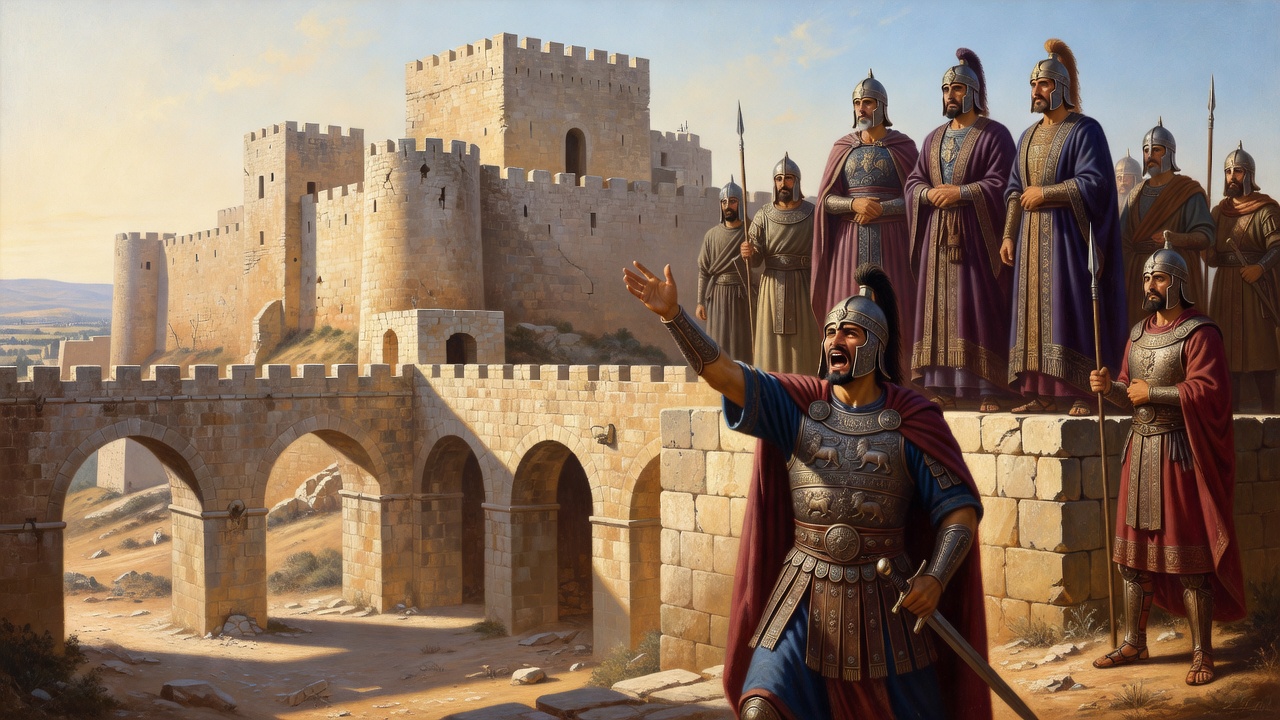
A ameaça de Senaqueribe contra Jerusalém
- O termo Rabsaqué não era um nome próprio, mas um título de alto escalão atribuído ao copeiro-chefe ou vizir da corte assíria. Senaqueribe enviou esse oficial de Laquis para Jerusalém com um grande exército para exigir a rendição do rei Ezequias.Fontes: Rabshakeh · Lachish · o próprio texto bíblico
- Os oficiais de Ezequias pediram que o enviado assírio falasse em aramaico, uma língua diplomática incompreensível para o povo comum. Rabsaqué recusou e gritou deliberadamente em hebraico para que os guardas e civis posicionados sobre a muralha ouvissem suas ameaças diretamente.Fontes: Rabshakeh · o próprio texto bíblico
- A delegação judaica enviada ao encontro do emissário assírio incluía Eliaquim, o administrador do palácio, Sebna, o escrivão, e Joá, o cronista. Depois de ouvirem o discurso que desafiava seu Deus e seu rei, eles retornaram a Ezequias em luto, com as vestes rasgadas.Fontes: Eliakim · Shebna · Joah · o próprio texto bíblico
Notas escritas com auxílio de IA a partir de fontes abertas (Theographic Bible Metadata, CC BY-SA 4.0; Easton’s Bible Dictionary, domínio público) e revisadas antes de publicar.
Lugares deste capítulo
- Assyria · 36.359, 43.153 · versículos 1, 2, 4, 8, 13, 15, 16, 18
- Jerusalem · 31.777, 35.234 · versículos 2, 7, 20
- Lachish · Hoje: Tell ed Duweir · 31.565, 34.849 · versículo 2
- Upper Pool · Hoje: in Jerusalem · 31.777, 35.234 · versículo 2
- Egypt · 30.129, 31.308 · versículos 6, 9
- Hamath · Hoje: Hama · 35.136, 36.750 · versículo 19
- Samaria · 32.276, 35.195 · versículo 19
Só aparecem lugares com identificação de alta confiança (90% ou mais segundo as fontes acadêmicas reunidas pelo OpenBible). Mapa da época: DARE (Digital Atlas of the Roman Empire), CC BY 4.0; mapa atual: © colaboradores do OpenStreetMap; lugares: OpenBible.info (CC BY 4.0).
Créditos e licença desta tradução
LXX2012: Septuagint in British/International English 2012
The Septuagint with Apocrypha, translated from Greek to English by Sir Lancelot C. L. Brenton and published in 1885, with some language updates (British/International English)
Public Domain
Language: English
Dialect (if applicable): British
Language in English: English
Translation by: Sir Lancelot Charles Lee Breton
LXX2012: Septuagint in English 2012, British/International English Edition
This is a translation of the Old Testament and Apocrypha/Deuterocanon from Hebrew to Greek to 19th Century British English, with some updates of spelling and word usage to contemporary British/International English. The original English translation was done by Sir Lancelot Charles Lee Brenton and published by Samuel Bagster & Sons, Ltd., in London in 1851. It has entered the Public Domain due to the passage of sufficient time. In the process of scanning and typing the text, the original poetry and prose formatting, as well as peripheral material like introductions and notes, have been omitted.
This edition of the Septuagint has some language updates. Brenton's word order and punctuation has been mostly retained, meaning that quotation marks are not used, and sentences within quotes may not start with capital letters, as was standard usage in 1851. Names transliterated from Greek to those transliterated from Hebrew in the common English Bibles often differ. These language updates are dedicated to the Public Domain by the author of those edits, Michael Paul Johnson. Therefore this edition may be freely copied, published, etc.
Before considering making changes to the text of this work, I recommend that you consult with God, because this is really His Book.
If you find errors in the text, please report them so that we can correct them.
Donations to help with the expenses of operating this web site and thus help others have free access to the Word of God may be made to us, but are not required. Please see http://MLJohnson.org/partner/ for more about that.
Títulos de seção adaptados da Berean Standard Bible (domínio público); não fazem parte do texto bíblico desta tradução.
Fonte: http://ebible.org/eng-uk-lxx2012/ · eBible.org