Gênesis 46
LXX2012: Septuagint in British/International English 2012 · Toque num versículo para ver as referências cruzadas.
Jacob’s Journey to Egypt
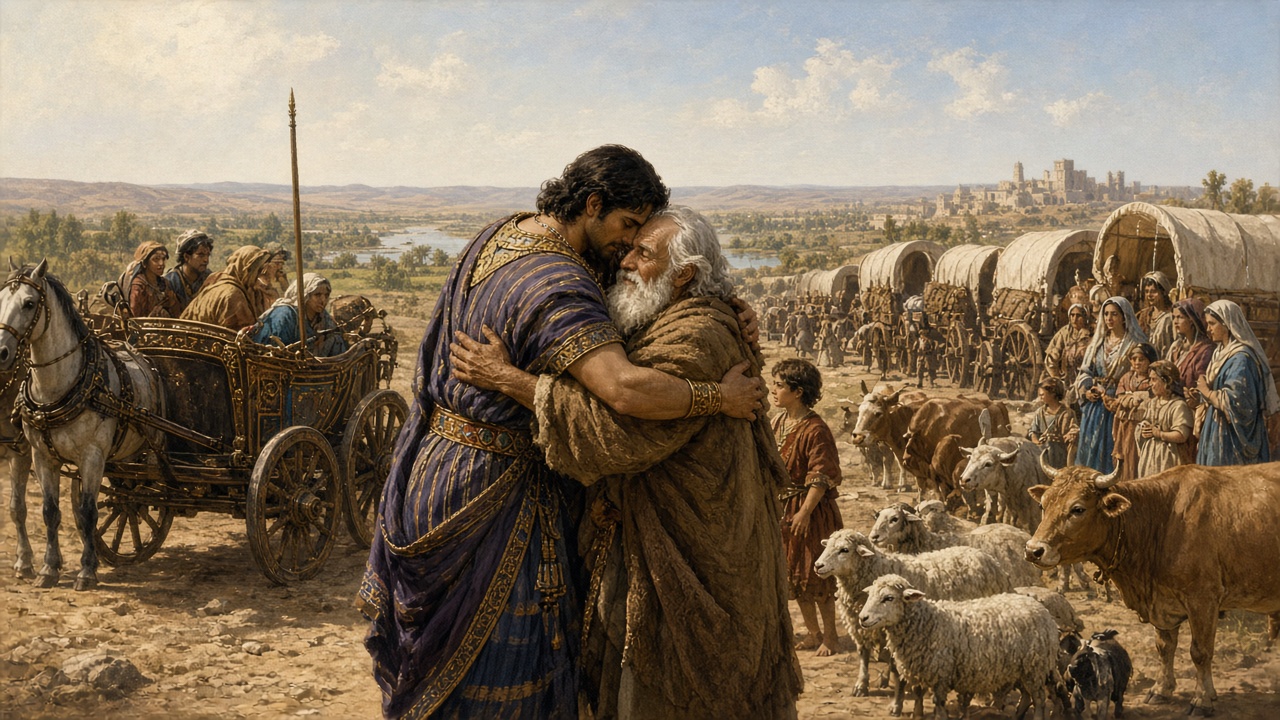
1And Israel departed, he and all that he had, and came to the well of the oath; and he offered sacrifice to the God of his father Isaac. 2And God spoke to Israel in a night vision, saying, Jacob, Jacob; and he said, What is it? 3And he says to him, I am the God of your fathers; fear not to go down into Egypt, for I will make you there a great nation. 4And I will go down with you into Egypt, and I will bring you up at the end; and Joseph shall put his hands on your eyes. 5And Jacob rose up from the well of the oath; and the sons of Israel took up their father, and the baggage, and their wives on the wagons, which Joseph sent to take them. 6And they took up their goods, and all their property, which they had gotten in the land of Chanaan; they came into the land of Egypt, Jacob, and all his seed with him.
Those Who Went to Egypt
7The sons, and the sons of his sons with him; his daughters, and the daughters of his daughters; and he brought all his seed into Egypt.
The Children of Leah
8And these are the names of the sons of Israel that went into Egypt with their father Jacob—Jacob and his sons. The firstborn of Jacob, Ruben. 9And the sons of Ruben; Enoch, and Phallus, Asron, and Charmi. 10and the sons of Symeon; Jemuel, and Jamin, and Aod, and Achin, and Saar, and Saul, the son of a Chananitish woman. 11And the sons of Levi; Gerson, Cath, and Merari. 12And the sons of Judas; Er, and Aunan, and Selom, and Phares, and Zara: and Er and Aunan died in the land of Chanaan. 13And the sons of Phares were Esron, and Jemuel. And the sons of Issachar; Thola, and Phua, and Asum, and Sambran. 14And the sons of Zabulun, Sered, and Allon, and Achoel. 15These are the sons of Lea, which she bore to Jacob in Mesopotamia of Syria, and Dina his daughter; all the souls, sons and daughters, thirty-three.
The Children of Zilpah
16And the sons of Gad; Saphon, and Angis, and Sannis, and Thasoban, and Aedis, and Aroedis, and Areelis. 17And the sons of Aser; Jemna, Jessua, and Jeul, and Baria, and Sara their sister. And the sons of Baria; Chobor, and Melchiil. 18These are the sons of Zelpha, which Laban gave to his daughter Lea, who bore these to Jacob, sixteen souls.
The Children of Rachel
19And the sons of Rachel, the wife of Jacob; Joseph, and Benjamin. 20And there were sons born to Joseph in the land of Egypt, whom Aseneth, the daughter of Petephres, priest of Heliopolis, bore to him, even Manasses and Ephraim. And there were sons born to Manasses, which the Syrian concubine bore to him, even Machir. And Machir begot Galaad. And the sons of Ephraim, the brother of Manasses; Sutalaam, and Taam. And the sons of Sutalaam; Edom. 21and the sons of Benjamin; Bala, and Bochor, and Asbel. And the sons of Bala were Gera, and Noeman, and Anchis, and Ros, and Mamphim. And Gera begot Arad. 22These are the sons of Rachel, which she bore to Jacob; all the souls eighteen.
The Children of Bilhah
23And the sons of Dan; Asom. 24And the sons of Nephthalim; Asiel, and Goni, and Issaar, and Sollem. 25These are the sons of Balla, whom Laban gave to his daughter Rachel, who bore these to Jacob; all the souls, seven. 26And all the souls that came with Jacob into Egypt, who came out of his loins, besides the wives of the sons of Jacob, even all the souls were sixty-six. 27And the sons of Joseph, who were born to him in the land of Egypt, were nine souls; all the souls of the house of Jacob who came with Joseph into Egypt, were seventy-five souls.
Jacob Arrives in Egypt
28And he sent Judas before him to Joseph, to meet him to the city of Heroes, into the land of Ramesses. 29And Joseph having made ready his chariots, went up to meet Israel his father, at the city of Heroes; and having appeared to him, fell on his neck, and wept with abundant weeping. 30And Israel said to Joseph, After this I will gladly die, since I have seen your face, for you are yet living. 31And Joseph said to his brethren, I will go up and tell Pharao, and will say to him, My brethren, and my father's house, who were in the land of Chanaan, are come to me. 32And the men are shepherds; for they have been feeders of cattle, and they have brought with them their cattle, and their kine, and all their property. 33If then Pharao call you, and say to you, What is you occupation? 34You⌃ shall say, We your servants are herdsmen from our youth until now, both we and our fathers: that you⌃ may dwell in the land of Gesem of Arabia, for every shepherd is an abomination to the Egyptians.
Você sabia?
Israel desce ao Egito
- Quando Israel partiu para o Egito com tudo o que possuía, parou em Berseba e ofereceu sacrifícios ao Deus de seu pai Isaque. Berseba, que significa poço do juramento ou poço dos sete, foi um poço que Abraão cavou e nomeou após um acordo com Abimeleque; quando Isaque o reabriu, deu-lhe o mesmo nome. Era um lugar predileto de morada dos dois patriarcas, e ali, naquela noite, Deus falou a Jacó numa visão, dizendo-lhe que não temesse descer ao Egito, pois ali o tornaria uma grande nação.Fontes: o próprio texto bíblico · Beersheba
- Jacó enviou Judá adiante de si a José, para obter o caminho até Gósen, distrito egípcio a leste do Nilo, aparentemente perto da residência real, onde a família permaneceu até o Êxodo. O Easton's Bible Dictionary (1897) chama essa terra de a melhor da região, hoje um deserto, e também de terra de Ramessés. José disse aos irmãos que afirmassem ter criado gado desde a juventude, para poderem estabelecer-se ali, pois os pastores eram detestáveis aos egípcios; esse dicionário sugere que o faraó era provavelmente Ápopis, o último rei dos hicsos, que acolheu esses pastores asiáticos, enquanto os egípcios nativos os abominavam, embora alguns argumentem que José chegou mais tarde, sob Tutmés III, depois da expulsão dos hicsos.Fontes: o próprio texto bíblico · Goshen · Pharaoh (of Joseph)
- O capítulo conta sessenta e seis descendentes diretos de Jacó que foram ao Egito, sem incluir as esposas de seus filhos, e setenta quando se incluem os dois filhos de José já nascidos no Egito. Os filhos de Lia e sua filha Diná aparecem nessa relação, embora o Easton's Bible Dictionary (1897) diga que a própria Lia já havia morrido em Canaã antes da viagem e fora sepultada na caverna de Macpela; Raquel morrera antes, ao dar à luz Benjamim, e foi sepultada no caminho de Efrata, isto é, Belém. Manassés e Efraim nasceram a José no Egito, de Asenate, filha de Potífera, sacerdote de On, um centro do culto ao sol que a Septuaginta e a Vulgata chamam de Heliópolis.Fontes: o próprio texto bíblico · Leah · Rachel · On
Notas escritas com auxílio de IA a partir de fontes abertas (Theographic Bible Metadata, CC BY-SA 4.0; Easton’s Bible Dictionary, domínio público) e revisadas antes de publicar.
Lugares deste capítulo
- Egypt · 30.129, 31.308 · versículos 1, 3, 4, 5, 6, 7, 8, 20, 26, 27
- Canaan · 32.767, 35.333 · versículos 6, 12, 31
- Heliopolis · Hoje: Ain Shams · 30.129, 31.308 · versículo 20
- Goshen · Hoje: Goshen 1 · 30.799, 31.834 · versículos 28, 29, 34
Só aparecem lugares com identificação de alta confiança (90% ou mais segundo as fontes acadêmicas reunidas pelo OpenBible). Mapa da época: DARE (Digital Atlas of the Roman Empire), CC BY 4.0; mapa atual: © colaboradores do OpenStreetMap; lugares: OpenBible.info (CC BY 4.0).
Créditos e licença desta tradução
LXX2012: Septuagint in British/International English 2012
The Septuagint with Apocrypha, translated from Greek to English by Sir Lancelot C. L. Brenton and published in 1885, with some language updates (British/International English)
Public Domain
Language: English
Dialect (if applicable): British
Language in English: English
Translation by: Sir Lancelot Charles Lee Breton
LXX2012: Septuagint in English 2012, British/International English Edition
This is a translation of the Old Testament and Apocrypha/Deuterocanon from Hebrew to Greek to 19th Century British English, with some updates of spelling and word usage to contemporary British/International English. The original English translation was done by Sir Lancelot Charles Lee Brenton and published by Samuel Bagster & Sons, Ltd., in London in 1851. It has entered the Public Domain due to the passage of sufficient time. In the process of scanning and typing the text, the original poetry and prose formatting, as well as peripheral material like introductions and notes, have been omitted.
This edition of the Septuagint has some language updates. Brenton's word order and punctuation has been mostly retained, meaning that quotation marks are not used, and sentences within quotes may not start with capital letters, as was standard usage in 1851. Names transliterated from Greek to those transliterated from Hebrew in the common English Bibles often differ. These language updates are dedicated to the Public Domain by the author of those edits, Michael Paul Johnson. Therefore this edition may be freely copied, published, etc.
Before considering making changes to the text of this work, I recommend that you consult with God, because this is really His Book.
If you find errors in the text, please report them so that we can correct them.
Donations to help with the expenses of operating this web site and thus help others have free access to the Word of God may be made to us, but are not required. Please see http://MLJohnson.org/partner/ for more about that.
Títulos de seção adaptados da Berean Standard Bible (domínio público); não fazem parte do texto bíblico desta tradução.
Fonte: http://ebible.org/eng-uk-lxx2012/ · eBible.org