Gênesis 41
LXX2012: Septuagint in British/International English 2012 · Toque num versículo para ver as referências cruzadas.
The Dreams of Pharaoh
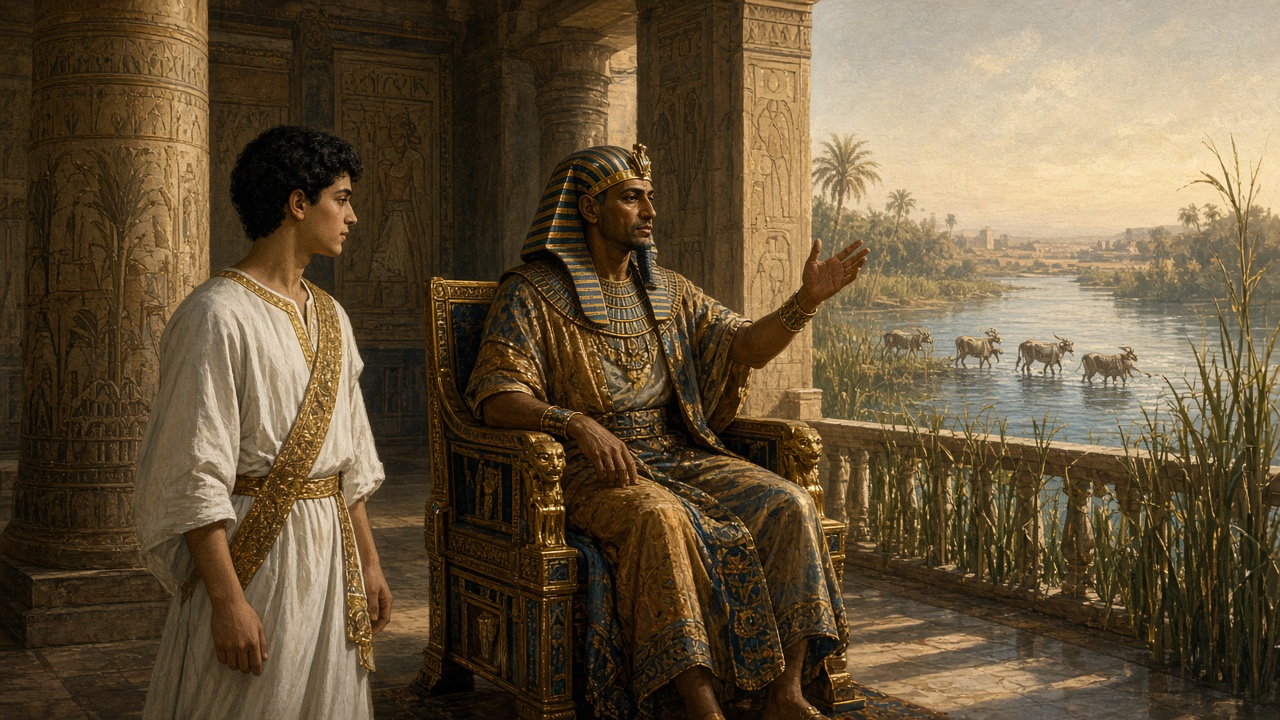
1And it came to pass after two full years that Pharao had a dream. He thought he stood upon the bank of the river. 2And behold, there came up as it were out of the river seven cows, fair in appearance, and choice of flesh, and they fed on the sedge. 3And other seven cows came up after these out of the river, ill-favoured and lean-fleshed, and fed by the other cows on the bank of the river. 4And the seven ill-favoured and lean cows devoured the seven well-favoured and choice-fleshed cows; and Pharao awoke. 5And he dreamt again. And, behold, seven ears came up on one stalk, choice and good. 6And, behold, seven ears thin and blasted with the wind, grew up after them. 7And the seven thin ears and blasted with the wind devoured the seven choice and full ears; and Pharao awoke, and it was a dream. 8And it was morning, and his soul was troubled; and he sent and called all the interpreters of Egypt, and all her wise men; and Pharao related to them his dream, and there was no one to interpret it to Pharao. 9And the chief cupbearer spoke to Pharao, saying, I this day remember my fault: 10Pharao was angry with his servants, and put us in prison in the house of the captain of the guard, both me and the chief baker. 11And we had a dream both in one night, I and he; we saw, each according to his dream. 12And there was there with us a young man, a Hebrew servant of the captain of the guard; and we related to him our dreams, and he interpreted them to us. 13And it came to pass, as he interpreted them to us, so also it happened, both that I was restored to my office, and that he was hanged.
Joseph Interprets Pharaoh’s Dreams
14And Pharao having sent, called Joseph; and they brought him out from the prison, and shaved him, and changed his dress, and he came to Pharao. 15And Pharao said to Joseph, I have seen a vision, and there is no one to interpret it; but I have heard say concerning you that you did hear dreams and interpret them. 16And Joseph answered Pharao and said, Without God an answer of safety shall not be given to Pharao. 17And Pharao spoke to Joseph, saying, In my dream I thought I stood by the bank of the river; 18and there came up as it were out of the river, seven cows well-favoured and choice-fleshed, and they fed on the sedge. 19And behold seven other cows came up after them out of the river, evil and ill-favoured and lean-fleshed, such that I never saw worse in all the land of Egypt. 20And the seven ill-favoured and thin cows ate up the seven first good and choice cows. 21And they went into their bellies; and it was not perceptible that they had gone into their bellies, and their appearance was ill-favoured, as also at the beginning; and after I awoke I slept, 22and saw again in my sleep, and as it were seven ears came up on one stem, full and good. 23And other seven ears, thin and blasted with the wind, sprang up close to them. 24And the seven thin and blasted ears devoured the seven fine and full ears: so I spoke to the interpreters, and there was no one to explain it to me. 25And Joseph said to Pharao, The dream of Pharao is one; whatever God does, he has shown to Pharao. 26The seven good cows are seven years, and the seven good ears are seven years; the dream of Pharao is one. 27And the seven thin kine that came up after them are seven years; and the seven thin and blasted ears are seven years; there shall be seven years of famine. 28And as for the word which I have told Pharao, whatever God intends to do, he has shown to Pharao: 29behold, for seven years there is coming great plenty in all the land of Egypt. 30But there shall come seven years of famine after these, and they shall forget the plenty that shall be in all Egypt, and the famine shall consume the land. 31And the plenty shall not be known in the land by reason of the famine that shall be after this, for it shall be very grievous. 32And concerning the repetition of the dream to Pharao twice, it is because the saying which is from God shall be true, and God will hasten to accomplish it. 33Now then, look out a wise and prudent man, and set him over the land of Egypt. 34And let Pharao make and appoint local governors over the land; and let them take up a fifth part of all the produce of the land of Egypt for the seven years of the plenty. 35And let them gather all the food of these seven good years that are coming, and let the corn be gathered under the hand of Pharao; let food be kept in the cities. 36And the stored food shall be for the land against the seven years of famine, which shall be in the land of Egypt; and the land shall not be utterly destroyed by the famine.
Joseph Given Charge of Egypt
37And the word was pleasing in the sight of Pharao, and in the sight of all his servants. 38And Pharao said to all his servants, Shall we find such a man as this, who has the Spirit of God in him? 39And Pharao said to Joseph, Since God has showed you all these things, there is not a wiser or more prudent man than you. 40You shall be over my house, and all my people shall be obedient to your word; only in the throne will I excel you. 41And Pharao said to Joseph, Behold, I set you this day over all the land of Egypt. 42And Pharao took his ring off his hand, and put it on the hand of Joseph, and put on him a robe of fine linen, and put a necklace of gold about his neck. 43And he mounted him on the second of his chariots, and a herald made proclamation before him; and he set him over all the land of Egypt. 44And Pharao said to Joseph, I am Pharao; without you no one shall lift up his hand on all the land of Egypt. 45And Pharao called the name of Joseph, Psonthomphanech; and he gave him Aseneth, the daughter of Petephres, priest of Heliopolis, to wife.
The Seven Years of Plenty
46And Joseph was thirty years old when he stood before Pharao, king of Egypt. And Joseph went out from the presence of Pharao, and went through all the land of Egypt. 47And the land produced, in the seven years of plenty, whole handfuls of corn. 48And he gathered all the food of the seven years, in which was the plenty in the land of Egypt; and he laid up the food in the cities; the food of the fields of a city round about it he laid up in it. 49And Joseph gathered very much corn as the sand of the sea, until it could not be numbered, for there was no number of it. 50And to Joseph were born two sons, before the seven years of famine came, which Aseneth, the daughter of Petephres, priest of Heliopolis, bore to him. 51And Joseph called the name of the firstborn, Manasse; for God, said he, has made me forget all my toils, and all my father's house. 52And he called the name of the second, Ephraim; for God, said he, has increased me in the land of my humiliation.
The Famine Begins
53And the seven years of plenty passed away, which were in the land of Egypt. 54And the seven years of famine began to come, as Joseph said; and there was a famine in all the land; but in all the land of Egypt there was bread. 55And all the land of Egypt was hungry; and the people cried to Pharao for bread. And Pharao said to all the Egyptians, Go to Joseph, and do whatever he shall tell you. 56And the famine was on the face of all the earth; and Joseph opened all the granaries, and sold to all the Egyptians. 57And all countries came to Egypt to buy of Joseph, for the famine prevailed in all the earth.
Você sabia?
Os sonhos do Faraó e a ascensão de José
- O rio à beira do qual o Faraó está em pé é o Nilo. Esse nome não aparece nas Escrituras; o Antigo Testamento o chama de Sior, 'o ribeiro negro', ou simplesmente de 'o rio', como neste capítulo.Fontes: Nile · o próprio texto bíblico
- O Faraó deu a José por esposa Asenate, filha de Potífera, sacerdote de On. O Easton's Bible Dictionary (1897) explica Asenate como um nome egípcio que significa 'dom do deus-sol'. On ficava na margem leste do Nilo, algumas milhas ao norte de Mênfis e perto do Cairo, e era um grande centro do culto ao sol; a Septuaginta e a Vulgata chamam-na de Heliópolis, 'cidade do sol'.Fontes: Asenath · On · o próprio texto bíblico
- Uma cronologia data a promoção de José no Egito em 1714 a.C., os sete anos de fartura a partir desse mesmo ano e os sete anos de fome a partir de 1707 a.C.Fontes: Joseph Promoted in Egypt · 7 years of plenty · 7 years of famine
Notas escritas com auxílio de IA a partir de fontes abertas (Theographic Bible Metadata, CC BY-SA 4.0; Easton’s Bible Dictionary, domínio público) e revisadas antes de publicar.
Lugares deste capítulo
- Nile · Hoje: Nile River · 31.465, 30.367 · versículos 1, 2, 3, 17, 18, 19
- Egypt · 30.129, 31.308 · versículos 8, 19, 29, 30, 33, 34, 36, 41, 43, 44, 45, 46, 48, 53, 54, 55, 56, 57
- Heliopolis · Hoje: Ain Shams · 30.129, 31.308 · versículos 45, 50
Só aparecem lugares com identificação de alta confiança (90% ou mais segundo as fontes acadêmicas reunidas pelo OpenBible). Mapa da época: DARE (Digital Atlas of the Roman Empire), CC BY 4.0; mapa atual: © colaboradores do OpenStreetMap; lugares: OpenBible.info (CC BY 4.0).
Créditos e licença desta tradução
LXX2012: Septuagint in British/International English 2012
The Septuagint with Apocrypha, translated from Greek to English by Sir Lancelot C. L. Brenton and published in 1885, with some language updates (British/International English)
Public Domain
Language: English
Dialect (if applicable): British
Language in English: English
Translation by: Sir Lancelot Charles Lee Breton
LXX2012: Septuagint in English 2012, British/International English Edition
This is a translation of the Old Testament and Apocrypha/Deuterocanon from Hebrew to Greek to 19th Century British English, with some updates of spelling and word usage to contemporary British/International English. The original English translation was done by Sir Lancelot Charles Lee Brenton and published by Samuel Bagster & Sons, Ltd., in London in 1851. It has entered the Public Domain due to the passage of sufficient time. In the process of scanning and typing the text, the original poetry and prose formatting, as well as peripheral material like introductions and notes, have been omitted.
This edition of the Septuagint has some language updates. Brenton's word order and punctuation has been mostly retained, meaning that quotation marks are not used, and sentences within quotes may not start with capital letters, as was standard usage in 1851. Names transliterated from Greek to those transliterated from Hebrew in the common English Bibles often differ. These language updates are dedicated to the Public Domain by the author of those edits, Michael Paul Johnson. Therefore this edition may be freely copied, published, etc.
Before considering making changes to the text of this work, I recommend that you consult with God, because this is really His Book.
If you find errors in the text, please report them so that we can correct them.
Donations to help with the expenses of operating this web site and thus help others have free access to the Word of God may be made to us, but are not required. Please see http://MLJohnson.org/partner/ for more about that.
Títulos de seção adaptados da Berean Standard Bible (domínio público); não fazem parte do texto bíblico desta tradução.
Fonte: http://ebible.org/eng-uk-lxx2012/ · eBible.org