Gênesis 28
LXX2012: Septuagint in British/International English 2012 · Toque num versículo para ver as referências cruzadas.
Jacob’s Departure
1And Isaac having called for Jacob, blessed him, and charged him, saying, You shall not take a wife of the daughters of the Chananites. 2Rise and depart quickly into Mesopotamia, to the house of Bathuel the father of your mother, and take to yourself thence a wife of the daughters of Laban your mother's brother. 3And may my God bless you, and increase you, and multiply you, and you shall become gatherings of nations. 4And may he give you the blessing of my father Abraam, even to you and to your seed after you, to inherit the land of your sojourning, which God gave to Abraam. 5So Isaac sent away Jacob, and he went into Mesopotamia to Laban the son of Bethuel the Syrian, the brother of Rebecca the mother of Jacob and Esau.
Esau Marries Mahalath
6And Esau saw that Isaac blessed Jacob, and sent him away to Mesopotamia of Syria as he blessed him, to take to himself a wife thence, and that he charged him, saying, You shall not take a wife of the daughters of the Chananites; 7and that Jacob listened to his father and his mother, and went to Mesopotamia of Syria. 8And Esau also having seen that the daughters of Chanaan were evil before his father Isaac, 9Esau went to Ismael, and took Maeleth the daughter of Ismael, the son of Abraam, the sister of Nabeoth, a wife in addition to his other wives.
Jacob’s Ladder
10And Jacob went forth from the well of the oath, and departed into Charrhan. 11And came to a certain place and slept there, for the sun had gone down; and he took one of the stones of the place, and put it at his head, and lay down to sleep in that place, 12and dreamt, and behold a ladder fixed on the earth, whose top reached to heaven, and the angels of God ascended and descended on it. 13And the Lord stood upon it, and said, I am the God of your father Abraam, and the God of Isaac; fear not, the land on which you lie, to you will I give it, and to your seed. 14And your seed shall be as the sand of the earth; and it shall spread abroad to the sea, and the south, and the north, and to the east; and in you and in your seed shall all the tribes of the earth be blessed. 15And behold I am with you to preserve you continually in all the way wherein you shall go; and I will bring you back to this land; for I will not desert you, until I have done all that I have said to you. 16And Jacob awaked out of his sleep, and said, The Lord is in this place, and I knew it not. 17And he was afraid, and said, How fearful is this place! this is none other than the house of God, and this is the gate of heaven.
The Stone of Bethel
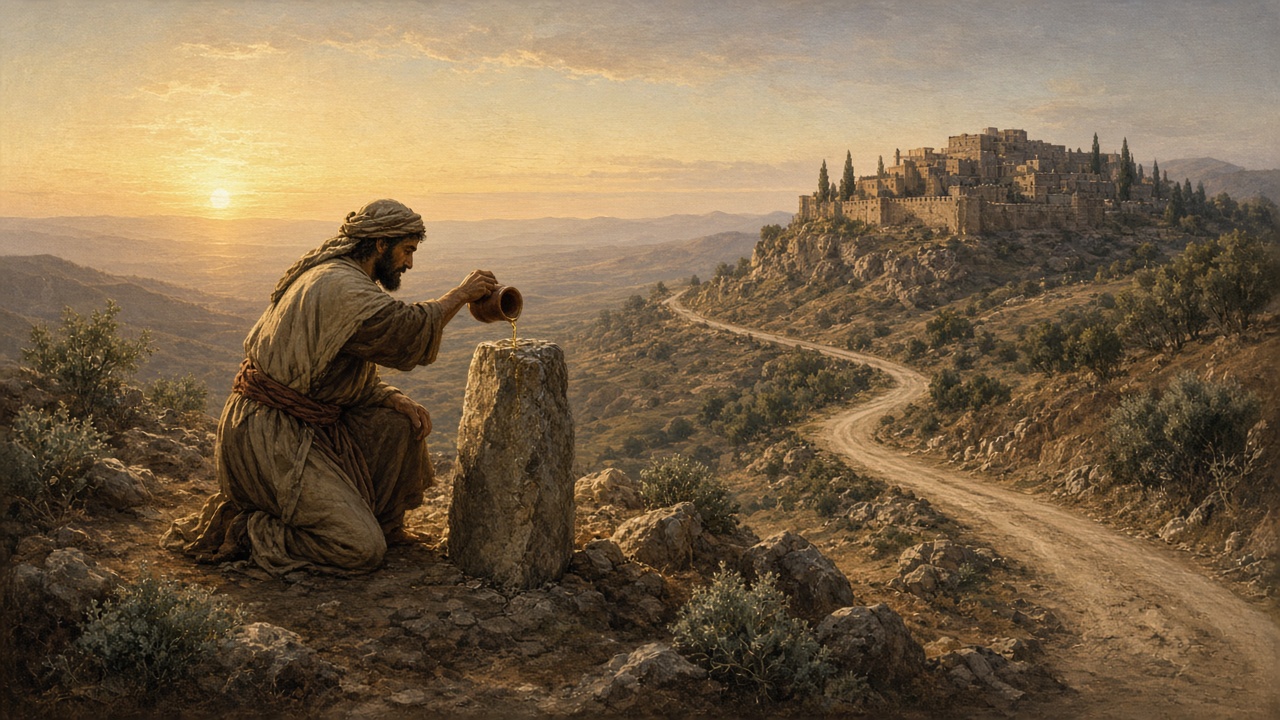
18And Jacob rose up in the morning, and took the stone he had laid there by his head, and he set it up as a pillar, and poured oil on the top of it. 19And he called the name of that place, the House of God; and the name of the city before was Ulam-luz. 20And Jacob vowed a vow, saying, If the Lord God will be with me, and guard me throughout on this journey, on which I am going, and give me bread to eat, and raiment to put on, 21and bring me back in safety to the house of my father, then shall the Lord be for a God to me. 22And this stone, which I have set up for a pillar, shall be to me a house of God; and of all whatever you shall give me, I will tithe a tenth for you.
Você sabia?
A viagem de Jacó e o sonho em Betel
- Isaque enviou Jacó de Berseba a Padã-Arã para tomar uma esposa entre as filhas de Labão, irmão de sua mãe Rebeca, e não entre as mulheres cananeias. Padã-Arã, chamada a planície de Arã, é comumente considerada o distrito mesopotâmico ao redor de Harã, onde Labão morava; Harã, também chamada cidade de Naor, foi onde Abraão permaneceu depois de deixar Ur, até a morte de seu pai Tera.Fontes: o próprio texto bíblico · Paddan-aram · Haran · Laban
- O lugar em que Jacó sonhou, levantou como coluna a pedra que havia posto sob a cabeça e derramou óleo sobre ela era a cidade real cananeia de Luz; ele a renomeou Betel. O Easton's Bible Dictionary (1897) situa Betel na Palestina central, a cerca de dez milhas ao norte de Jerusalém, e observa que o nome foi a princípio, ao que parece, dado a um santuário nas vizinhanças de Luz, e não foi dado à própria cidade até depois que a tribo de Efraim a conquistou.Fontes: o próprio texto bíblico · Luz · Bethel (of Palestine)
- Quando Esaú soube que Isaque havia abençoado Jacó e lhe ordenara não se casar com uma mulher cananeia, foi até Ismael e casou-se com Maalate, irmã de Nebaiote e filha de Ismael, filho de Abraão, além das esposas que já tinha. O Easton's Bible Dictionary (1897) também a chama Basemate e observa que as três esposas de Esaú recebem nomes diferentes na genealogia edomita de Gênesis 36 daqueles dados na narrativa de Gênesis 26 e 28.Fontes: o próprio texto bíblico · Bashemath
Notas escritas com auxílio de IA a partir de fontes abertas (Theographic Bible Metadata, CC BY-SA 4.0; Easton’s Bible Dictionary, domínio público) e revisadas antes de publicar.
Lugares deste capítulo
- Canaan · 32.767, 35.333 · versículos 1, 6, 8
- Haran · Hoje: Harran · 36.864, 39.033 · versículo 10
- Luz · Hoje: Beitin · 31.923, 35.241 · versículo 19
Só aparecem lugares com identificação de alta confiança (90% ou mais segundo as fontes acadêmicas reunidas pelo OpenBible). Mapa da época: DARE (Digital Atlas of the Roman Empire), CC BY 4.0; mapa atual: © colaboradores do OpenStreetMap; lugares: OpenBible.info (CC BY 4.0).
Créditos e licença desta tradução
LXX2012: Septuagint in British/International English 2012
The Septuagint with Apocrypha, translated from Greek to English by Sir Lancelot C. L. Brenton and published in 1885, with some language updates (British/International English)
Public Domain
Language: English
Dialect (if applicable): British
Language in English: English
Translation by: Sir Lancelot Charles Lee Breton
LXX2012: Septuagint in English 2012, British/International English Edition
This is a translation of the Old Testament and Apocrypha/Deuterocanon from Hebrew to Greek to 19th Century British English, with some updates of spelling and word usage to contemporary British/International English. The original English translation was done by Sir Lancelot Charles Lee Brenton and published by Samuel Bagster & Sons, Ltd., in London in 1851. It has entered the Public Domain due to the passage of sufficient time. In the process of scanning and typing the text, the original poetry and prose formatting, as well as peripheral material like introductions and notes, have been omitted.
This edition of the Septuagint has some language updates. Brenton's word order and punctuation has been mostly retained, meaning that quotation marks are not used, and sentences within quotes may not start with capital letters, as was standard usage in 1851. Names transliterated from Greek to those transliterated from Hebrew in the common English Bibles often differ. These language updates are dedicated to the Public Domain by the author of those edits, Michael Paul Johnson. Therefore this edition may be freely copied, published, etc.
Before considering making changes to the text of this work, I recommend that you consult with God, because this is really His Book.
If you find errors in the text, please report them so that we can correct them.
Donations to help with the expenses of operating this web site and thus help others have free access to the Word of God may be made to us, but are not required. Please see http://MLJohnson.org/partner/ for more about that.
Títulos de seção adaptados da Berean Standard Bible (domínio público); não fazem parte do texto bíblico desta tradução.
Fonte: http://ebible.org/eng-uk-lxx2012/ · eBible.org