Ezequiel 41
LXX2012: Septuagint in British/International English 2012 · Toque num versículo para ver as referências cruzadas.
Inside the Temple
1And he brought me into the temple, the porch of which he measured, six cubits the breadth on one side, and six cubits the breadth of the porch on the other side. 2And the breadth of the gateway was ten cubits, and the side-pieces of the gateway were five cubits on this side, and five cubits on that side: and he measured the length of it, forty cubits, and the breadth, twenty cubits. 3And he went into the inner court, and measured the post of the door, two cubits; and the door, six cubits; and the side-pieces of the door, seven cubits on one side, and seven cubits on the other side. 4And he measured the length of the doors, forty cubits; and the breadth, twenty cubits, in front of the temple: and he said, This is the holy of holies.
Outside the Temple
5And he measured the wall of the house, six cubits: and the breadth of each side, four cubits round about. 6And the sides were twice ninety, side against side; and there was a space in the wall of the house at the sides round about, that they should be for them that take hold of them to see, that they should not at all touch the walls of the house. 7And the breadth of the upper side was made according to the projection out of the wall, against the upper one round about the house, that it might be enlarged above, and that men might go up to the upper chambers from those below, and from the ground-sills to the third story. 8And as for the height of the house round about, each space between the sides was equal to a reed of six cubits; 9and the breadth of the wall of each side without was five cubits; and the spaces that were left between the sides of the house, 10and between the chambers, were a width of twenty cubits, the circumference of the house. 11And the doors of the chambers were towards the space left by the one door that looked northward, and there was one door southward; and the breadth of the remaining open space was five cubits in extent round about. 12And the partition wall in front of the remaining space, towards the west, was seventy cubits in breadth; the breadth of the partition wall was five cubits round about, and the length of it ninety cubits. 13And he measured in front of the house a length of one hundred cubits, and the remaining spaces and the partitions; and the walls thereof were in length one hundred cubits. 14And the breadth in front of the house, and the remaining spaces before it were one hundred cubits.
The Interior Structures
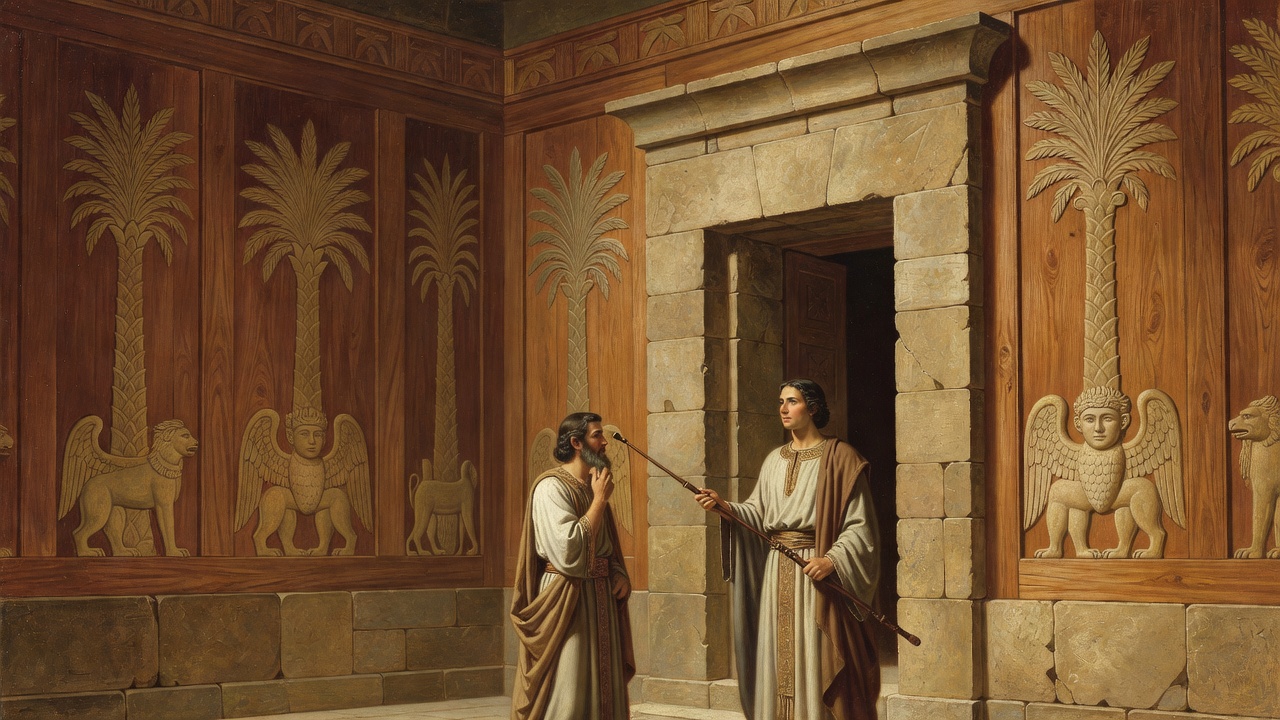
15And he measured the length of the partition in front of the space left by the back parts of that house; and the spaces left on this side and on that side were in length one hundred cubits: and the temple and the corners and the outer porch were ceiled. 16And the windows were latticed, giving light round about to the three storeys, so as to look through: and the house and the parts adjoining were planked round about, and so was the floor, and from the floor up to the windows, and the window shutters folded back in three parts for one to look through. 17And almost all the way to the inner, and close to the outer side, and upon all the wall round about within and without, 18were carved cherubs and palm-trees between the cherubs, and each cherub had two faces. 19The face of a man was towards one palm tree on this side and on that side, and the face of a lion towards another palm tree on this side and on that side: the house was carved all round. 20From the floor to the ceiling were cherubs and palm-trees carved. 21And the holy place and the temple opened on four sides; in front of the holy places the appearance was as the look of 22a wooden altar, the height of it three cubits, and the length two cubits, and the breadth two cubits; and it had horns, and the base of it and the sides of it were of wood: and he said to me, This is the table, which is before the face of the Lord. 23And the temple had two doors, and the sanctuary had two doors, with two turning leaves apiece; 24two leaves to the one, and two leaves to the other door. 25And there was carved work upon them, and cherubs on the doors of the temple, and palm-trees according to the carving of the sanctuary; and there were stout planks in front of the porch without. 26And there were secret windows; and he measured from side to side, to the roofing of the porch; and the sides of the house were closely planked.
Você sabia?
O Interior do Templo Visionário
- O santuário na visão de Ezequiel é dividido em duas seções principais: um santuário exterior medindo quarenta por vinte côvados e uma sala interior de vinte côvados quadrados, identificada como o Lugar Santíssimo.Fontes: o próprio texto bíblico · Most Holy Place
- As paredes internas e as portas duplas eram revestidas de madeira e entalhadas com palmeiras e querubins alternados. Cada querubim foi retratado com dois rostos: o de um ser humano voltado para uma palmeira e o de um leão jovem voltado para a outra.Fontes: o próprio texto bíblico
- Três andares de câmaras laterais cercavam o templo, com trinta quartos em cada nível. As estruturas apoiavam-se em saliências externas para que os suportes não precisassem ser fixados diretamente na parede do próprio templo.Fontes: o próprio texto bíblico
Notas escritas com auxílio de IA a partir de fontes abertas (Theographic Bible Metadata, CC BY-SA 4.0; Easton’s Bible Dictionary, domínio público) e revisadas antes de publicar.
Lugares deste capítulo
- Most Holy Place · Hoje: on Mount Moriah · 31.778, 35.236 · versículo 4
- Holy Place · Hoje: on Mount Moriah · 31.778, 35.236 · versículos 21, 23
Só aparecem lugares com identificação de alta confiança (90% ou mais segundo as fontes acadêmicas reunidas pelo OpenBible). Mapa da época: DARE (Digital Atlas of the Roman Empire), CC BY 4.0; mapa atual: © colaboradores do OpenStreetMap; lugares: OpenBible.info (CC BY 4.0).
Créditos e licença desta tradução
LXX2012: Septuagint in British/International English 2012
The Septuagint with Apocrypha, translated from Greek to English by Sir Lancelot C. L. Brenton and published in 1885, with some language updates (British/International English)
Public Domain
Language: English
Dialect (if applicable): British
Language in English: English
Translation by: Sir Lancelot Charles Lee Breton
LXX2012: Septuagint in English 2012, British/International English Edition
This is a translation of the Old Testament and Apocrypha/Deuterocanon from Hebrew to Greek to 19th Century British English, with some updates of spelling and word usage to contemporary British/International English. The original English translation was done by Sir Lancelot Charles Lee Brenton and published by Samuel Bagster & Sons, Ltd., in London in 1851. It has entered the Public Domain due to the passage of sufficient time. In the process of scanning and typing the text, the original poetry and prose formatting, as well as peripheral material like introductions and notes, have been omitted.
This edition of the Septuagint has some language updates. Brenton's word order and punctuation has been mostly retained, meaning that quotation marks are not used, and sentences within quotes may not start with capital letters, as was standard usage in 1851. Names transliterated from Greek to those transliterated from Hebrew in the common English Bibles often differ. These language updates are dedicated to the Public Domain by the author of those edits, Michael Paul Johnson. Therefore this edition may be freely copied, published, etc.
Before considering making changes to the text of this work, I recommend that you consult with God, because this is really His Book.
If you find errors in the text, please report them so that we can correct them.
Donations to help with the expenses of operating this web site and thus help others have free access to the Word of God may be made to us, but are not required. Please see http://MLJohnson.org/partner/ for more about that.
Títulos de seção adaptados da Berean Standard Bible (domínio público); não fazem parte do texto bíblico desta tradução.
Fonte: http://ebible.org/eng-uk-lxx2012/ · eBible.org