Êxodo 7
LXX2012: Septuagint in British/International English 2012 · Toque num versículo para ver as referências cruzadas.
God Commands Moses and Aaron
1And the Lord spoke to Moses, saying, Behold, I have made you a god to Pharao, and Aaron your brother shall be your prophet. 2And you shall say to him all things that I charge you, and Aaron your brother shall speak to Pharao, that he should send forth the children of Israel out of his land. 3And I will harden the heart of Pharao, and I will multiply my signs and wonders in the land of Egypt. 4And Pharao will not listen to you, and I will lay my hand upon Egypt; and will bring out my people the children of Israel with my power out of the land of Egypt with great vengeance. 5And all the Egyptians shall know that I am the Lord, stretching out my hand upon Egypt, and I will bring out the children of Israel out of the midst of them. 6And Moses and Aaron did as the Lord commanded them, so did they. 7And Moses was eighty years old, and Aaron his brother was eighty-three years old, when he spoke to Pharao.
Aaron’s Staff
8And the Lord spoke to Moses and Aaron, saying, 9Now if Pharao should speak to you, saying, Give us a sign or a wonder, then shall you say to your brother Aaron, Take your rod and cast it upon the ground before Pharao, and before his servants, and it shall become a serpent. 10And Moses and Aaron went in before Pharao, and before his servants, and they did so, as the Lord commanded them; and Aaron cast down his rod before Pharao, and before his servants, and it became a serpent. 11But Pharao called together the wise men of Egypt, and the sorcerers, and the charmers also of the Egyptians did likewise with their sorceries. 12And they cast down each his rod, and they became serpents, but the rod of Aaron swallowed up their rods. 13and the heart of Pharao was hardened, and he listened not to them, as the Lord charged them.
The First Plague: Blood
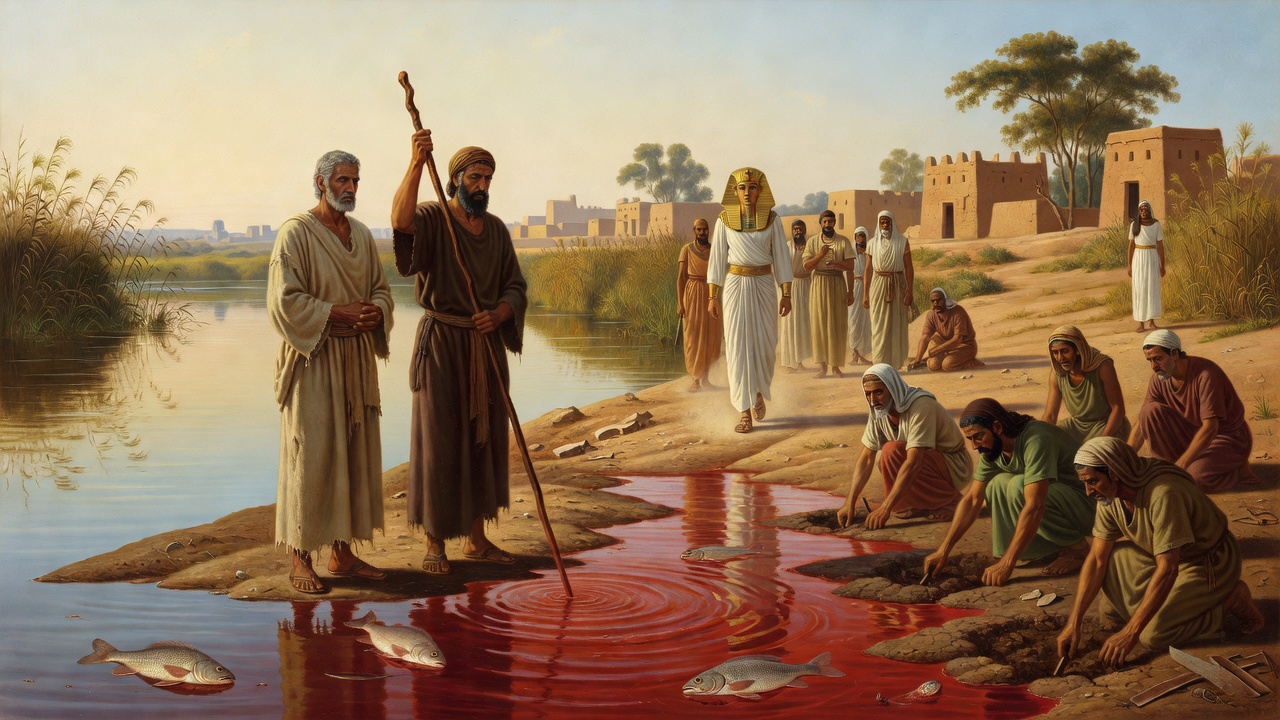
14and the Lord said to Moses, The heart of Pharao is made hard, so that he should not let the people go. 15Go to Pharao early in the morning: behold, he goes forth to the water; and you shall meet him on the bank of the river, and you shall take in your hand the rod that was turned into a serpent. 16And you shall say to him, The Lord God of the Hebrews has sent me to you, saying, Send my people away, that they may serve me in the wilderness, and, behold, hitherto you have not listened. 17These things says the Lord: Hereby shall you know that I am the Lord: behold, I strike with the rod that is in my hand on the water which is in the river, and it shall change it into blood. 18And the fish that are in the river shall die, and the river shall stink thereupon, and the Egyptians shall not be able to drink water from the river. 19And the Lord said to Moses, Say to your brother Aaron, Take your rod in your hand, and stretch forth your hand over the waters of Egypt, and over their rivers, and over their canals, and over their ponds, and over all their standing water, and it shall become blood: and there was blood in all the land of Egypt, both in vessels of wood and of stone. 20and Moses and Aaron did so, as the Lord commanded them; and Aaron having lifted up his hand with his rod, struck the water in the river before Pharao, and before his servants, and changed all the water in the river into blood. 21And the fish in the river died, and the river stank thereupon; and the Egyptians could not drink water from the river, and the blood was in all the land of Egypt. 22And the charmers also of the Egyptians did so with their sorceries; and the heart of Pharao was hardened, and he did not listen to them, even as the Lord said. 23And Pharao turned and entered into his house, nor did he fix his attention even on this thing. 24And all the Egyptians dug round about the river, so as to drink water, for they could not drink water from the river. 25and seven days were fulfilled after the Lord has struck the river.
Você sabia?
Moisés e Arão diante do faraó
- Moisés tinha oitenta anos e Arão oitenta e três quando falaram ao faraó. O Easton's Bible Dictionary (1897) observa que Arão, o filho mais velho de Anrão e Joquebede, nasceu no Egito três anos antes de seu irmão Moisés. Neste capítulo, o SENHOR diz que fez Moisés "como Deus para o faraó", e que Arão será seu profeta: Moisés deve falar tudo o que lhe for ordenado, e Arão deve dizer ao faraó que deixe os israelitas sair de sua terra.Fontes: o próprio texto bíblico · Aaron
- O Easton's Bible Dictionary (1897) observa que o nome Nilo não se encontra nas Escrituras; o Antigo Testamento chama esse rio de Sihor, "a corrente negra", ou simplesmente "o rio", e também "a inundação do Egito". O Nilo é formado pelo Nilo Branco e pelo Nilo Azul, que se encontram em Cartum, e é essa a água que Arão fere neste capítulo. Os peixes morreram, o rio cheirou mal, os egípcios não puderam bebê-la e cavaram ao redor do Nilo em busca de água, e passaram-se sete dias completos.Fontes: Nile · o próprio texto bíblico
- O Easton's Bible Dictionary (1897) diz que o faraó do Êxodo foi provavelmente Menephtah I, o décimo quarto e mais velho filho sobrevivente de Rameses II, e que ele residia em Zoan, onde teve as entrevistas com Moisés e Arão registradas em Êxodo. O mesmo verbete deixa a identificação em aberto: ainda é uma questão se Seti II ou seu pai Menephtah foi esse faraó, e alguns acham que as evidências favorecem Seti II.Fontes: Pharaoh (of the Exodus) · o próprio texto bíblico
Notas escritas com auxílio de IA a partir de fontes abertas (Theographic Bible Metadata, CC BY-SA 4.0; Easton’s Bible Dictionary, domínio público) e revisadas antes de publicar.
Lugares deste capítulo
- Egypt · 30.129, 31.308 · versículos 3, 4, 5, 11, 19, 21, 22
- Nile · Hoje: Nile River · 31.465, 30.367 · versículos 15, 17, 18, 20, 21, 24, 25
Só aparecem lugares com identificação de alta confiança (90% ou mais segundo as fontes acadêmicas reunidas pelo OpenBible). Mapa da época: DARE (Digital Atlas of the Roman Empire), CC BY 4.0; mapa atual: © colaboradores do OpenStreetMap; lugares: OpenBible.info (CC BY 4.0).
Créditos e licença desta tradução
LXX2012: Septuagint in British/International English 2012
The Septuagint with Apocrypha, translated from Greek to English by Sir Lancelot C. L. Brenton and published in 1885, with some language updates (British/International English)
Public Domain
Language: English
Dialect (if applicable): British
Language in English: English
Translation by: Sir Lancelot Charles Lee Breton
LXX2012: Septuagint in English 2012, British/International English Edition
This is a translation of the Old Testament and Apocrypha/Deuterocanon from Hebrew to Greek to 19th Century British English, with some updates of spelling and word usage to contemporary British/International English. The original English translation was done by Sir Lancelot Charles Lee Brenton and published by Samuel Bagster & Sons, Ltd., in London in 1851. It has entered the Public Domain due to the passage of sufficient time. In the process of scanning and typing the text, the original poetry and prose formatting, as well as peripheral material like introductions and notes, have been omitted.
This edition of the Septuagint has some language updates. Brenton's word order and punctuation has been mostly retained, meaning that quotation marks are not used, and sentences within quotes may not start with capital letters, as was standard usage in 1851. Names transliterated from Greek to those transliterated from Hebrew in the common English Bibles often differ. These language updates are dedicated to the Public Domain by the author of those edits, Michael Paul Johnson. Therefore this edition may be freely copied, published, etc.
Before considering making changes to the text of this work, I recommend that you consult with God, because this is really His Book.
If you find errors in the text, please report them so that we can correct them.
Donations to help with the expenses of operating this web site and thus help others have free access to the Word of God may be made to us, but are not required. Please see http://MLJohnson.org/partner/ for more about that.
Títulos de seção adaptados da Berean Standard Bible (domínio público); não fazem parte do texto bíblico desta tradução.
Fonte: http://ebible.org/eng-uk-lxx2012/ · eBible.org