Êxodo 5
LXX2012: Septuagint in British/International English 2012 · Toque num versículo para ver as referências cruzadas.
Pharaoh’s First Refusal
1And after this went in Moses and Aaron to Pharao, and they said to him, These things says the Lord God of Israel, Send my people away, that they may keep a feast to me in the wilderness. 2And Pharao said, Who is he that I should listen to his voice, so that I should send away the children of Israel? I do not know the Lord, and I will not let Israel go. 3And they say to him, The God of the Hebrews has called us to him: we will go therefore a three days' journey into the wilderness, that we may sacrifice to the Lord our God, lest at any time death or slaughter happen to us. 4And the king of Egypt said to them, Why do you⌃, Moses and Aaron, turn the people from their works? depart each of you to your works. 5And Pharao said, Behold now, the people is very numerous; let us not then give them rest from their work.
Bricks and Straw
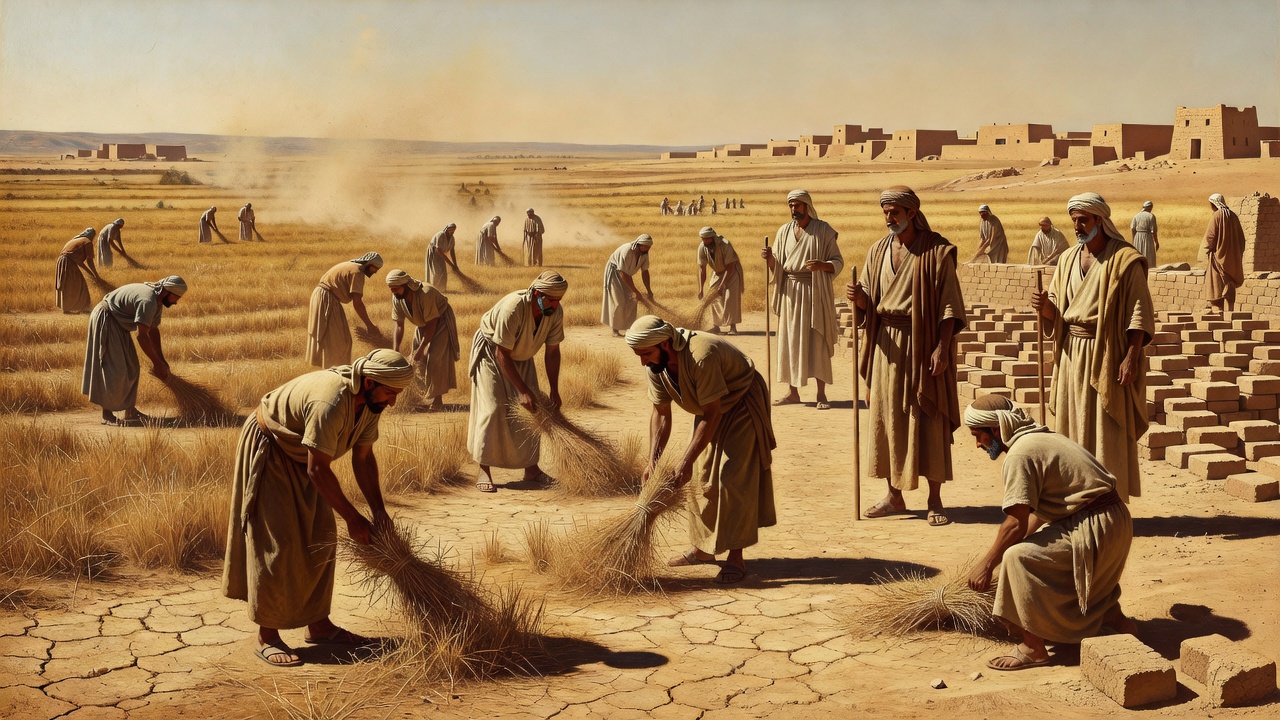
6And Pharao gave orders to the taskmasters of the people and the accountants, saying, 7You⌃ shall no longer give straw to the people for brick-making as yesterday and the third day; but let them go themselves, and collect straw for themselves. 8And you shall impose on them daily the rate of brick-making which they perform: you shall not abate anything, for they are idle; therefore have they cried, saying, Let us arise and do sacrifice to our God. 9Let the works of these men be made grievous, and let them care for these things, and not care for vain words. 10And the taskmasters and the accountants hastened them, and they spoke to the people, saying, thus says Pharao, I will give you straw no longer. 11Go you⌃, yourselves, get for yourselves straw wherever you⌃ can find it, for nothing is diminished from your rate. 12So the people were dispersed in all the land of Egypt, to gather stubble for straw. 13and the taskmasters hastened them, saying, Fulfil your regular daily tasks, even as when straw was given you. 14And the accountants of the race of the children of Israel, who were set over them by the masters of Pharao, were scourged, [and questioned,] men saying, Why have you⌃ not fulfilled your rates of brick work as yesterday and the third day, today also?
The Cry of the Israelites
15And the accountants of the children of Israel went in and cried to Pharao, saying, Why do you act thus to your servants? 16Straw is not given to your servants, and they tell us to make brick; and behold your servants have been scourged: you will therefore injure your people. 17And he said to them, You⌃ are idle, you⌃ are idlers: therefore you⌃ say, Let us go and do sacrifice to our God. 18Now then go and work, for straw shall not be given to you, yet you⌃ shall return the rate of bricks. 19And the accountants of the children of Israel saw themselves in an evil plight, men saying, You⌃ shall not fail to deliver the daily rate of the brick-making. 20And they met Moses and Aaron coming forth to meet them, as they came forth from Pharao. 21And they said to them, The Lord look upon you and judge you, for you⌃ have made our savour abominable before Pharao, and before his servants, to put a sword into his hands to kill us. 22And Moses turned to the Lord, and said, I pray, Lord, why have you afflicted this people? and therefore have you sent me? 23For from the time that I went to Pharao to speak in your name, he has afflicted this people, and you have not delivered your people.
Você sabia?
Trabalho mais duro depois da recusa do faraó
- O Easton's Bible Dictionary (1897) diz que o faraó do Êxodo foi provavelmente Menephtah I, o décimo quarto e mais velho filho sobrevivente de Ramsés II, mas trata a identificação como uma questão ainda em aberto: alguns estudiosos, observa a obra, preferem Seti II, cujo reinado ela descreve como iniciado em paz e terminado num desastre repentino. O verbete diz que ele residia em Zoã, onde recebeu Moisés e Arão nas audiências registradas em Êxodo.Fontes: Pharaoh (of the Exodus) · o próprio texto bíblico
- O Easton's Bible Dictionary (1897) situa a chegada de Jacó ao Egito provavelmente cerca de 350 anos antes do nascimento de Moisés. Diz que um rei hicso, de um povo semita pastoril da Ásia e chamado rei pastor, recebeu a família com favor e lhes destinou Gósen, a melhor terra; neste capítulo o faraó trata o povo de Israel, já numeroso, como trabalhadores que não pretende deixar partir.Fontes: Moses · o próprio texto bíblico
- O faraó responde ao pedido de celebrar uma festa no deserto deixando de fornecer a palha para os tijolos, mas ainda exigindo a mesma cota diária. O povo se espalha por toda a terra do Egito para recolher restolho, e os oficiais israelitas que os capatazes do faraó haviam posto sobre eles são espancados quando essa cota não é cumprida.Fontes: o próprio texto bíblico
Notas escritas com auxílio de IA a partir de fontes abertas (Theographic Bible Metadata, CC BY-SA 4.0; Easton’s Bible Dictionary, domínio público) e revisadas antes de publicar.
Lugares deste capítulo
Só aparecem lugares com identificação de alta confiança (90% ou mais segundo as fontes acadêmicas reunidas pelo OpenBible). Mapa da época: DARE (Digital Atlas of the Roman Empire), CC BY 4.0; mapa atual: © colaboradores do OpenStreetMap; lugares: OpenBible.info (CC BY 4.0).
Créditos e licença desta tradução
LXX2012: Septuagint in British/International English 2012
The Septuagint with Apocrypha, translated from Greek to English by Sir Lancelot C. L. Brenton and published in 1885, with some language updates (British/International English)
Public Domain
Language: English
Dialect (if applicable): British
Language in English: English
Translation by: Sir Lancelot Charles Lee Breton
LXX2012: Septuagint in English 2012, British/International English Edition
This is a translation of the Old Testament and Apocrypha/Deuterocanon from Hebrew to Greek to 19th Century British English, with some updates of spelling and word usage to contemporary British/International English. The original English translation was done by Sir Lancelot Charles Lee Brenton and published by Samuel Bagster & Sons, Ltd., in London in 1851. It has entered the Public Domain due to the passage of sufficient time. In the process of scanning and typing the text, the original poetry and prose formatting, as well as peripheral material like introductions and notes, have been omitted.
This edition of the Septuagint has some language updates. Brenton's word order and punctuation has been mostly retained, meaning that quotation marks are not used, and sentences within quotes may not start with capital letters, as was standard usage in 1851. Names transliterated from Greek to those transliterated from Hebrew in the common English Bibles often differ. These language updates are dedicated to the Public Domain by the author of those edits, Michael Paul Johnson. Therefore this edition may be freely copied, published, etc.
Before considering making changes to the text of this work, I recommend that you consult with God, because this is really His Book.
If you find errors in the text, please report them so that we can correct them.
Donations to help with the expenses of operating this web site and thus help others have free access to the Word of God may be made to us, but are not required. Please see http://MLJohnson.org/partner/ for more about that.
Títulos de seção adaptados da Berean Standard Bible (domínio público); não fazem parte do texto bíblico desta tradução.
Fonte: http://ebible.org/eng-uk-lxx2012/ · eBible.org