Deuteronômio 16
LXX2012: Septuagint in British/International English 2012 · Toque num versículo para ver as referências cruzadas.
Passover and the Feast of Unleavened Bread
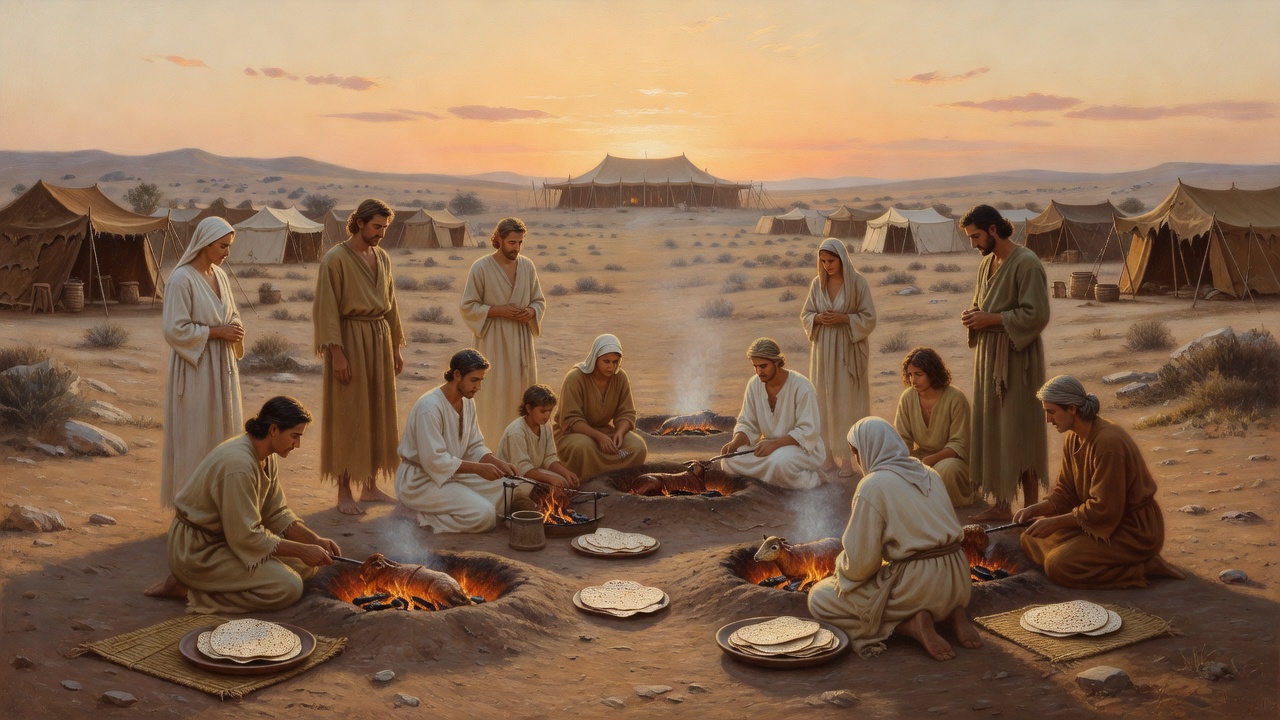
1Observe the month of new corn, and you shall sacrifice the passover to the Lord your God; because in the month of new corn you came out of Egypt by night. 2And you shall sacrifice the passover to the Lord your God, sheep and oxen in the place which the Lord your God shall choose to have his name called upon it. 3You shall not eat leaven with it; seven days shall you eat unleavened bread with it, bread of affliction, because you⌃ came forth out of Egypt in haste; that you⌃ may remember the day of your coming forth out of the land of Egypt all the days of your life. 4Leaven shall not be seen with you in all your borders for seven days, and there shall not be left of the flesh which you shall sacrifice at even on the first day until the morning. 5you shall not have power to sacrifice the passover in any of the cities, which the Lord your God gives you. 6But in the place which the Lord your God shall choose, to have his name called there, you shall sacrifice the passover at even at the setting of the sun, at the time when you came out of Egypt. 7And you shall boil and roast and eat it in the place, which the Lord your God shall choose; and you shall return in the morning, and go to your house. 8Six days shall you eat unleavened bread, and on the seventh day is a holiday, a feast to the Lord your God: you shall not do in it any work, save what must be done by any one.
The Feast of Weeks
9Seven weeks shall you number to yourself; when you have begun to put the sickle to the corn, you shall begin to number seven weeks. 10And you shall keep the feast of weeks to the Lord your God, accordingly as your hand has power in as many things as the Lord your God shall give you. 11And you shall rejoice before the Lord your God, you and your son, and your daughter, your man-servant and your maidservant, and the Levite, and the stranger, and the orphan, and the widow which dwells amongst you, in whatever place the Lord your God shall choose, that his name should be called there. 12And you shall remember that you were a servant in the land of Egypt, and you shall observe and do these commands.
The Feast of Tabernacles
13You shall keep for yourself the feast of tabernacles seven days, when you gather in your produce from your corn-floor and your wine-press. 14And you shall rejoice in your feast, you, and your son, and your daughter, your man-servant, and your maidservant, and the Levite, and the stranger, and the orphan, and the widow that is in your cities. 15Seven days shall you keep a feast to the Lord your God in the place which the Lord your God shall choose for himself; and if the Lord your God shall bless you in all your fruits, and in every work of your hands, then you shall rejoice. 16Three times in the year shall all your males appear before the Lord your God in the place which the Lord shall choose in the feast of unleavened bread, and in the feast of weeks, and in the feast of tabernacles: you shall not appear before the Lord your God empty. 17Each one according to his ability, according to the blessing of the Lord your God which he has given you.
Judges and Justice
18You shall make for yourself judges and officers in your cities, which the Lord your God gives you in your tribes, and they shall judge the people with righteous judgement: 19they shall not wrest judgement, nor favour persons, nor receive a gift; for gifts blind the eyes of the wise, and pervert the words of the righteous. 20You shall justly pursue justice, that you⌃ may live, and go in and inherit the land which the Lord your God gives you.
Forbidden Forms of Worship
21You shall not plant for yourself a grove; you shall not plant for yourself any tree near the altar of your God. 22You shall not set up for yourself a pillar, which the Lord your God hates.
Você sabia?
Festas Fixas e Justiça Reta
- Deuteronômio estabelece três festas anuais de peregrinação: a Festa dos Pães Asmos (Páscoa), a Festa das Semanas e a Festa dos Tabernáculos. Nessas ocasiões, os homens de Israel deviam comparecer diante de Deus não em suas próprias cidades, mas no lugar central escolhido como habitação para o Seu Nome.Fontes: o próprio texto bíblico
- As celebrações da Festa das Semanas e da Festa dos Tabernáculos incluíam expressamente grupos vulneráveis da sociedade, como servos, levitas, estrangeiros, órfãos e viúvas. Essa alegria comunitária estava diretamente ligada à lembrança da libertação da escravidão no Egito.Fontes: o próprio texto bíblico
- Além das assembleias religiosas, o texto ordena a nomeação de juízes e oficiais em todas as cidades. Eles eram proibidos de aceitar suborno ou demonstrar parcialidade, estabelecendo a ordem de seguir estritamente a justiça em toda a terra.Fontes: o próprio texto bíblico
Notas escritas com auxílio de IA a partir de fontes abertas (Theographic Bible Metadata, CC BY-SA 4.0; Easton’s Bible Dictionary, domínio público) e revisadas antes de publicar.
Lugares deste capítulo
Só aparecem lugares com identificação de alta confiança (90% ou mais segundo as fontes acadêmicas reunidas pelo OpenBible). Mapa da época: DARE (Digital Atlas of the Roman Empire), CC BY 4.0; mapa atual: © colaboradores do OpenStreetMap; lugares: OpenBible.info (CC BY 4.0).
Créditos e licença desta tradução
LXX2012: Septuagint in British/International English 2012
The Septuagint with Apocrypha, translated from Greek to English by Sir Lancelot C. L. Brenton and published in 1885, with some language updates (British/International English)
Public Domain
Language: English
Dialect (if applicable): British
Language in English: English
Translation by: Sir Lancelot Charles Lee Breton
LXX2012: Septuagint in English 2012, British/International English Edition
This is a translation of the Old Testament and Apocrypha/Deuterocanon from Hebrew to Greek to 19th Century British English, with some updates of spelling and word usage to contemporary British/International English. The original English translation was done by Sir Lancelot Charles Lee Brenton and published by Samuel Bagster & Sons, Ltd., in London in 1851. It has entered the Public Domain due to the passage of sufficient time. In the process of scanning and typing the text, the original poetry and prose formatting, as well as peripheral material like introductions and notes, have been omitted.
This edition of the Septuagint has some language updates. Brenton's word order and punctuation has been mostly retained, meaning that quotation marks are not used, and sentences within quotes may not start with capital letters, as was standard usage in 1851. Names transliterated from Greek to those transliterated from Hebrew in the common English Bibles often differ. These language updates are dedicated to the Public Domain by the author of those edits, Michael Paul Johnson. Therefore this edition may be freely copied, published, etc.
Before considering making changes to the text of this work, I recommend that you consult with God, because this is really His Book.
If you find errors in the text, please report them so that we can correct them.
Donations to help with the expenses of operating this web site and thus help others have free access to the Word of God may be made to us, but are not required. Please see http://MLJohnson.org/partner/ for more about that.
Títulos de seção adaptados da Berean Standard Bible (domínio público); não fazem parte do texto bíblico desta tradução.
Fonte: http://ebible.org/eng-uk-lxx2012/ · eBible.org