2 Crônicas 14
LXX2012: Septuagint in British/International English 2012 · Toque num versículo para ver as referências cruzadas.
Asa Reigns in Judah
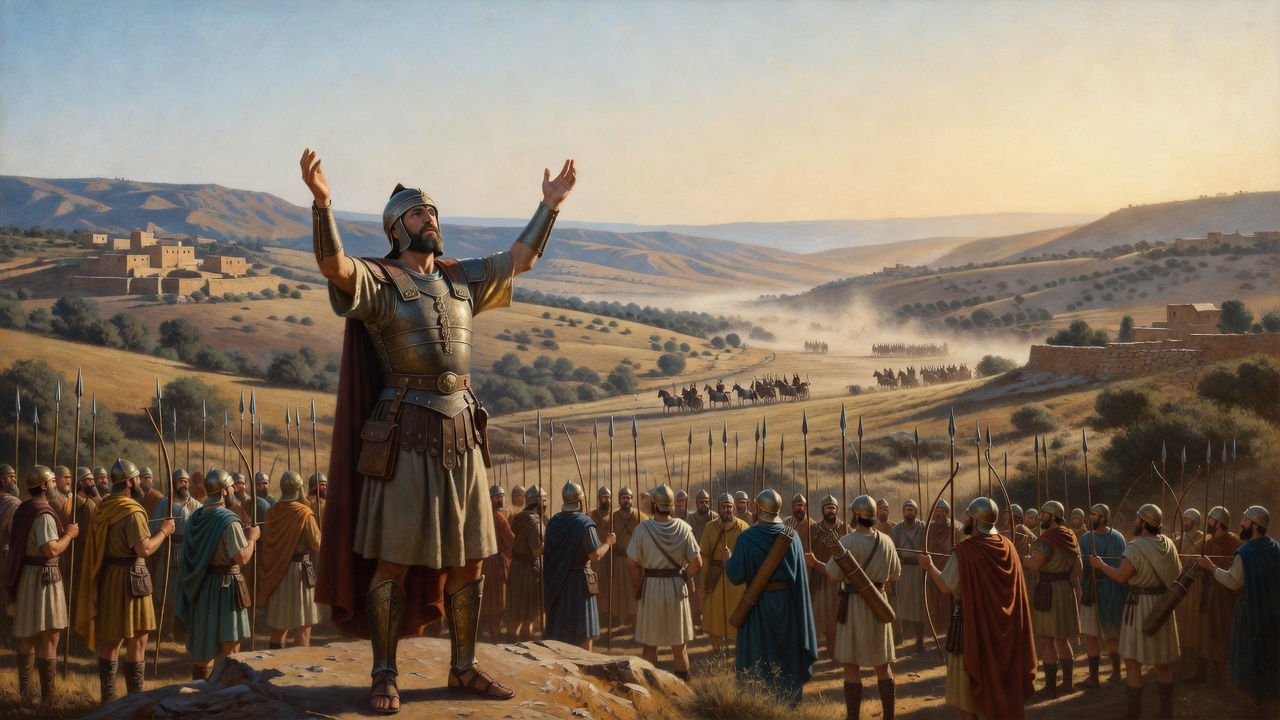
1And Abia died with his fathers, and they buried him in the city of David; and Asa his son reigned in his stead. In the days of Asa the land of Juda had rest ten years. 2And he did that which was good and right in the sight of the Lord his God. 3And he removed the altars of the strange gods, and the high places, and broke the pillars in pieces, and cut down the groves: 4and he told Juda to seek earnestly the Lord God of their fathers, and to perform the law and commandments. 5And he removed from all the cities of Juda the altars and the idols, and established in quietness 6fortified cities in the land of Juda; for the land was quiet, and he had no war in these years; for the Lord gave him rest. 7And he said to Juda, Let us fortify these cities, and make walls, and towers, and gates, and bars: we shall prevail over the land, for as we have sought out the Lord our God, he has sought out us, and has given us rest round about, and prospered us. 8And Asa had a force of armed men bearing shields and spears in the land of Juda, even three hundred thousand, and in the land of Benjamin two hundred and eighty thousand targeteers and archers: all these were mighty warriors. 9And Zare the Ethiopian went out against them, with a force of a million, and three hundred chariots; and came to Maresa. 10And Asa went out to meet him, and set the battle in array in the valley north of Maresa. 11And Asa cried to the Lord his God, and said, O Lord, it is not impossible with you to save by many or by few: strengthen us, O Lord our God; for we trust in you, and in your name have we come against this great multitude. O Lord our God, let not man prevail against you. 12And the Lord struck the Ethiopians before Juda; and the Ethiopians fled. 13And Asa and his people pursued them to Gedor; and the Ethiopians fell, so that they could not recover themselves; for they were crushed before the Lord, and before his host; and they took many spoils. 14And they destroyed their towns roundabout Gedor; for a terror of the Lord was upon them: and they spoiled all their cities, for they had much spoil. 15Also they destroyed the tents of cattle, and the Alimazons, and took many sheep and camels, and returned to Jerusalem.
Você sabia?
As reformas e a vitória de Asa
- Ao suceder seu pai Abias, o rei Asa iniciou amplas reformas religiosas em Judá, removendo altares estrangeiros, altares de incenso, lugares altos, colunas sagradas e postes de Aserá para restabelecer o culto a Deus.Fontes: Asa · o próprio texto bíblico
- O exército de Judá contava com divisões tribais distintas: 300.000 guerreiros de Judá equipados com grandes escudos e lanças, além de 280.000 guerreiros de Benjamim armados com escudos menores e arcos.Fontes: o próprio texto bíblico
- Quando Zerá, o cuxita, invadiu com uma imensa força de um milhão de homens e trezentos carros de guerra, Asa o enfrentou no vale de Zefatá, perto de Maressa, derrotando completamente os invasores e perseguindo-os até Gerar.Fontes: Zerah · Mareshah · Gerar · o próprio texto bíblico
Notas escritas com auxílio de IA a partir de fontes abertas (Theographic Bible Metadata, CC BY-SA 4.0; Easton’s Bible Dictionary, domínio público) e revisadas antes de publicar.
Lugares deste capítulo
- City of David · 31.774, 35.236 · versículo 1
- Mareshah · Hoje: Tel Maresha · 31.593, 34.898 · versículos 9, 10
- Jerusalem · 31.777, 35.234 · versículo 15
Só aparecem lugares com identificação de alta confiança (90% ou mais segundo as fontes acadêmicas reunidas pelo OpenBible). Mapa da época: DARE (Digital Atlas of the Roman Empire), CC BY 4.0; mapa atual: © colaboradores do OpenStreetMap; lugares: OpenBible.info (CC BY 4.0).
Créditos e licença desta tradução
LXX2012: Septuagint in British/International English 2012
The Septuagint with Apocrypha, translated from Greek to English by Sir Lancelot C. L. Brenton and published in 1885, with some language updates (British/International English)
Public Domain
Language: English
Dialect (if applicable): British
Language in English: English
Translation by: Sir Lancelot Charles Lee Breton
LXX2012: Septuagint in English 2012, British/International English Edition
This is a translation of the Old Testament and Apocrypha/Deuterocanon from Hebrew to Greek to 19th Century British English, with some updates of spelling and word usage to contemporary British/International English. The original English translation was done by Sir Lancelot Charles Lee Brenton and published by Samuel Bagster & Sons, Ltd., in London in 1851. It has entered the Public Domain due to the passage of sufficient time. In the process of scanning and typing the text, the original poetry and prose formatting, as well as peripheral material like introductions and notes, have been omitted.
This edition of the Septuagint has some language updates. Brenton's word order and punctuation has been mostly retained, meaning that quotation marks are not used, and sentences within quotes may not start with capital letters, as was standard usage in 1851. Names transliterated from Greek to those transliterated from Hebrew in the common English Bibles often differ. These language updates are dedicated to the Public Domain by the author of those edits, Michael Paul Johnson. Therefore this edition may be freely copied, published, etc.
Before considering making changes to the text of this work, I recommend that you consult with God, because this is really His Book.
If you find errors in the text, please report them so that we can correct them.
Donations to help with the expenses of operating this web site and thus help others have free access to the Word of God may be made to us, but are not required. Please see http://MLJohnson.org/partner/ for more about that.
Títulos de seção adaptados da Berean Standard Bible (domínio público); não fazem parte do texto bíblico desta tradução.
Fonte: http://ebible.org/eng-uk-lxx2012/ · eBible.org