Josué 18
Translation for Translators · Toque num versículo para ver as referências cruzadas.
The rest of the land was allotted
1The Israeli people captured all the land that they were able to, but there were still seven tribes that had not been allotted any land. The Israeli people all gathered at Shiloh, and they set up the Sacred Tent there. 3Joshua said to them, “Why are you waiting a long time to take control of the rest of the land that Yahweh, the God whom your ancestors worshiped, has promised to give to you [RHQ]?
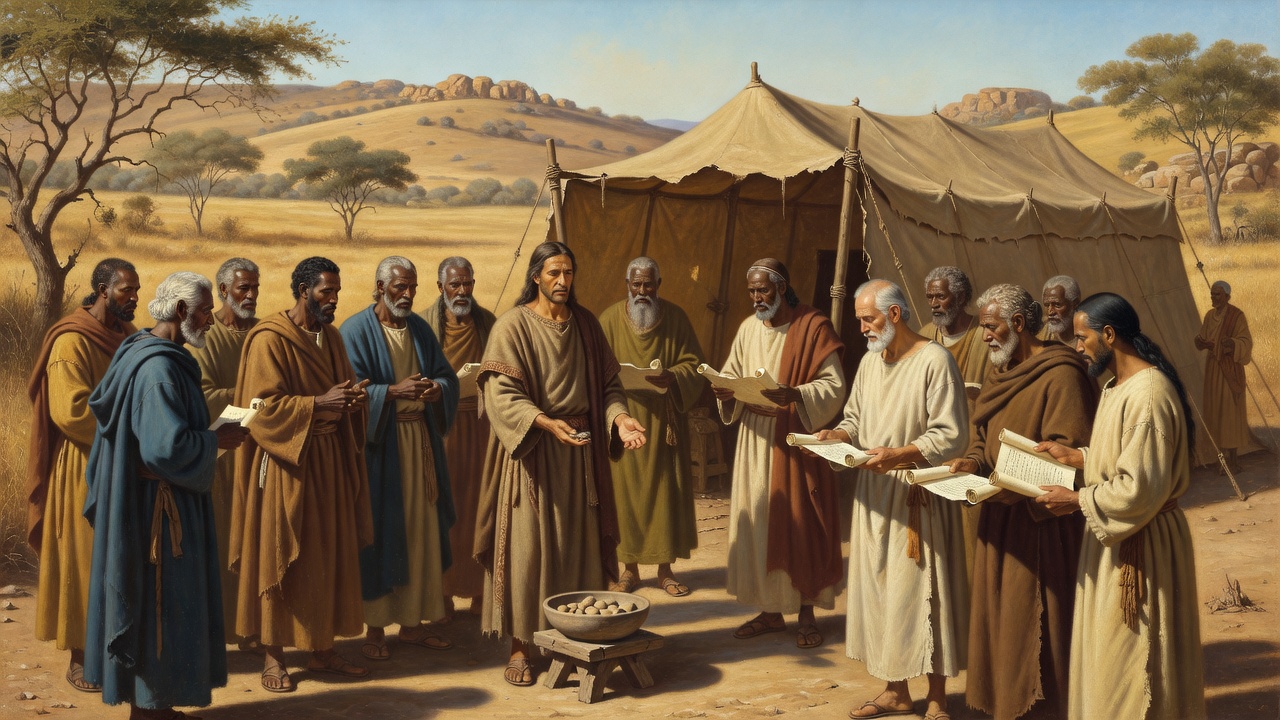
4Choose three men from each of your seven tribes. Then I will send them to explore the parts of the land which you have not occupied yet. When they finish exploring it, they must write a report, in which they will ◄make a map/show the boundaries► of the land that each tribe wants to receive. 5They will divide the remaining land into seven parts. The tribe of Judah will keep its land in the south, and the tribes of Ephraim and Manasseh will keep their land in the north. 6But in their report, the men from the seven tribes should describe the seven parts of the remaining land that they wish to receive, and bring the report to me. While Yahweh is watching, I will ◄cast lots/throw marked stones► to decide which land should be allotted to each tribe. 7But the tribe of Levi will not be allotted any land, because their reward is that they will be Yahweh’s priests. The tribes of Gad, Reuben, and half the tribe of Manasseh have already been allotted their land on the east side of the Jordan River, just as Moses, the man who served God well, decided, so they will not get any more land.”
8When the men who were chosen got ready to leave, Joshua told them, “Go and explore the land. Then write a report of what you have seen, and bring it back to me. Then while Yahweh is watching, I will ◄cast lots/throw marked stones► here at Shiloh, to determine what area each tribe will receive.” 9So the men left and walked through the area. Then they described in a scroll each town that was in the seven parts into which they had divided the land. Then they returned to Joshua, who was still at Shiloh. 10After Joshua read their report, while Yahweh was watching, he ◄cast lots/threw marked stones► to choose which land would be allotted to each of the seven Israeli tribes.
The land for the tribe of Benjamin
11The first tribe that was allotted land was the tribe of Benjamin. Each clan in that tribe was allotted some of the land that was between the area that was allotted to the tribe of Judah and the area that was allotted to the tribes of Ephraim and Manasseh.
12The northern border started at the Jordan River and extended west along the northern side of Jericho, into the hilly area. From there the border extended west to the desert near Beth-Aven town. 13From there it extended southwest to Luz (which is now named Bethel). From there it extended southwest to Ataroth-Addar town, which is on the hill south of Lower Beth-Horon city.
14At the hill south of Beth-Horon, the border turned and extended south to Kiriath-Baal town, which is also named Kiriath-Jearim. That is a town where people of the tribe of Judah live. That was the western border of the land allotted to the tribe of Benjamin.
15The southern border of their land started near Kiriath-Jearim and extended west to Nephtoah Springs. 16From there it extended south to the bottom of the hill, near Ben-Hinnom Valley, on the north side of Repha Valley. The border extended south along the Hinnom Valley, south of the city where the Jebus people-group lived, to En-Rogel. 17From there the border extended west to En-Shemesh, and continued to Geliloth near Adummim Pass. Then it extended to the great stone of Reuben’s son Bohan. 18From there the border extended to the northern edge of Beth-Arabah town and down into the Jordan River Valley. 19From there it extended east to the northern edge of Beth-Hoglah town and ended at the north end of the Dead Sea, where the Jordan River flows into the Dead Sea. That was the southern boundary of the land allotted to the tribe of Benjamin.
20The Jordan River was the eastern boundary of the land allotted to the tribe of Benjamin. Those were the boundaries of the land allotted to them.
21The cities in the land allotted to the tribe of Benjamin were Jericho, Beth-Hoglah, Emek-Keziz, 22Beth-Arabah, Zemaraim, Bethel, 23Avvim, Parah, Ophrah, 24Kephar-Ammoni, Ophni, and Geba. Altogether there were fourteen towns and the surrounding villages.
25The tribe of Benjamin also had the towns of Gibeon, Ramah, Beeroth, 26Mizpah, Kephirah, Mozah, 27Rekem, Irpeel, Taralah, 28Zelah, Haeleph, the city where the Jebus people-group lived (which is now named Jerusalem), Gibeah, and Kiriath. Altogether there were 14 towns and the surrounding villages. All that area was allotted to the clans of the tribe of Benjamin.
Você sabia?
A assembleia em Siló e a herança de Benjamim
- A assembleia de Israel estabeleceu a Tenda do Encontro em Siló, uma cidade em Efraim situada ao norte de Betel. Isso transformou Siló no santuário central e no local para a distribuição das terras restantes entre as tribos.Fontes: o próprio texto bíblico · Shiloh
- Para dividir o território entre as sete tribos restantes, Josué enviou três homens de cada tribo para percorrer a terra e registrar uma descrição detalhada em sete porções. Em seguida, Josué lançou sortes na presença do Senhor em Siló para determinar a porção de cada uma.Fontes: o próprio texto bíblico
- A primeira sorte entre as sete tribos coube a Benjamim, situada entre os territórios de Judá, ao sul, e a casa de José, ao norte. Essa porção abrangia cidades importantes como Jericó, Betel e Jebus (Jerusalém).Fontes: o próprio texto bíblico · Benjamin (patriarch)
Notas escritas com auxílio de IA a partir de fontes abertas (Theographic Bible Metadata, CC BY-SA 4.0; Easton’s Bible Dictionary, domínio público) e revisadas antes de publicar.
Lugares deste capítulo
- Shiloh · Hoje: Khirbet Seilun · 32.056, 35.290 · versículos 1, 8, 9, 10
- Jordan · Hoje: Jordan River · 31.761, 35.558 · versículos 7, 12, 19, 20
- Jericho · Hoje: Tell es Sultan · 31.872, 35.445 · versículos 12, 21
- Lower Beth-horon · Hoje: Beit Ur al Tahta · 31.895, 35.084 · versículo 13
- Luz · Hoje: Beitin · 31.923, 35.241 · versículo 13
- Beth-horon · Hoje: Beit Ur al Tahta · 31.895, 35.084 · versículo 14
- Kiriath-jearim · Hoje: Deir el Azar · 31.809, 35.104 · versículos 14, 15, 28
- Valley of Hinnom · Hoje: Hinnom Valley · 31.769, 35.228 · versículo 16
- Valley of Rephaim · 31.763, 35.219 · versículo 16
- Adummim · 31.817, 35.362 · versículo 17
- Arabah · 30.417, 35.151 · versículo 18
- Salt Sea · Hoje: Dead Sea · 31.500, 35.500 · versículo 19
- Gibeon · Hoje: El Jib · 31.847, 35.183 · versículo 25
- Mizpeh · Hoje: Tell en Nasbeh · 31.885, 35.216 · versículo 26
- Jerusalem · 31.777, 35.234 · versículo 28
Só aparecem lugares com identificação de alta confiança (90% ou mais segundo as fontes acadêmicas reunidas pelo OpenBible). Mapa da época: DARE (Digital Atlas of the Roman Empire), CC BY 4.0; mapa atual: © colaboradores do OpenStreetMap; lugares: OpenBible.info (CC BY 4.0).
Créditos e licença desta tradução
Translation for Translators
A Bible Translation for Bible Translators which makes implied information explicit in the text as an aid to the translator who may need that information to correctly translate into a particular language.
Copyright © 2008-2017 Ellis W. Deibler, Jr.
Language: English
Dialect: American
This translation is made available to you under the terms of the
Creative Commons Attribution Share-Alike license 4.0.
You have permission to share and redistribute this Bible translation in any format and to make reasonable revisions and adaptations of this translation, provided that:
You include the above copyright and source information.
If you make any changes to the text, you must indicate that you did so in a way that makes it clear that the original licensor is not necessarily endorsing your changes.
If you redistribute this text, you must distribute your contributions under the same license as the original.
Pictures included with Scriptures and other documents on this site are licensed just for use with those Scriptures and documents.
For other uses, please contact the respective copyright owners.
Note that in addition to the rules above, revising and adapting God's Word involves a great responsibility to be true to God's Word. See Revelation 22:18-19.
2026-10-02
Fonte: http://ebible.org/eng-t4t/ · eBible.org