Juízes 21
Translation for Translators · Toque num versículo para ver as referências cruzadas.
They found wives for the men of the tribe of Benjamin
1When the Israeli men gathered at Mizpah before the battle started, they vowed, “None of us will ever allow one of our daughters to marry any man from the tribe of Benjamin!” 2But now the Israelis went to Bethel and they cried loudly to Yahweh all day, until the sun went down. 3They kept saying, “Yahweh, God of us Israeli people, it is as though one of the tribes of us Israelis does not exist any more! ◄Why has this happened to us?/It is terrible that this has happened to us!►” [RHQ]
4Early the next morning the people built an altar. Then they completely burned some sacrifices on the altar, and also offered other sacrifices to maintain fellowship with God.
5Then, because they had vowed that anyone who did not meet with them at Mizpah to help fight the men of the tribe of Benjamin would be killed, they asked among themselves, “Were there any of the tribes of Israel who did not come to Mizpah to meet with us in the presence of Yahweh?”
6The Israelis felt sorry for their fellow Israelis from the tribe of Benjamin. They said, “Today one of our Israeli tribes ◄has disappeared/no longer exists►. 7Yahweh heard us solemnly declare that we would not allow any of our daughters to marry any man from the tribe of Benjamin. What can we do to make certain that the men of the tribe of Benjamin who were not killed will have wives?” 8Then one of them asked, “What group from any of the tribes of Israel did not send any men here to Mizpah?” 9They realized that when the soldiers were counted, there was no one from Jabesh-Gilead city who had come there.
10So all the Israelis decided to send 12,000 very good soldiers to Jabesh-Gilead to kill the people there with their swords, even to kill the married women and children. 11They told this to those men: “This is what you must do: You must kill every man in Jabesh-Gilead. You must also kill every married woman. But do not kill the unmarried women.” 12So those soldiers went to Jabesh-Gilead and killed all the men, married women, and children. But they found 400 unmarried young women there. So they brought them to their camp at Shiloh, in Canaan, across the river from the Gilead area that belonged to the tribe of Benjamin.
13Then all the Israelis who had gathered sent a message to the 600 men who were at Rimmon Rock. They said that they would like to make peace with them. 14So the men came back from Rimmon Rock. The Israelis gave to them the women from Jabesh-Gilead whom they had not killed. But there were only 400 women. But there were not enough women for those 600 men.
15The Israelis still felt sorry for the men of the tribe of Benjamin, because Yahweh had ◄decimated/almost wiped out► one of the Israeli tribes. 16The Israeli leaders said, “We have killed all the married women of the tribe of Benjamin. Where can we get women to be wives of the men who are still alive? 17These men must have wives to give birth to children, in order that their families will continue. If that does not happen, all the people of one of the tribes of Israel will die. 18But we cannot allow our daughters to marry these men, because we vowed that Yahweh will curse anyone who gives one of his daughters to become a wife of any man of the tribe of Benjamin.” 19Then one of them ◄had an idea/thought of something that they could do►. He said, “Every year there is a festival to honor Yahweh at Shiloh, which is north of Bethel and east of the road that extends from Bethel to Shechem, and it is south of Lebonah city.”
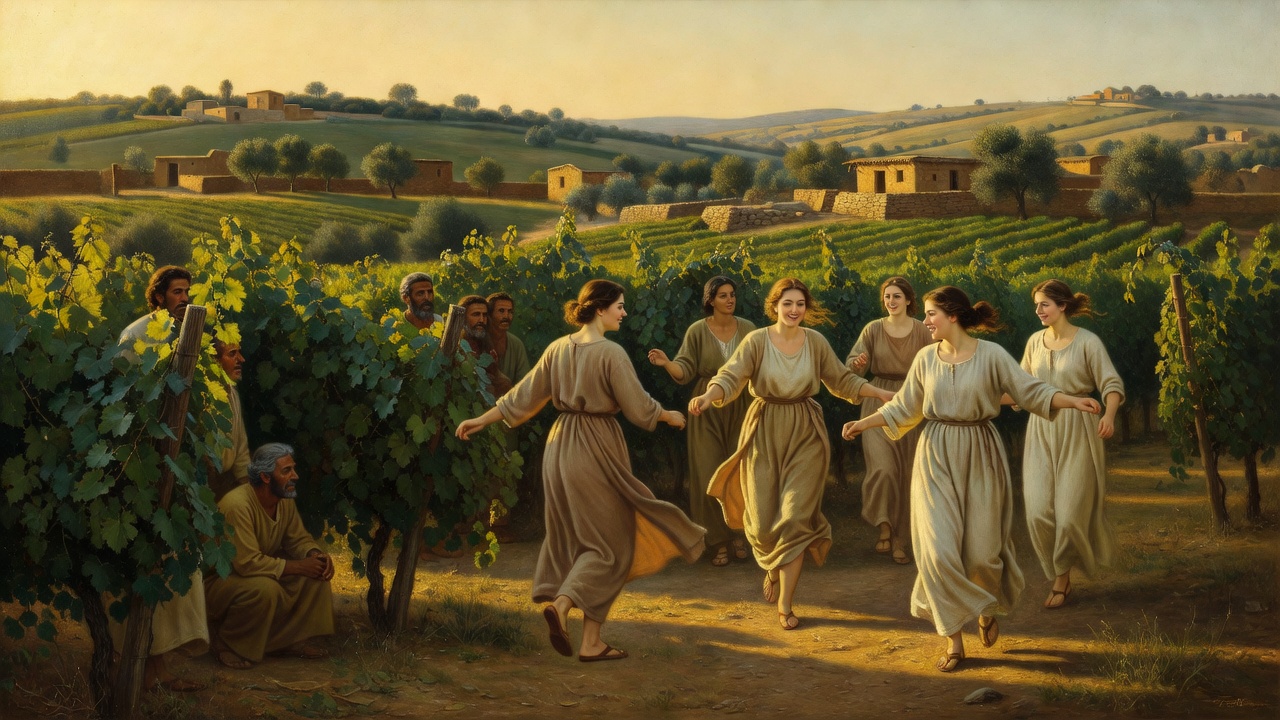
20So the Israeli leaders told the men of the tribe of Benjamin, “ When it is the time for that festival, go to Shiloh and hide in the vineyards. 21Keep watching for the young women to come out of the city to dance. When they come out, all of you should run out of the vineyards. Each of you can seize one of the young women of Shiloh. Then you can all return to your homes with those women. 22If their fathers or brothers come to us and complain about what you have done, we will say to them, ‘Be kind to the men of the tribe of Benjamin. When we fought them, we did not leave any women alive to become their wives, and you did not give those young women to the men from the tribe of Benjamin. They stole them. So you will not be guilty, even though you said that you would not allow any of your daughters to marry one of them.’ ”
23So that is what the men of the tribe of Benjamin did. They went to Shiloh at the time of the festival. And when the young women were dancing, each man caught one of them and took her away and married her. Then they took their wives back to the land that God had given to them. They rebuilt their cities that had been burned down, and they lived there.
24The other Israelis went to their homes in the areas where their tribes and clans lived, the areas that God had allotted to them.
25At that time, the Israeli people did not have a king. Everyone did what they themselves thought was right.
Você sabia?
A preservação da tribo de Benjamim
- A assembleia de Israel havia se reunido em Mispá, um ponto elevado em Benjamim usado para reuniões nacionais, onde juraram não dar suas filhas aos benjamitas nem poupar quem faltasse ao encontro. Diante da quase extinção de Benjamim — reduzida a apenas seiscentos homens na rocha de Rimom —, os líderes buscaram soluções extremas para preservar a tribo sem quebrar formalmente o juramento.Fontes: o próprio texto bíblico · Mizpah · Rimmon
- Para conseguir esposas para os sobreviventes benjamitas, Israel atacou Jabes-Gileade, a leste do Jordão, por não ter comparecido à assembleia, e poupou quatrocentas jovens. Como ainda faltavam mulheres, os anciãos permitiram que os demais benjamitas emboscassem e levassem jovens que dançavam na festa anual ao Senhor em Siló, ao norte de Betel.Fontes: o próprio texto bíblico · Jabesh-gilead · Shiloh · Bethel (of Palestine)
Notas escritas com auxílio de IA a partir de fontes abertas (Theographic Bible Metadata, CC BY-SA 4.0; Easton’s Bible Dictionary, domínio público) e revisadas antes de publicar.
Lugares deste capítulo
- Canaan · 32.767, 35.333 · versículo 12
- Shiloh · Hoje: Khirbet Seilun · 32.056, 35.290 · versículos 12, 19, 21
- Shechem · Hoje: Tell Balatah · 32.214, 35.282 · versículo 19
Só aparecem lugares com identificação de alta confiança (90% ou mais segundo as fontes acadêmicas reunidas pelo OpenBible). Mapa da época: DARE (Digital Atlas of the Roman Empire), CC BY 4.0; mapa atual: © colaboradores do OpenStreetMap; lugares: OpenBible.info (CC BY 4.0).
Créditos e licença desta tradução
Translation for Translators
A Bible Translation for Bible Translators which makes implied information explicit in the text as an aid to the translator who may need that information to correctly translate into a particular language.
Copyright © 2008-2017 Ellis W. Deibler, Jr.
Language: English
Dialect: American
This translation is made available to you under the terms of the
Creative Commons Attribution Share-Alike license 4.0.
You have permission to share and redistribute this Bible translation in any format and to make reasonable revisions and adaptations of this translation, provided that:
You include the above copyright and source information.
If you make any changes to the text, you must indicate that you did so in a way that makes it clear that the original licensor is not necessarily endorsing your changes.
If you redistribute this text, you must distribute your contributions under the same license as the original.
Pictures included with Scriptures and other documents on this site are licensed just for use with those Scriptures and documents.
For other uses, please contact the respective copyright owners.
Note that in addition to the rules above, revising and adapting God's Word involves a great responsibility to be true to God's Word. See Revelation 22:18-19.
2026-10-02
Fonte: http://ebible.org/eng-t4t/ · eBible.org