Isaías 53
Translation for Translators · Toque num versículo para ver as referências cruzadas.
The Suffering Servant
1◄Who will believe what we will tell them about God’s servant?/Hardly anyone will believe what we will tell them about God’s servant.► [RHQ]
◄Who will see what Yahweh does by his great power?/Very few people will see what Yahweh does by his great power.► [MTY, RHQ]
2While God watches, his servant will grow up appearing/seeming to be very insignificant/unimportant,
like a weak young plant that shoots up from a root of a tree that is growing in dry ground.
There will be nothing beautiful or majestic about him,
nothing that would cause us to want to be with him.
3People will despise and reject him. {He will be despised and rejected.}
He will endure much pain, and he will suffer much.
Because his face will be very disfigured, people will not want to look at him;
people will despise him and think that he is not worth paying any attention to.
4But he will be punished for the sicknesses of our souls;
he will endure great pain for us.
But we will think that he is being punished by God,
afflicted/punished for his own sins.
5But his body will be bruised because of the evil things that we did,
wounded because of our sins.
He will be beaten in order that things will go well for our souls;
and because he will be whipped, our souls can be healed.
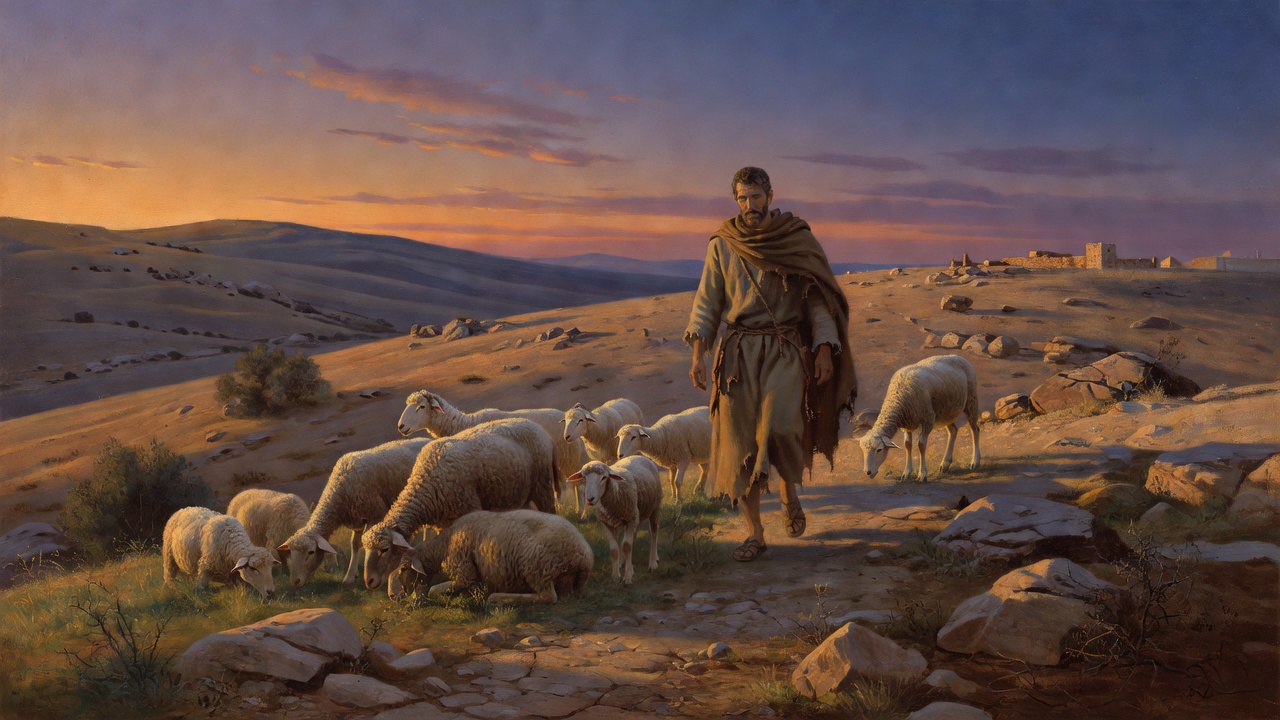
6All of us have gone away from God like [SIM] sheep who have strayed away from their shepherd.
We have turned away from doing the things that God wants in order to do the things that we wanted [MET].
We deserve to be punished, but Yahweh will punish him instead of punishing us for all of our sins.
7He will be abused and caused to suffer,
but he will not say anything to complain.
They will lead him to where they will execute him,
like they lead a lamb to where it will be slaughtered.
And like a sheep does not ◄bleat/make any noise► when the shearer cuts off its wool,
he will not say anything [MTY] to defend himself when he is killed.
8After he is arrested and put on trial,
he will be taken away and executed.
And no one [RHQ] will be able to talk about his descendants,
because he will die [EUP] without being married and having children.
He will be ◄afflicted/caused to suffer► for the wrong things that we have done.
A Grave Assigned
9Although he will never have done any wrong or deceived [MTY] anyone,
people will plan to bury his corpse where wicked people are buried,
but instead, a rich man will bury him after he dies.
10But it will be Yahweh’s will that he be afflicted and caused to suffer.
And when he dies, Yahweh will cause him to be an offering to remove the guilt of sinners.
But later he will have many spiritual children,
and he will live ◄a long time/forever► after he dies and becomes alive again,
and he [MTY] will accomplish everything that Yahweh has planned.
11When he sees all that he will accomplish because of his suffering,
he will be satisfied.
And because of what will have happened to him,
Yahweh’s righteous servant will cause the guilt of many people to be ended,
because he will remove the guilt for their sins.
12So Yahweh will consider him to be one of the truly great people;
he will be like a king who divides up among his soldiers the ◄spoils/things they took from their enemies after defeating them► [MET],
because he will sacrifice himself and die.
Even though people will consider him to be a sinner,
he will remove the guilt of many people,
and he will intercede/pray that those who have done things that are wrong will be forgiven.
Você sabia?
O Servo Sofredor
- O poema retrata uma figura simples, descrita como um renovo que brota de terra seca, que suporta sofrimento, rejeição e aflição sem protestar, comparada a uma ovelha muda diante dos seus tosquiadores.Fontes: o próprio texto bíblico
- O texto apresenta a vida do Servo como uma oferta pela culpa que carrega as transgressões alheias, prometendo que, após sua angústia, ele verá a luz da vida, prolongará seus dias e repartirá despojos com os grandes.Fontes: o próprio texto bíblico
- Tradições cronológicas situam o início do ministério profético de Isaías por volta de 758 a.C., estendendo-se por mais de sessenta anos.Fontes: Prophecies of Isaiah
Notas escritas com auxílio de IA a partir de fontes abertas (Theographic Bible Metadata, CC BY-SA 4.0; Easton’s Bible Dictionary, domínio público) e revisadas antes de publicar.
Créditos e licença desta tradução
Translation for Translators
A Bible Translation for Bible Translators which makes implied information explicit in the text as an aid to the translator who may need that information to correctly translate into a particular language.
Copyright © 2008-2017 Ellis W. Deibler, Jr.
Language: English
Dialect: American
This translation is made available to you under the terms of the
Creative Commons Attribution Share-Alike license 4.0.
You have permission to share and redistribute this Bible translation in any format and to make reasonable revisions and adaptations of this translation, provided that:
You include the above copyright and source information.
If you make any changes to the text, you must indicate that you did so in a way that makes it clear that the original licensor is not necessarily endorsing your changes.
If you redistribute this text, you must distribute your contributions under the same license as the original.
Pictures included with Scriptures and other documents on this site are licensed just for use with those Scriptures and documents.
For other uses, please contact the respective copyright owners.
Note that in addition to the rules above, revising and adapting God's Word involves a great responsibility to be true to God's Word. See Revelation 22:18-19.
2026-10-02
Títulos de seção adaptados da Berean Standard Bible (domínio público); não fazem parte do texto bíblico desta tradução.
Fonte: http://ebible.org/eng-t4t/ · eBible.org