Isaías 36
Translation for Translators · Toque num versículo para ver as referências cruzadas.
The army of Assyria invaded Judah
1When King Hezekiah had been ruling Judah for almost 14 years, King Sennacherib of Assyria came with his army to attack the cities in Judah that had walls around them. They did not conquer Jerusalem, but they conquered all the other cities. 2Then the king of Assyria sent a large army with some of his important officials from Lachish city to persuade King Hezekiah to surrender. When they arrived at Jerusalem, they stood in their positions alongside the aqueduct/channel in which water flows into the upper pool into Jerusalem, near the road to the field where the women wash clothes. 3The Israeli officials who went out of the city to talk with them were Hilkiah’s son Eliakim, the ◄palace administrator/man who supervised the workers in the palace►, Shebna the king’s secretary, and Asaph’s son Joah, who wrote down the government decisions.
4Then one of Sennacherib’s important officials told them to take this message to Hezekiah:
This is what the King of Assyria, the great king, says: “What are you trusting in to rescue you? 5You say that you have weapons to fight us and some country’s promises to help you, and that will enable you to defeat us, but that is only talk [RHQ]. Who do you think will help you to rebel against my soldiers from Assyria? 6Listen to me! You are relying on the army of Egypt. But that will be like [MET] using a broken reed for a walking stick on which you could lean. But it would pierce the hand of anyone who would lean on it! That is what the King of Egypt would be like for anyone who relied on him for help. 7But perhaps you will say to me, ‘ No, we are relying on Yahweh our God to help us.’ I would reply, ‘Is he not the one whom you insulted by tearing down his shrines and altars and forcing everyone in Jerusalem and other places in Judah to worship only in front of the altar in Jerusalem?’
8So I suggest that you make a deal with my master/boss, the king of Assyria. I will give you 2,000 horses, but I do not think that you can find 2,000 of your men who can ride on them! 9You are expecting the king of Egypt to send chariots and men riding horses to assist you. But they certainly would not [RHQ] be able to resist/defeat even the most insignificant/unimportant official in the army of Assyria! 10Furthermore, do not think that [RHQ] we have come here to attack and destroy this land without Yahweh’s orders! It is Yahweh himself who told us to come here and destroy this land!”
11Then Eliakim, Shebna, and Joah said to the official from Assyria, “Please speak to us in your Aramaic language, because we understand it. Do not speak to us in our Hebrew language, because the people who are standing on the wall will understand it and become frightened.”
12But the official replied, “Do you think that my master sent me to say these things only to you, and not to the people standing on the wall [RHQ]? If you reject this message, the people in this city will soon need to eat their own dung and drink their own urine, just like you will, because there will be nothing more for you to eat or drink.”
13Then the official stood up and shouted in the Hebrew language to the people sitting on the wall. He said, “Listen to this message from the great king, the King of Assyria! 14He says, ‘Do not allow Hezekiah to deceive you! He will not be able to rescue you! 15Do not allow him to persuade you to trust in Yahweh, saying that Yahweh will rescue you, and that the army of the King of Assyria will never capture this city!’
16Do not pay attention to what Hezekiah says! This is what the king of Assyria says: ‘Come out of the city and surrender to me. If you do that, I will arrange for each of you to drink the juice from your own grapevines and to eat figs from your own trees, and to drink water from your own well. 17You will be able to do that until we come and take you to a land that is like your land—a land where there is grain to make bread and vineyards to produce grapes for making new wine and, and where we make lots of bread.’
18Do not allow Hezekiah to mislead you by saying, “Yahweh will rescue us.” The gods that people of other nations worship have never [RHQ] rescued any of them from the power [MTY] of the King of Assyria! 19Why were the gods of Hamath and Arpad cities, and the gods of Sepharvaim unable to rescue Samaria from my power [MTY]? 20No, no god [RHQ] of any nation has been able to rescue their people from me. So why do you think that Yahweh will rescue you people of Jerusalem from my power [MTY]?’”
21But the people who were listening were silent. No one said anything, because King Hezekiah had commanded, “ When the official from Assyria talks to you, do not answer him.”
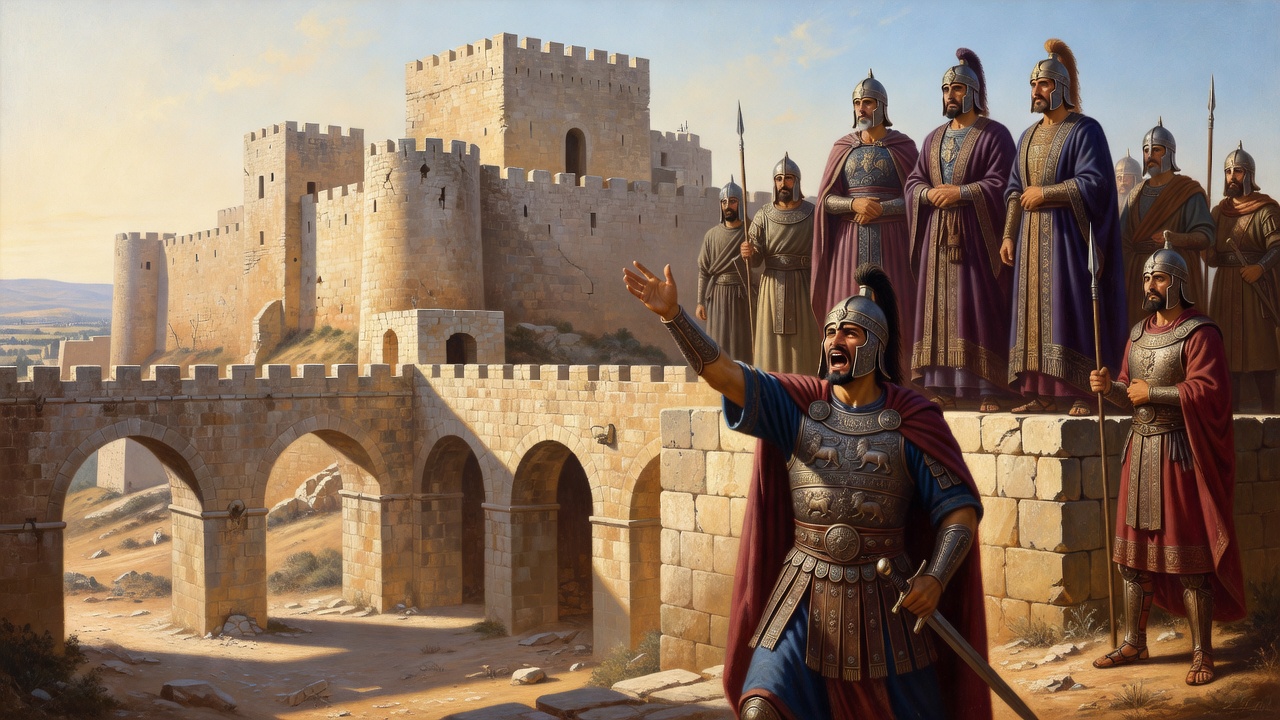
22Then Eliakim and Shebna and Joah returned to Hezekiah with their clothes torn because they were extremely distressed. They told him what the official from Assyria had said.
Você sabia?
A ameaça de Senaqueribe contra Jerusalém
- O termo Rabsaqué não era um nome próprio, mas um título de alto escalão atribuído ao copeiro-chefe ou vizir da corte assíria. Senaqueribe enviou esse oficial de Laquis para Jerusalém com um grande exército para exigir a rendição do rei Ezequias.Fontes: Rabshakeh · Lachish · o próprio texto bíblico
- Os oficiais de Ezequias pediram que o enviado assírio falasse em aramaico, uma língua diplomática incompreensível para o povo comum. Rabsaqué recusou e gritou deliberadamente em hebraico para que os guardas e civis posicionados sobre a muralha ouvissem suas ameaças diretamente.Fontes: Rabshakeh · o próprio texto bíblico
- A delegação judaica enviada ao encontro do emissário assírio incluía Eliaquim, o administrador do palácio, Sebna, o escrivão, e Joá, o cronista. Depois de ouvirem o discurso que desafiava seu Deus e seu rei, eles retornaram a Ezequias em luto, com as vestes rasgadas.Fontes: Eliakim · Shebna · Joah · o próprio texto bíblico
Notas escritas com auxílio de IA a partir de fontes abertas (Theographic Bible Metadata, CC BY-SA 4.0; Easton’s Bible Dictionary, domínio público) e revisadas antes de publicar.
Lugares deste capítulo
- Assyria · 36.359, 43.153 · versículos 1, 2, 4, 8, 13, 15, 16, 18
- Jerusalem · 31.777, 35.234 · versículos 2, 7, 20
- Lachish · Hoje: Tell ed Duweir · 31.565, 34.849 · versículo 2
- Upper Pool · Hoje: in Jerusalem · 31.777, 35.234 · versículo 2
- Egypt · 30.129, 31.308 · versículos 6, 9
- Hamath · Hoje: Hama · 35.136, 36.750 · versículo 19
- Samaria · 32.276, 35.195 · versículo 19
Só aparecem lugares com identificação de alta confiança (90% ou mais segundo as fontes acadêmicas reunidas pelo OpenBible). Mapa da época: DARE (Digital Atlas of the Roman Empire), CC BY 4.0; mapa atual: © colaboradores do OpenStreetMap; lugares: OpenBible.info (CC BY 4.0).
Créditos e licença desta tradução
Translation for Translators
A Bible Translation for Bible Translators which makes implied information explicit in the text as an aid to the translator who may need that information to correctly translate into a particular language.
Copyright © 2008-2017 Ellis W. Deibler, Jr.
Language: English
Dialect: American
This translation is made available to you under the terms of the
Creative Commons Attribution Share-Alike license 4.0.
You have permission to share and redistribute this Bible translation in any format and to make reasonable revisions and adaptations of this translation, provided that:
You include the above copyright and source information.
If you make any changes to the text, you must indicate that you did so in a way that makes it clear that the original licensor is not necessarily endorsing your changes.
If you redistribute this text, you must distribute your contributions under the same license as the original.
Pictures included with Scriptures and other documents on this site are licensed just for use with those Scriptures and documents.
For other uses, please contact the respective copyright owners.
Note that in addition to the rules above, revising and adapting God's Word involves a great responsibility to be true to God's Word. See Revelation 22:18-19.
2026-10-02
Fonte: http://ebible.org/eng-t4t/ · eBible.org