Esdras 10
Translation for Translators · Toque num versículo para ver as referências cruzadas.
The men agreed to divorce their foreign wives
1While I was kneeling down in front of the temple and praying and crying, I was confessing the sins that the Israeli people had committed. Many people, men and women and children, gathered around me and also cried very much. 2Then Shecaniah, the son of Jehiel from the clan of Elam, said this to me: “We have disobeyed God. Some of us have married women who are not Israelis. But we can still confidently expect Yahweh to be merciful to us Israeli people. 3We will do what you, and the others who have an awesome respect for what our God has commanded, tell us to do. We will do what God told us in his laws. We will make an agreement with our God, saying that we will divorce our wives who are not Israelis, and we will send them away with their children. 4◄It is your responsibility to/Because you are our leader, you must► tell us what to do. So get up, and be courageous, and do what is necessary. We will ◄support you/tell people to do what you say►.”
5So I stood up and demanded that the leaders of the priests, the other descendants of Levi, and all the other Israeli people solemnly declare that they would do what Shecaniah said that they should do. So they all solemnly promised to do that. 6Then I went away from the front of the temple and went to the room where Jehohanan lived. I stayed there that night, but I did not eat or drink anything. I was still sad because some of the Israelis who had returned from Babylonia had not faithfully obeyed God’s laws.
7Then we sent a message to all the people in Jerusalem and in other towns in Judah, saying that all those who had returned from Babylonia should come to Jerusalem immediately. 8We said that if any of them did not arrive within three days, the leaders of the people would order that all the property of those people would be taken from them, and that they would no longer be considered to belong to the Israeli people; they would be considered to be foreigners.
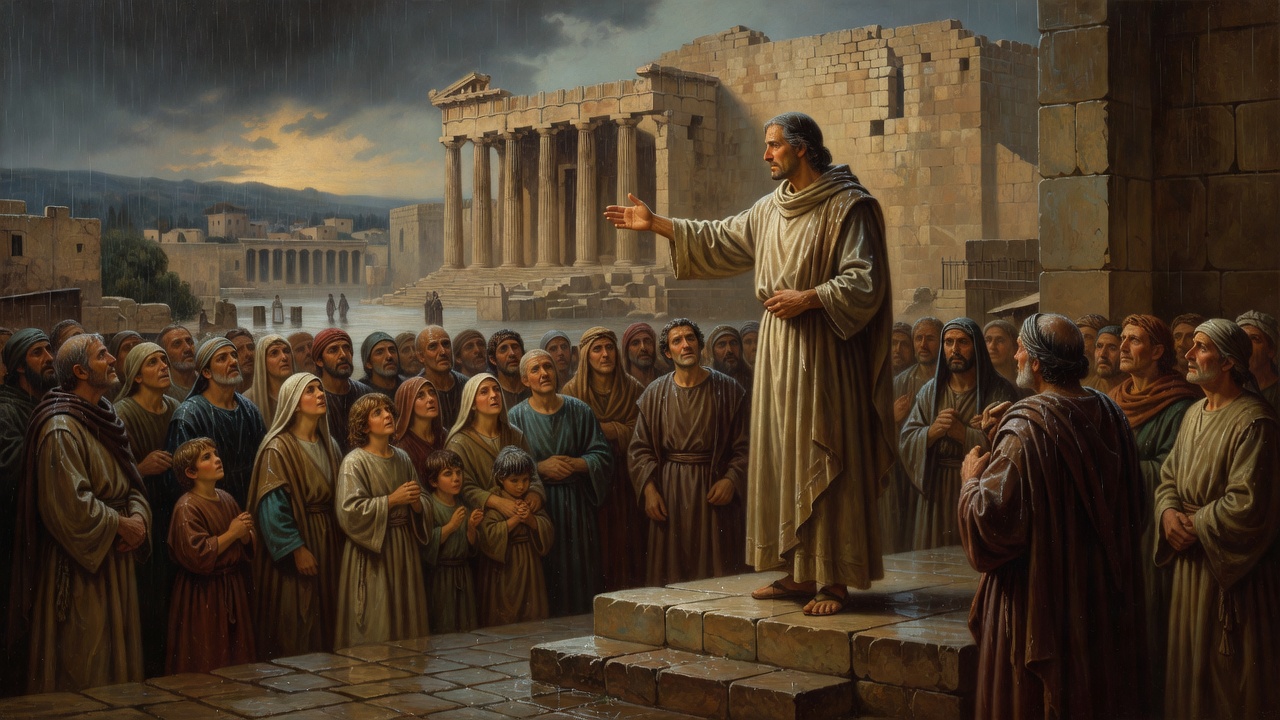
9So within three days, on December 19, all the people of the tribes of Judah and Benjamin gathered in Jerusalem. They were there, sitting in the courtyard in front of the temple. They were trembling because it was raining hard and because they were worried that they would be punished for what they had done. 10Then I stood up and said to them, “ Some of you men have committed a very bad sin. You have married women who are not Israelis. By doing that, you have made us Israeli people more guilty than we were before. 11So now you must confess to Yahweh, the God whom your ancestors worshiped/belonged to, the sin which you have committed, and you must do what he wants. Separate yourselves from the people of other nations and from the women from those nations whom you have married.”
12The whole group answered, shouting loudly, “Yes, what you have said is right! We will do what you have said.” 13But then one of them said, “But we are a very large group, and it is raining hard. Also, there are many of us who have committed this bad sin. This is something that we cannot ◄take care of/handle► in one or two days, and we cannot stand here in this rain. 14So allow our leaders to decide for all of us what we should do. Tell everyone who has married a woman who is not Israeli to come at a time that you decide. They should come with the elders and judges from each city. If we do that, our God will stop being angry with us because of what we have done.”
15Jonathan the son of Asahel, Jahzeiah the son of Tikvah, Meshullam, and Shabbethai, a descendant of Levi, were the only ones who objected to this.
16All the others who had returned from Babylonia said that they would do it. So I chose leaders of each of the clans, and I wrote down their names. On December 29, these men came and sat down to investigate the matter. 17By March 27 of the next year they finished determining which men had married women who were not Israelis.
The men who had married foreign wives
18This is a list of the names of the priests who had married non-Israeli women, and the clans to which they belonged. From the clan of Jeshua and his brothers, who were sons of Jehozadak, there were Maaseiah, Eliezer, Jarib, and Gedaliah. 19They solemnly promised to divorce their wives, and they each sacrificed a ram to be an offering to atone for their sins.
20From the clan of Immer there were Hanani and Zebadiah.
21From the clan of Harim there were Maaseiah, Elijah, Shemaiah, Jehiel, and Uzziah.
22From the clan of Pashhur there were Elioenai, Maaseiah, Ishmael, Nethanel, Jozabad, and Elasah.
23The other descendants of Levi who had married non-Israeli women were Jozabad, Shimei, Kelaiah (whose other name was Kelita), Pethahiah, Judah, and Eliezer.
24There was Eliashib the musician.
From the temple guards there were Shallum, Telem, and Uri.
25This is a list of the names of the other Israelis who had married foreign wives:
From the clan of Parosh there were Ramiah, Izziah, Malchijah, Mijamin, Eleazar, Hashabiah, and Benaiah.
26From the clan of Elam there were Mattaniah, Zechariah, Jehiel, Abdi, Jeremoth, and Elijah.
27From the clan of Zattu there were Elioenai, Eliashib, Mattaniah, Jeremoth, Zabad, and Aziza.
28From the clan of Bebai there were Jehohanan, Hananiah, Zabbai, and Athlai.
29From the clan of Bani there were Meshullam, Malluch,, Adaiah, Jashub, Sheal, and Jeremoth.
30From the clan of Pahath-Moab there were Adna, Kelal, Benaiah, Maaseiah, Mattaniah, Bezalel, Binnui, and Manasseh.
31From the clan of Harim there were Eliezer, Ishijah, Malkijah, Shemaiah, Shimeon, 32Benjamin, Malluch, and Shemariah.
33From the clan of Hashum there were Mattenai, Mattattah, Zabad, Eliphelet, Jeremai, Manasseh, and Shimei.
34From the clan of Bigvai there were Maadai, Amram, Uel, 35Benaiah, Bedeiah, Keluhi, 36Vaniah, Meremoth, Eliashib, 37Mattaniah, Mattenai, and Jaasu.
38From the clan of Binnui there were Shimei,
39Shelemiah, Nathan, Adaiah, 40Macnadebai, Shashai, Sharai, 41Azarel, Shelemiah, Shemariah, 42Shallum, Amariah, and Joseph.
43From the clan of Nebo there were Jeiel, Mattithiah, Zabad, Zebina, Jaddai, Joel, and Benaiah.
44Each of those men had married a woman who was not an Israeli. But immediately they divorced those women and sent them and their children away.
Você sabia?
A assembleia e o juramento de separação
- Para tratar da questão dos casamentos mistos, os líderes emitiram uma proclamação exigindo que todos os exilados em Judá e Benjamim se reunissem em Jerusalém em até três dias, sob pena de confisco de bens e expulsão da comunidade. Ao se reunirem na praça diante da casa de Deus, as pessoas tremiam tanto pela gravidade da situação quanto pela chuva intensa.Fontes: o próprio texto bíblico · Jerusalem
- Como a grande multidão não podia permanecer ao ar livre durante o período de chuvas de inverno, a comunidade organizou um inquérito formal. Esdras e os chefes de família designados examinaram os casos cidade por cidade ao longo de três meses inteiros, do primeiro dia do décimo mês ao primeiro dia do primeiro mês.Fontes: o próprio texto bíblico · Ezra
- O capítulo e o livro se encerram com um registro minucioso de mais de cem homens que haviam tomado mulheres estrangeiras. A lista demonstra que os casamentos mistos atingiram todos os níveis da sociedade pós-exílica, incluindo descendentes da linhagem sacerdotal, levitas, cantores do templo, porteiros e cidadãos comuns.Fontes: o próprio texto bíblico
Notas escritas com auxílio de IA a partir de fontes abertas (Theographic Bible Metadata, CC BY-SA 4.0; Easton’s Bible Dictionary, domínio público) e revisadas antes de publicar.
Lugares deste capítulo
Só aparecem lugares com identificação de alta confiança (90% ou mais segundo as fontes acadêmicas reunidas pelo OpenBible). Mapa da época: DARE (Digital Atlas of the Roman Empire), CC BY 4.0; mapa atual: © colaboradores do OpenStreetMap; lugares: OpenBible.info (CC BY 4.0).
Créditos e licença desta tradução
Translation for Translators
A Bible Translation for Bible Translators which makes implied information explicit in the text as an aid to the translator who may need that information to correctly translate into a particular language.
Copyright © 2008-2017 Ellis W. Deibler, Jr.
Language: English
Dialect: American
This translation is made available to you under the terms of the
Creative Commons Attribution Share-Alike license 4.0.
You have permission to share and redistribute this Bible translation in any format and to make reasonable revisions and adaptations of this translation, provided that:
You include the above copyright and source information.
If you make any changes to the text, you must indicate that you did so in a way that makes it clear that the original licensor is not necessarily endorsing your changes.
If you redistribute this text, you must distribute your contributions under the same license as the original.
Pictures included with Scriptures and other documents on this site are licensed just for use with those Scriptures and documents.
For other uses, please contact the respective copyright owners.
Note that in addition to the rules above, revising and adapting God's Word involves a great responsibility to be true to God's Word. See Revelation 22:18-19.
2026-10-02
Fonte: http://ebible.org/eng-t4t/ · eBible.org