Ezequiel 46
Translation for Translators · Toque num versículo para ver as referências cruzadas.
The Prince’s Offerings
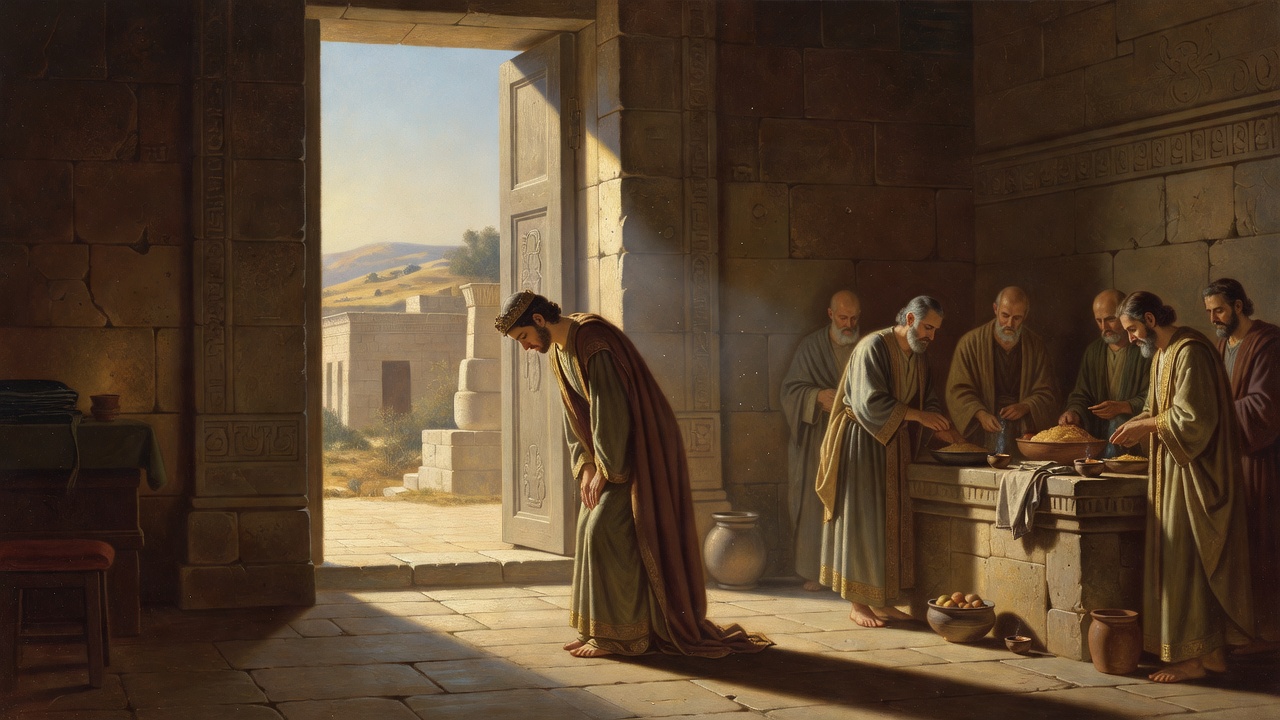
1“ ‘This is also what I, Yahweh the Lord, declare: The east entryway of the inner courtyard must be shut during the six days in which people work each week, but on the Sabbath days and on the days when there is a new moon, that entryway must remain open until that evening. 2The king must enter the courtyard through the entry room of the entryway, and stand alongside the entry post. Then the priests must sacrifice the animal that the king brought to be completely burned on the altar, and also his offering to maintain fellowship with me. The king must worship me at the entrance of the entryway, and then he must go out. After he leaves, the entryway will not be shut until that evening. 3On the Sabbath days and on the days when there is a new moon, the people must worship me at the entrance of the entryway. 4The offering that the king brings to be completely burned on the Sabbath day must be six lambs and one ram, all with no defects. 5The offering that he gives with the ram must be a bushel of grain, and the grain that he offers with the lambs should be as much as he desires to offer, along with ◄1 gallon/3.8 liters► of olive oil for each bushel of grain. 6Then each day that there is a new moon, he must offer a young bull, six lambs and a ram, all with no defects. 7He must also provide one bushel of grain with the bull, one bushel of grain with the ram, and as much grain as he wants with the lambs, along with one quart/liter of olive oil with each bushel of grain. 8When the king enters the temple area, he must enter through the entry room of the entryway, and he must go out through that same entry room when he leaves.
9When the Israeli people come to worship me at the festivals that I have appointed, those who enter the temple area through the north entryway must go out through the south entryway. And those who enter through the south entryway must go out through the north entryway. People must not go out through the entryway through which they entered; they must go out through the opposite entryway. 10The king must go in when the other people go in, and go out when the people go out.
11During the festivals and sacred feasts, the king must present a bushel of grain along with each bull or ram, and as much grain as he wants to bring, along with the lambs and ◄1 gallon/3.8 liters► of olive oil with each bushel of grain. 12When the king gives an offering that is not required, either one to be completely burned on the altar or an offering to maintain fellowship with me, Yahweh, the entryway on the east side of the courtyard must be opened for him. Then he must present those offerings like he does on the Sabbath days. Then he must go out, and after he goes out, the entryway must be shut.
13Every day, during the morning, someone must provide a one-year-old lamb with no defects to be an offering to me that will be completely burned. 14Someone must also provide each morning an offering of flour. It must be one sixth of a bushel of flour mixed with one quart/liter of olive oil. These offerings of flour and olive oil to must be presented to me, Yahweh, each day. 15The lamb and the offering of flour and olive oil must be presented to me every morning, to be completely burned on the altar.
16This is what I, Yahweh the Lord, declare: If the king gives some of his land to one of his sons, to belong to him permanently, it will then belong to his son’s descendants forever. 17However, if he gives some of his land to one of his servants, the servant is allowed to keep that land until the Year of Celebration. Then the king will own it again; the king’s land must belong to his descendants forever. 18The king must not take any land that the people own and force them to live somewhere else. The land that he gives to his sons must be from his own property, not from anyone else’s property, in order that none of my people will be forced to leave his own property.’ ”
The Courts for Boiling and Baking
19Then, in the vision, the man who was showing the temple area to me brought me through the entrance alongside the entryway and led me to the sacred rooms on the north side, the rooms that the priests used, and he showed me a place at the western end of those rooms. 20He said to me, “This is the place where the priests must cook the meat of the offerings that people bring in order to no longer be guilty for having sinned, and offerings for their sins, and where they will bake bread made with the flour brought to be offerings. They will cook those things in their rooms in order to avoid bringing them into the outer courtyard to cook them there, lest someone be punished because of touching them.”
21Then the man brought me to the outer courtyard and led me to its four corners. In each corner I saw an enclosed area; 22each of those areas was ◄70 feet/21.2 meters► long and ◄52-1/2 feet/15.9 meters► wide. 23Around the inside of each of those enclosed areas was a stone ledge, with places to make fires all around under each ledge. 24The man said to me, “These are the kitchens where the descendants of Levi who work in the temple must cook the sacrifices that the people bring.”
Você sabia?
Adoração, Deveres Reais e Cozinhas do Templo
- A porta oriental do átrio interior permanecia fechada durante os seis dias de trabalho, sendo aberta apenas no sábado e no dia da lua nova. O príncipe devia permanecer junto ao batente da porta e adorar no limiar enquanto os sacerdotes ofereciam os seus sacrifícios, e a porta ficava aberta até a tarde.Fontes: o próprio texto bíblico
- Durante as festas fixas, os adoradores que entravam pela porta norte deviam sair pela porta sul, e os que entravam pelo sul deviam sair pelo norte. Além disso, as leis de propriedade proibiam expressamente que o príncipe tomasse as terras do povo, devendo dar herança a seus filhos apenas de seus próprios bens.Fontes: o próprio texto bíblico
- A visão detalha áreas de cozinha distintas no templo: câmaras especiais a oeste para os sacerdotes cozinharem as ofertas pelo pecado e pela culpa, e quatro átrios menores nos cantos do pátio externo, onde os ministros do templo preparavam os sacrifícios oferecidos pelo povo.Fontes: o próprio texto bíblico
Notas escritas com auxílio de IA a partir de fontes abertas (Theographic Bible Metadata, CC BY-SA 4.0; Easton’s Bible Dictionary, domínio público) e revisadas antes de publicar.
Créditos e licença desta tradução
Translation for Translators
A Bible Translation for Bible Translators which makes implied information explicit in the text as an aid to the translator who may need that information to correctly translate into a particular language.
Copyright © 2008-2017 Ellis W. Deibler, Jr.
Language: English
Dialect: American
This translation is made available to you under the terms of the
Creative Commons Attribution Share-Alike license 4.0.
You have permission to share and redistribute this Bible translation in any format and to make reasonable revisions and adaptations of this translation, provided that:
You include the above copyright and source information.
If you make any changes to the text, you must indicate that you did so in a way that makes it clear that the original licensor is not necessarily endorsing your changes.
If you redistribute this text, you must distribute your contributions under the same license as the original.
Pictures included with Scriptures and other documents on this site are licensed just for use with those Scriptures and documents.
For other uses, please contact the respective copyright owners.
Note that in addition to the rules above, revising and adapting God's Word involves a great responsibility to be true to God's Word. See Revelation 22:18-19.
2026-10-02
Títulos de seção adaptados da Berean Standard Bible (domínio público); não fazem parte do texto bíblico desta tradução.
Fonte: http://ebible.org/eng-t4t/ · eBible.org