Ezequiel 27
Translation for Translators · Toque num versículo para ver as referências cruzadas.
The trade with Tyre
1Yahweh said this to me: 2“You human, sing a funeral song about Tyre. 3The city of Tyre is located on an island at the edge of the sea, and their merchants ◄traded/bought and sold goods► with people-groups who live along many seacoasts. This is what I, Yahweh the Lord, say that you should tell them:
‘You people of Tyre said that your city was very beautiful.
4You controlled what was bought and sold by people who lived along the sea.
Those who built your city caused it to become very beautiful.
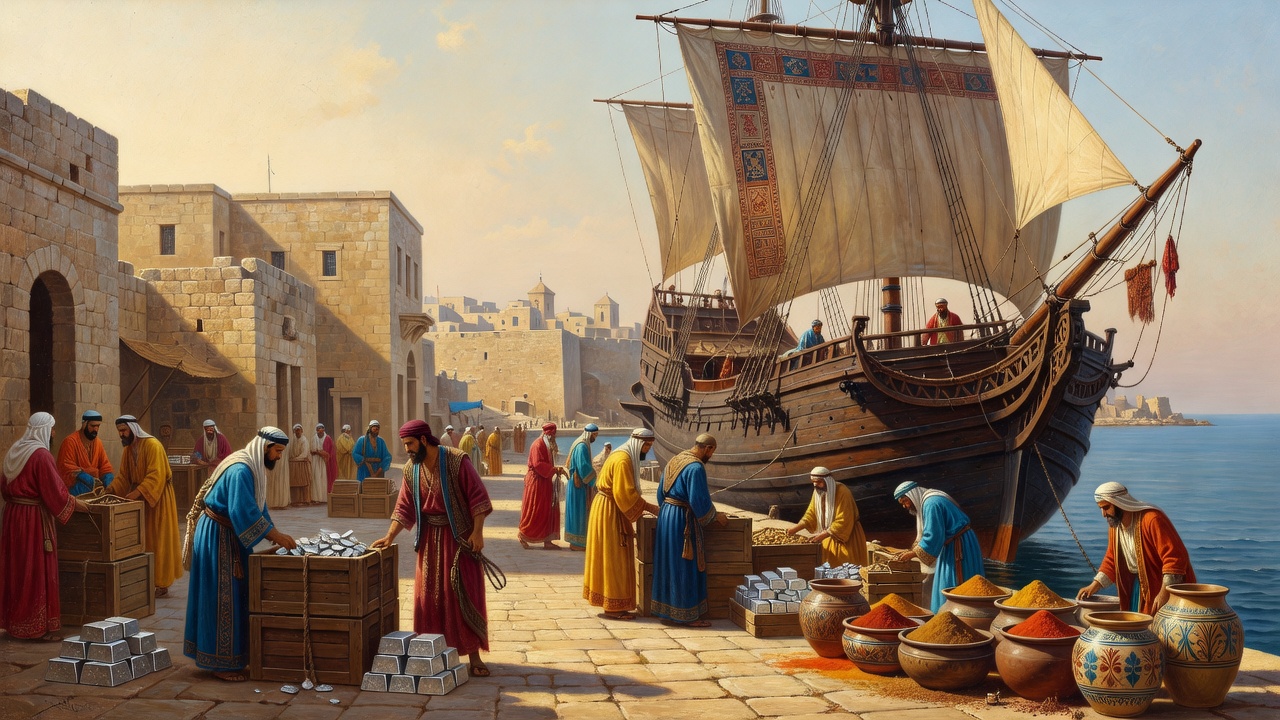
5You were like [SIM] a huge ship
that was built from the from pine/cypress trees on Hermon Mountain.
Then they took cedar wood from Lebanon to make a mast for the ship.
6They carved your oars from oak trees from the Bashan region.
They made the deck from cypress/pine wood from Cyprus island,
and they covered the decks with ivory.
7The sails for the ship were made from fine embroidered linen from Egypt,
and those sails were like flags that people could see far away.
For shade they hung pieces of blue and purple cloth
brought from people living on Cyprus island.
8Men from Sidon and Arvad cities pulled the oars;
the men who steered the boat were skilled men from Tyre.
9Experienced craftsmen from Byblos city on the coast ◄did the caulking/filled the spaces between the planks in the sides► of the ship.
Sailors from many countries came in their ships to buy and sell goods there.
10Men from as far away as Persia, Lydia, and Libya were soldiers in your army.
They hung their shields and helmets on the walls of your city,
and that caused people to admire your city.
11Men from Arvad and Helech cities were watchmen on the walls of your city;
men from Gammad town were in your towers.
They also hung their shields on your walls;
they also caused your city to be very beautiful.
12Because of the many things that you had to trade, men from Tarshish in Spain sent merchants who brought silver, iron, tin, and lead to trade for things that you had.
13Merchants from Greece, Tubal, and Meshech brought slaves and things made from bronze to trade for things that you had.
14Men from Beth-Togarmah in Armenia brought work horses, war horses, and mules to trade for things that you had.
15Merchants came to you from Rhodes island.
People from nations along the coast traded with you; they brought ◄ivory/elephant tusks► and valuable black ebony wood to trade for things that you had.
16Because you had very many things to trade, people from Syria brought to you valuable turquoise stones, purple cloth, embroidered cloth, fine linen cloth, and jewelry made from coral and rubies to trade for your things.
17Men from Judah and Israel brought wheat from Minnith city in Ammon, and figs, honey, olive oil, and ointment to trade for your things.
18Because you had very many things to trade, men from Damascus brought wine from Helbon town and white wool from the Zahar area to trade for many things that you had.
19Greek men from the Uzal area brought things made of iron, and cassia spice, and fragrant calamus seeds to trade for things that you had.
20Merchants came from Dedan in southern Edom bringing saddle blankets to trade for things that you had.
21Men from Arabia and all the rulers of the Kedar region sent merchants to trade lambs and rams and male goats for things that you had.
22Merchants from Sheba and Raamah in Arabia brought many kinds of very good spices and jewels and gold to exchange for things that you had.
23Men came from Haran, Canneh, Eden, Sheba, Asshur and Kilmad in Mesopotamia with their goods. 24They brought pretty things to trade: Blue cloth, embroidered cloth, and rugs of many colors that were rolled up and tied with ropes.
25Cargo ships from Tarshish carried all those things that you traded;
and the warehouses on your island were full of all those things.’ ”
The destruction of Tyre
26“ ‘The men who row your boats took the ships full of cargo out on the stormy seas.
But the strong east wind wrecked those cargo boats.
27Everything in the boats ◄was lost/sank to the bottom of the sea►—
all the valuable cargo [DOU] and many of [HYP] the sailors and ship pilots,
the ship workers and merchants and soldiers.
On the day that the ships were wrecked,
many of those on the ships sank to the bottom of the sea.
28The people in cities along the coast trembled
when they heard your ship pilots cry out.
29All the men who remained who pulled the oars left the ships;
the sailors and pilots go to the shore and stand on the beach.
30They cry aloud because of what has happened to your wealth,
and they weep bitterly.
They throw dirt on their heads
and roll around in ashes.
31They shave their heads to show that they are very sad because of what has happened to you,
and they put on rough sackcloth.
They weep for you very bitterly
and mourn for you.
32While they wail and mourn because of what has happened to you,
they sing this sad funeral song:
“There was certainly never [RHQ] a city like Tyre
that now is silent,
covered by the waves of the sea.”
33The goods that your merchants traded
were things that pleased the people of many countries.
Kings in very distant places became rich
from the wealth that they obtained from trading with you.
34But now your city is like a ship [MET] that is wrecked in the sea,
and everything that was in it is broken, at the bottom of the sea.
All of your cargo and your sailors have sunk to the bottom of the sea along with the ships.
35All the people who live along the seacoast are appalled/horrified
because of what has happened to you.
Their kings are very horrified,
causing their faces to be twisted as they watch.
36The merchants of the other nations shake their heads
because it is difficult for them to believe what has happened;
your city has disappeared,
and it will not exist any more.’ ”
Você sabia?
O lamento e o comércio de Tiro
- Neste lamento, o profeta retrata a cidade marítima fenícia de Tiro como um magnífico navio mercante. Sua estrutura é descrita como construída com madeiras de cedro do Líbano, cipreste e carvalho de Basã, equipada com velas de linho egípcio e tripulada por marinheiros e artífices de cidades costeiras como Sídon, Arvade e Gebal.Fontes: o próprio texto bíblico · Tyre · Lebanon · Arvad
- O capítulo oferece um catálogo detalhado do comércio no antigo Mediterrâneo e no Oriente Próximo. As conexões comerciais de Tiro iam desde Társis, no ocidente, para metais como prata e estanho, até Javã (Grécia), as tribos nômades de Quedar para rebanhos, e os mercadores de Sabá, no sul da Arábia, para ouro, pedras preciosas e especiarias finas.Fontes: o próprio texto bíblico · Tarshish · Javan · Sheba
Notas escritas com auxílio de IA a partir de fontes abertas (Theographic Bible Metadata, CC BY-SA 4.0; Easton’s Bible Dictionary, domínio público) e revisadas antes de publicar.
Lugares deste capítulo
- Tyre · 33.271, 35.196 · versículos 2, 3, 8, 32
- Lebanon · 33.540, 35.584 · versículo 5
- Senir · Hoje: Mount Hermon · 33.400, 35.850 · versículo 5
- Bashan · 32.781, 35.935 · versículo 6
- Cyprus · 35.000, 33.000 · versículo 6
- Egypt · 30.129, 31.308 · versículo 7
- Sidon · Hoje: Sandikli archaeological site in Sidon · 33.561, 35.372 · versículo 8
- Gebal · Hoje: Byblos · 34.119, 35.646 · versículo 9
- Lud · Hoje: Lydia · 38.488, 28.040 · versículo 10
- Persia · 34.806, 48.516 · versículo 10
- Javan · Hoje: Ionia · 38.200, 27.500 · versículo 13
- Meshech · Hoje: about 200 km around Gordion · 39.655, 31.994 · versículo 13
- Tubal · Hoje: Tabal · 37.296, 36.254 · versículo 13
- Syria · Hoje: Aram · 33.511, 36.306 · versículo 16
- Damascus · 33.511, 36.306 · versículo 18
- Dan · Hoje: Tel Dan · 33.249, 35.652 · versículo 19
- Arabia · Hoje: Arabian Peninsula · 23.000, 46.000 · versículo 21
- Kedar · 29.811, 39.868 · versículo 21
- Sheba · 15.348, 44.206 · versículos 22, 23
- Asshur · Hoje: Assur · 35.457, 43.263 · versículo 23
- Eden · Hoje: Beth-eden · 36.701, 38.087 · versículo 23
- Haran · Hoje: Harran · 36.864, 39.033 · versículo 23
Só aparecem lugares com identificação de alta confiança (90% ou mais segundo as fontes acadêmicas reunidas pelo OpenBible). Mapa da época: DARE (Digital Atlas of the Roman Empire), CC BY 4.0; mapa atual: © colaboradores do OpenStreetMap; lugares: OpenBible.info (CC BY 4.0).
Créditos e licença desta tradução
Translation for Translators
A Bible Translation for Bible Translators which makes implied information explicit in the text as an aid to the translator who may need that information to correctly translate into a particular language.
Copyright © 2008-2017 Ellis W. Deibler, Jr.
Language: English
Dialect: American
This translation is made available to you under the terms of the
Creative Commons Attribution Share-Alike license 4.0.
You have permission to share and redistribute this Bible translation in any format and to make reasonable revisions and adaptations of this translation, provided that:
You include the above copyright and source information.
If you make any changes to the text, you must indicate that you did so in a way that makes it clear that the original licensor is not necessarily endorsing your changes.
If you redistribute this text, you must distribute your contributions under the same license as the original.
Pictures included with Scriptures and other documents on this site are licensed just for use with those Scriptures and documents.
For other uses, please contact the respective copyright owners.
Note that in addition to the rules above, revising and adapting God's Word involves a great responsibility to be true to God's Word. See Revelation 22:18-19.
2026-10-02
Fonte: http://ebible.org/eng-t4t/ · eBible.org