Deuteronômio 24
Translation for Translators · Toque num versículo para ver as referências cruzadas.
Laws about divorcing and remarrying
1“Suppose a man marries a woman and later decides that he does not want her because there is something about her that he doesn’t like. And suppose he writes on paper that he is divorcing her, and he gives the paper to her [SYN] and sends her away from his house. 2Then suppose that she goes and marries another man, 3and that man later also decides that he does not like her, and he also writes on paper that he is divorcing her, and he sends her away from his house. Or, suppose that the second husband dies. 4If either of those things happens, her first husband must not marry her again. He must consider that she has become unacceptable to Yahweh. Yahweh would consider it to be disgusting if he married her again. You must not sin [MTY] by doing that in the land that Yahweh our God is giving to you.”
Various laws
5“When some man has recently become married, he must not be required to become a soldier in the army or be required to do any other work for the government for one year after being married. He should stay happily at home with his wife for that year.
6“Anyone who lends money to someone else is allowed to require that person to give him something to guarantee that he will pay back the money that he borrowed. But he must not take from him his ◄millstone/stone for grinding grain►. That would be taking the millstone that his family needs to grind the grain to make the bread they need to stay alive.
7“If someone kidnaps/steals a fellow Israeli to cause that person to become his slave or to sell him to become someone else’s slave, you must execute the person who did that. By doing that, you will get rid of this evil among you.
8“If you are suffering from ◄leprosy/a dreaded skin disease►, be sure to do everything that the priests, who are from the tribe of Levi, tell you to do. Obey carefully the instructions that I have given to them. 9Do not forget what Yahweh our God did to Miriam, when she became a leper, after your ancestors left Egypt.
10“When you lend something to someone, do not go into his house to take the cloak that he says that he will give you to guarantee that he will return what he has borrowed. 11Stand outside his house, and the man to whom you are lending something will bring the cloak out to you. 12But if he is poor, do not keep that cloak all night. 13When the sun sets, take the cloak back to him, in order that he may wear it while he sleeps. If you do that, he will ask God to bless you, and Yahweh our God will be pleased with you.
14“Do not mistreat any servants whom you have hired who are poor and needy [DOU], whether they are Israelis or foreigners who are living in your town. 15Every day, before sunset, you must pay/give them the money that they have earned. They are poor and they need to get their pay. If you do not pay them right away, they will cry out against you to Yahweh, and he will punish [MTY] you for having sinned like that.
16“Parents must not be executed for crimes that their children have committed, and children must not be executed for crimes that their parents have committed. People should be executed only for the crimes that they themselves have committed.
17“You must [LIT] do for foreigners who live among you and for orphans what the laws state must be done for them. And if you lend something to a widow, do not take her coat from her as a guarantee that she will return it. 18Do not forget that you had great hardships/troubles when you were slaves in Egypt, and Yahweh our God rescued you from there. That is why I am commanding you to help others who have troubles.
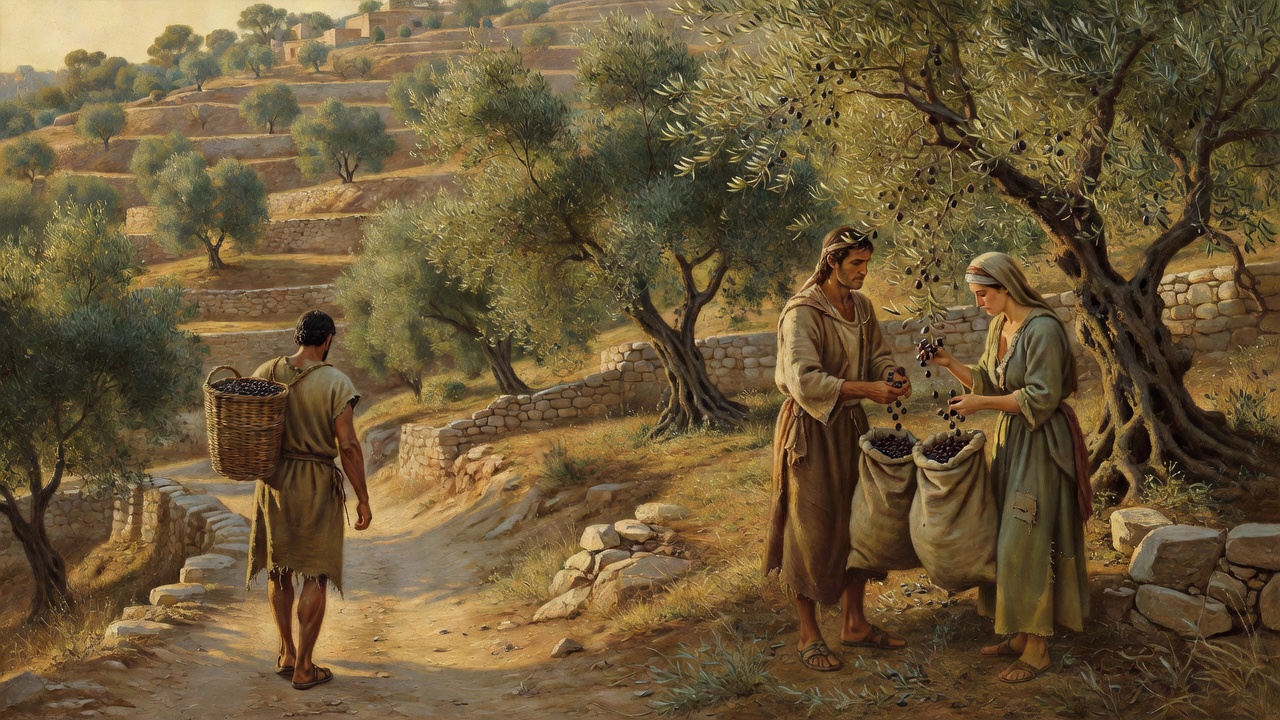
19“When you harvest your crops, if you have forgotten that you left one bundle in the field, do not go back to get it. Leave it there for foreigners, orphans, and widows. If you do that, Yahweh will bless you in everything that you do. 20And when you have harvested/picked all your olives from the trees once, do not go back to pick the ones that are still on the trees. 21Similarly, when you pick the grapes in your vineyard, do not go back a second time to try to find more. Leave them for the foreigners, orphans, and widows among you. 22Do not forget that Yahweh was kind to you when you were slaves in Egypt. That is why I am commanding you to be kind to those who are needy.”
Você sabia?
Leis de Compaixão, Justiça e Proteção Social
- As leis de colheita israelitas exigiam que os proprietários deixassem feixes esquecidos de cereais, azeitonas restantes e respigos de uvas para os grupos vulneráveis: o estrangeiro residente, o órfão e a viúva. Esse sistema de assistência apoiava-se na memória coletiva de que os israelitas haviam sido escravos no Egito.Fontes: o próprio texto bíblico · Egypt
- Devedores e trabalhadores assalariados contavam com limites legais explícitos. Os credores eram proibidos de entrar na casa de um devedor para tomar penhores, de reter mós indispensáveis ao sustento diário ou de guardar a capa de dormir de uma pessoa pobre após o pôr do sol, além de deverem pagar os diaristas antes do anoitecer.Fontes: o próprio texto bíblico
- Ao dar instruções sobre doenças infecciosas da pele e as orientações dos sacerdotes levíticos, o texto relembra a aflição que atingiu Miriã, irmã de Moisés e Arão, durante a caminhada pelo deserto após a saída do Egito.Fontes: o próprio texto bíblico · Miriam · Egypt
Notas escritas com auxílio de IA a partir de fontes abertas (Theographic Bible Metadata, CC BY-SA 4.0; Easton’s Bible Dictionary, domínio público) e revisadas antes de publicar.
Lugares deste capítulo
Só aparecem lugares com identificação de alta confiança (90% ou mais segundo as fontes acadêmicas reunidas pelo OpenBible). Mapa da época: DARE (Digital Atlas of the Roman Empire), CC BY 4.0; mapa atual: © colaboradores do OpenStreetMap; lugares: OpenBible.info (CC BY 4.0).
Créditos e licença desta tradução
Translation for Translators
A Bible Translation for Bible Translators which makes implied information explicit in the text as an aid to the translator who may need that information to correctly translate into a particular language.
Copyright © 2008-2017 Ellis W. Deibler, Jr.
Language: English
Dialect: American
This translation is made available to you under the terms of the
Creative Commons Attribution Share-Alike license 4.0.
You have permission to share and redistribute this Bible translation in any format and to make reasonable revisions and adaptations of this translation, provided that:
You include the above copyright and source information.
If you make any changes to the text, you must indicate that you did so in a way that makes it clear that the original licensor is not necessarily endorsing your changes.
If you redistribute this text, you must distribute your contributions under the same license as the original.
Pictures included with Scriptures and other documents on this site are licensed just for use with those Scriptures and documents.
For other uses, please contact the respective copyright owners.
Note that in addition to the rules above, revising and adapting God's Word involves a great responsibility to be true to God's Word. See Revelation 22:18-19.
2026-10-02
Fonte: http://ebible.org/eng-t4t/ · eBible.org