1 Reis 15
Translation for Translators · Toque num versículo para ver as referências cruzadas.
King Abijah of Judah
1After Jeroboam had been the king of Israel for almost 18 years, Abijah became the king of Judah. 2He ruled for three years in Jerusalem. His mother’s name was Maacah, the granddaughter of David’s son Absalom.
3Abijah committed the same kind of sins that his father had committed. He was not fully dedicated/committed to Yahweh his God, as his grandfather David had been. 4But, because of what Yahweh his God had promised to David, Yahweh gave Abijah a son [MET] to rule in Jerusalem after him, and in order to protect Jerusalem from their enemies. 5Yahweh did that because David had always done what pleased Yahweh and because David had always obeyed Yahweh. The only time when he disobeyed Yahweh was when he caused Uriah to be killed.
6There were wars between the armies of Rehoboam and Jeroboam all during the time that Abijah ruled. 7Everything else that Abijah did is written [RHQ] in the scroll called ‘The History of the Kings of Judah’. 8Abijah died [EUP] and was buried in the part of Jerusalem called ‘The City of David’, and his son Asa became king.
King Asa of Judah
9After Jeroboam had been the king of Israel for almost 20 years, Asa started to rule Judah. 10He ruled in Jerusalem for 41 years. His grandmother was Maacah, the granddaughter of Absalom.
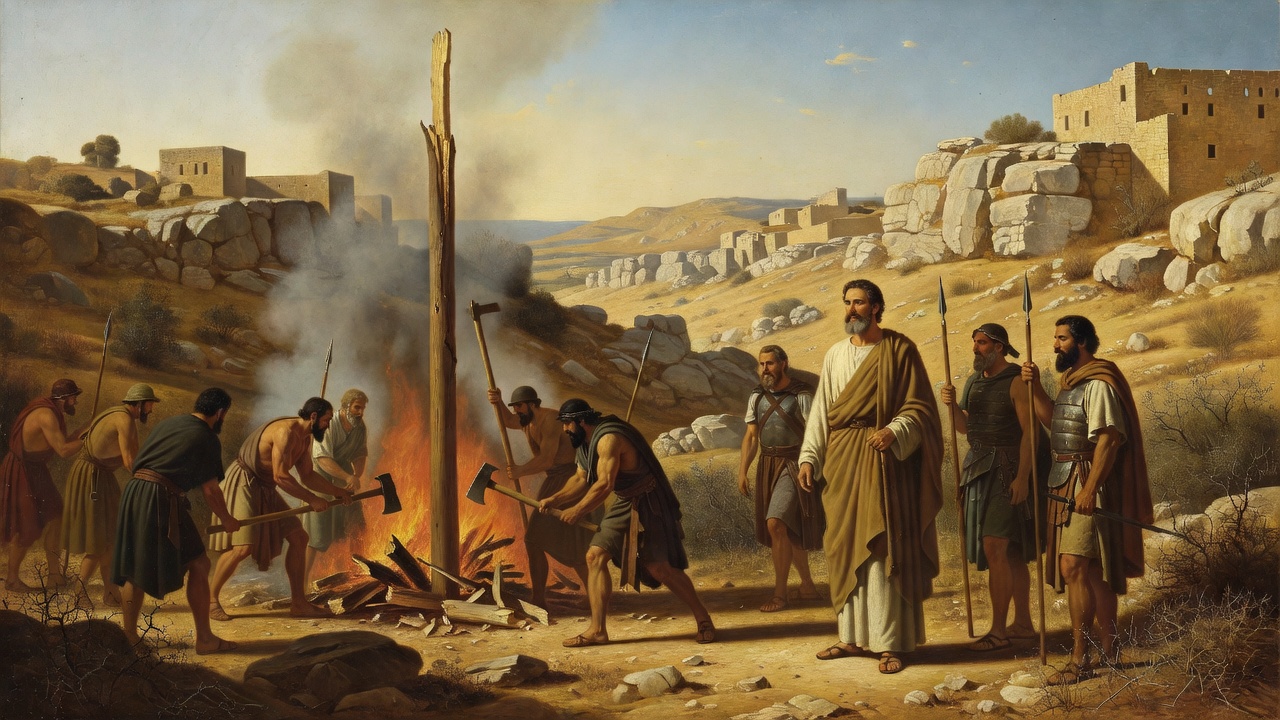
11Asa did what was pleasing to Yahweh, as his ancestor David had done. 12He got rid of the male prostitutes that were at the places where the people worshiped idols, and he also got rid of all the idols that his ancestors had made. 13He also removed his grandmother Maacah so that she no longer had influence in the government because of being the mother of a previous king. He did that because she had made a disgusting wooden statue of the goddess Asherah. Asa told his workers to cut down the statue and burned it in the Kidron Valley. 14He was not able to destroy all the places where the people worshiped idols on the high hills, but he continued to be dedicated/committed to Yahweh his entIre life. 15He told his workers to place in the temple all the items that his father had dedicated to God, and all the gold and silver things that he had dedicated to God.
16There were wars between the armies of Asa and Baasha, the king of Israel, all during the time that they ruled. 17Baasha’s army invaded Judah. They captured Ramah town north of Jerusalem. Then they started to build a wall around it in order to prevent people from entering or leaving the area in Judah that was ruled by King Asa.
18So Asa told his workers to take all the silver and gold that was still in the storerooms in the temple and in the palace. He told them to take it to Damascus and give it to King Ben-Hadad who ruled Syria. Ben-Hadad was the son of Tabrimmon and grandson of Hezion. He told the workers to say this to Ben-Hadad: 19“I want there to be a peace treaty between you and me, like there was between your father and my father. For that reason, I am giving you this silver and gold. So now please cancel the treaty that you made with Baasha, the king of Israel, in order that he will take his soldiers away from attacking mine, because he will be afraid of your army.” 20So the workers went and gave the message to Ben-Hadad, and he did what Asa suggested. He sent his army commanders and their soldiers to attack some of the towns in Israel. They captured Ijon, Dan, Abel-Beth-Maacah, the area near Galilee Lake, and all the land of the tribe of Naphtali. 21When Baasha heard about that, he told his soldiers to stop working at Ramah. He and his soldiers returned to Tirzah and stayed there. 22Then King Asa sent a message to all the people in the towns in Judah, stating that they all were required to go to Ramah and carry away the stones and timber that Baasha’s soldiers had been using to build a wall around the city. With those stones and timber they fortified Mizpah city north of Jerusalem, and Geba, a town in the territory of the tribe of Benjamin.
23Everything else that Asa did, the armies that his soldiers defeated, and the names of the cities that he caused to be fortified, are [RHQ] written in the scroll called ‘The History of the Kings of Judah’. But when Asa became old, he got a disease in his feet. 24He died [EUP] and was buried where his ancestors were buried in the part of Jerusalem called ‘The City of David’. Then his son Jehoshaphat became king.
King Nadab of Israel
25After Asa had been the king of Judah for almost two years, King Jeroboam’s son Nadab started to rule Israel. He ruled for two years. 26He did things that Yahweh considered to be evil. His behavior was sinful like his father’s behavior had been, and what he did led the people of Israel to sin.
27A man named Baasha, from the tribe of Issachar, planned to harm him. He killed Nadab when Nadab and his army had surrounded Gibbethon city in the Philistia area. 28That [DOU] was when Asa had been the king ruling Judah for almost three years. Then Baasha became the king of Israel.
29As soon as Baasha became king, he commanded his soldiers to kill all of Jeroboam’s family. Doing what Yahweh had told the prophet Ahijah from Shiloh would happen, they killed all of Jeroboam’s family. None of them ◄was left/remained alive►. 30That happened because Yahweh had become very angry with Jeroboam because of all the sins that Jeroboam had committed, and because of the sins that he had persuaded the people of Israel to commit.
31Everything else that Nadab did is written [RHQ] in the scroll called ‘The History of the Kings of Israel’. 32There were wars between the armies of King Asa and King Baasha all the time that they ruled.
King Baasha of Israel
33After Asa had been the king of Judah for almost three years, Baasha, the son of Ahijah, started to rule Israel at Tirzah city. He ruled for 24 years. 34He did things that Yahweh considered to be evil, and his behavior was sinful like his father’s had been, and he led the people of Israel to sin.
Você sabia?
Reis de Judá e Israel
- Asa, o terceiro rei de Judá, reinou quarenta e um anos em Jerusalém e realizou grandes reformas religiosas. Ele removeu os ídolos pagãos da terra e destituiu sua avó Maaca da posição de rainha-mãe depois que ela fez um poste sagrado detestável, o qual Asa derrubou e queimou no vale de Cedrom.Fontes: o próprio texto bíblico · Asa · Kidron
- Para combater Baasa de Israel, que estava fortificando Ramá para bloquear Judá, o rei Asa enviou ouro e prata do templo e do palácio a Ben-Hadade, rei da Síria em Damasco. Quando Ben-Hadade atacou o norte de Israel, Baasa recuou para Tirza, permitindo que os homens de Asa desmontassem as fortificações de Ramá e usassem os materiais para edificar Geba e Mispá.Fontes: o próprio texto bíblico · Baasha · Ben-hadad · Ramah
- Depois de reinar apenas dois anos, Nadabe, filho de Jeroboão, foi assassinado durante um cerco militar a Gibetom por Baasa, da tribo de Issacar. Ao assumir o trono, Baasa destruiu toda a descendência de Jeroboão, cumprindo a profecia de Aías, o silonita.Fontes: o próprio texto bíblico · Nadab · Baasha
Notas escritas com auxílio de IA a partir de fontes abertas (Theographic Bible Metadata, CC BY-SA 4.0; Easton’s Bible Dictionary, domínio público) e revisadas antes de publicar.
Lugares deste capítulo
- Jerusalem · 31.777, 35.234 · versículos 2, 4, 10
- City of David · 31.774, 35.236 · versículos 8, 24
- Kidron · Hoje: Kidron River · 31.780, 35.240 · versículo 13
- Damascus · 33.511, 36.306 · versículo 18
- Syria · Hoje: Aram · 33.511, 36.306 · versículo 18
- Dan · Hoje: Tel Dan · 33.249, 35.652 · versículo 20
- Shiloh · Hoje: Khirbet Seilun · 32.056, 35.290 · versículo 29
Só aparecem lugares com identificação de alta confiança (90% ou mais segundo as fontes acadêmicas reunidas pelo OpenBible). Mapa da época: DARE (Digital Atlas of the Roman Empire), CC BY 4.0; mapa atual: © colaboradores do OpenStreetMap; lugares: OpenBible.info (CC BY 4.0).
Créditos e licença desta tradução
Translation for Translators
A Bible Translation for Bible Translators which makes implied information explicit in the text as an aid to the translator who may need that information to correctly translate into a particular language.
Copyright © 2008-2017 Ellis W. Deibler, Jr.
Language: English
Dialect: American
This translation is made available to you under the terms of the
Creative Commons Attribution Share-Alike license 4.0.
You have permission to share and redistribute this Bible translation in any format and to make reasonable revisions and adaptations of this translation, provided that:
You include the above copyright and source information.
If you make any changes to the text, you must indicate that you did so in a way that makes it clear that the original licensor is not necessarily endorsing your changes.
If you redistribute this text, you must distribute your contributions under the same license as the original.
Pictures included with Scriptures and other documents on this site are licensed just for use with those Scriptures and documents.
For other uses, please contact the respective copyright owners.
Note that in addition to the rules above, revising and adapting God's Word involves a great responsibility to be true to God's Word. See Revelation 22:18-19.
2026-10-02
Fonte: http://ebible.org/eng-t4t/ · eBible.org