1 Crônicas 25
Translation for Translators · Toque num versículo para ver as referências cruzadas.
The duties that David assigned to the musicians
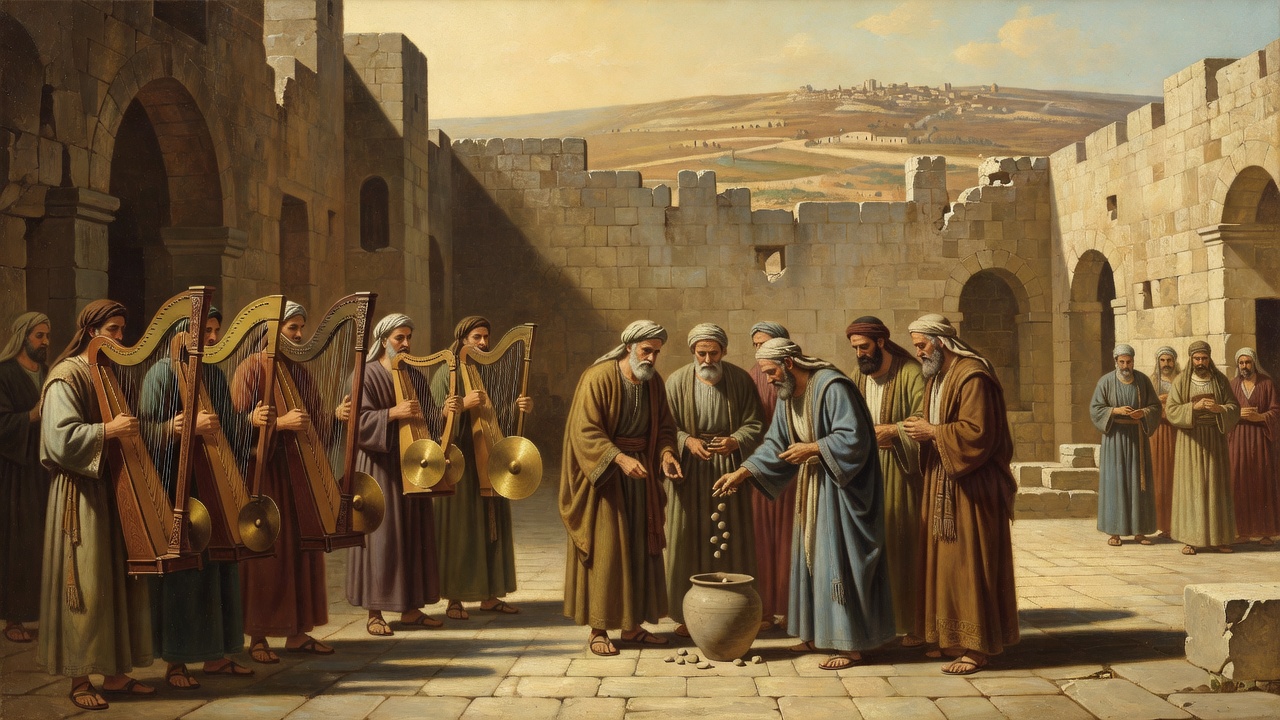
1David and some of the temple officials (OR, army commanders) chose some of the descendants of Asaph, Heman, and Jeduthun to be in charge of proclaiming God’s messages, and to play harps and lyres and cymbals. This is a list of the men whom they chose for that work:
2From the sons of Asaph they chose Zaccur, Joseph, Nethaniah, and Aserelah. Asaph supervised them. And the king appointed Asaph to proclaim God’s messages.
3From the sons of Jeduthun they chose six men: Gedaliah, Zeri, Jeshaiah, Shimei, Hashabiah, and Mattithiah. Jeduthun supervised them and also proclaimed God’s messages, playing his harp while he thanked and praised Yahweh.
4From the sons of Heman, who was one of the king’s prophets, they chose Bukkiah, Mattaniah, Uzziel, Shubael, Jerimoth, Hananiah, Hanani, Eliathah, Giddalti, Romamti-Ezer, Joshbekashah, Mallothi, Hothir, and Mahazioth. 5God promised to cause Heman to be strong, so altogether, God have him 14 sons and three daughters.
6All those men were supervised by their fathers while they played music in the temple of Yahweh. They played cymbals, lyres, and harps. And their fathers—Asaph, Jeduthun and Heman—were supervised by the king. 7Those men and their relatives were all trained and skilled for playing musical instruments in the temple. That was their work for Yahweh. Including their relatives, there were 288 of them. 8All of them, including ones who were young and those who were old, cast lots to determine what work they would do.
9From the family of Asaph, the first ones selected were Joseph and 12 of his sons and relatives.
10Next, Gedaliah and 12 of his sons and relatives were selected.
11Next, Zaccur and 12 of his sons and relatives were selected.
12Next, Nethaniah and 12 of his sons and relatives were selected.
13Next, Bukkiah and 12 of his sons and relatives were selected.
14Next, Jesarelah and 12 of his sons and relatives were selected.
15Next, Jeshaiah and 12 of his sons and relatives were selected.
16Next, Mattaniah and 12 of his sons and relatives were selected.
17Next, Shimei and 12 of his sons and relatives were selected.
18Next, Azarel and 12 of his sons and relatives were selected.
19Next, Hashabiah and 12 of his sons and relatives were selected.
20Next, Shubael and 12 of his sons and relatives were selected.
21Next, Mattithiah and 12 of his sons and relatives were selected.
22Next, Jerimoth and 12 of his sons and relatives were selected.
23Next, Hananiah and 12 of his sons and relatives were selected.
24Next, Joshbekashah and 12 of his sons and relatives were selected.
25Next, Hanani and 12 of his sons and relatives were selected.
26Next, Mallothi and 12 of his sons and relatives were selected.
27Next, Eliathah and 12 of his sons and relatives were selected.
28Next, Hothir and 12 of his sons and relatives were selected.
29Next, Giddalti and 12 of his sons and relatives were selected.
30Next, Mahazioth and 12 of his sons and relatives were selected.
31Next, Romamti-Ezer and 12 of his sons and relatives were selected.
Você sabia?
Organização dos Músicos do Templo
- O ministério dos músicos levitas sob a liderança de Asafe, Hemã e Jedutum é descrito como profetizar com harpas, liras e címbalos. Isso reflete uma estreita associação bíblica entre a prática musical, as ações de graças e a inspiração profética no culto de Israel.Fontes: o próprio texto bíblico · Asaph (Levite) · Heman
- Os músicos foram organizados em 24 divisões de 12 membros habilitados cada, totalizando 288 cantores e instrumentistas treinados. Suas funções e a ordem de serviço eram determinadas por sorteio, tratando jovens e idosos, mestre e discípulo, em termos de igualdade.Fontes: o próprio texto bíblico
- Os líderes dessas famílias musicais desempenhavam importantes funções espirituais; Asafe e Hemã são identificados como videntes, e a tradição atribui diversos salmos bíblicos diretamente a eles ou a seus grupos.Fontes: o próprio texto bíblico · Asaph (Levite) · Heman · Jeduthun (Ethan)
Notas escritas com auxílio de IA a partir de fontes abertas (Theographic Bible Metadata, CC BY-SA 4.0; Easton’s Bible Dictionary, domínio público) e revisadas antes de publicar.
Créditos e licença desta tradução
Translation for Translators
A Bible Translation for Bible Translators which makes implied information explicit in the text as an aid to the translator who may need that information to correctly translate into a particular language.
Copyright © 2008-2017 Ellis W. Deibler, Jr.
Language: English
Dialect: American
This translation is made available to you under the terms of the
Creative Commons Attribution Share-Alike license 4.0.
You have permission to share and redistribute this Bible translation in any format and to make reasonable revisions and adaptations of this translation, provided that:
You include the above copyright and source information.
If you make any changes to the text, you must indicate that you did so in a way that makes it clear that the original licensor is not necessarily endorsing your changes.
If you redistribute this text, you must distribute your contributions under the same license as the original.
Pictures included with Scriptures and other documents on this site are licensed just for use with those Scriptures and documents.
For other uses, please contact the respective copyright owners.
Note that in addition to the rules above, revising and adapting God's Word involves a great responsibility to be true to God's Word. See Revelation 22:18-19.
2026-10-02
Fonte: http://ebible.org/eng-t4t/ · eBible.org