Provérbios 30
Revised Version with Apocrypha (1895) · Toque num versículo para ver as referências cruzadas.
The Words of Agur
1The words of Agur the son of Jakeh; the oracle. The man saith unto Ithiel, unto Ithiel and Ucal: 2Surely I am more brutish than any man, and have not the understanding of a man: 3And I have not learned wisdom, neither have I the knowledge of the Holy One. 4Who hath ascended up into heaven, and descended? who hath gathered the wind in his fists? who hath bound the waters in his garment? who hath established all the ends of the earth? what is his name, and what is his son’s name, if thou knowest? 5Every word of God is tried: he is a shield unto them that trust in him. 6Add thou not unto his words, lest he reprove thee, and thou be found a liar. 7Two things have I asked of thee; deny me them not before I die: 8Remove far from me vanity and lies: give me neither poverty nor riches; feed me with the food that is needful for me: 9Lest I be full, and deny thee, and say, Who is the LORD? or lest I be poor, and steal, and use profanely the name of my God. 10Slander not a servant unto his master, lest he curse thee, and thou be held guilty. 11There is a generation that curseth their father, and doth not bless their mother. 12There is a generation that are pure in their own eyes; and yet are not washed from their filthiness. 13There is a generation, Oh how lofty are their eyes! and their eyelids are lifted up. 14There is a generation whose teeth are as swords, and their jaw teeth as knives, to devour the poor from off the earth, and the needy from among men. 15The horseleach hath two daughters, Crying, Give, give. There are three things that are never satisfied, yea, four that say not, Enough: 16The grave; and the barren womb; the earth that is not satisfied with water; and the fire that saith not, Enough. 17The eye that mocketh at his father, and despiseth to obey his mother, the ravens of the valley shall pick it out, and the young eagles shall eat it. 18There be three things which are too wonderful for me, yea, four which I know not: 19The way of an eagle in the air; the way of a serpent upon a rock; the way of a ship in the midst of the sea; and the way of a man with a maid. 20So is the way of an adulterous woman; she eateth, and wipeth her mouth, and saith, I have done no wickedness. 21For three things the earth doth tremble, and for four, which it cannot bear: 22For a servant when he is king; and a fool when he is filled with meat; 23For an odious woman when she is married; and an handmaid that is heir to her mistress. 24There be four things which are little upon the earth, but they are exceeding wise: 25The ants are a people not strong, yet they provide their meat in the summer; 26The conies are but a feeble folk, yet make they their houses in the rocks; 27The locusts have no king, yet go they forth all of them by bands; 28The lizard taketh hold with her hands, yet is she in kings’ palaces, 29There be three things which are stately in their march, yea, four which are stately in going: 30The lion, which is mightiest among beasts, and turneth not away for any; 31The greyhound; the he-goat also; and the king, against whom there is no rising up. 32If thou hast done foolishly in lifting up thyself, or if thou hast thought evil, lay thine hand upon thy mouth. 33For the churning of milk bringeth forth butter, and the wringing of the nose bringeth forth blood: so the forcing of wrath bringeth forth strife.
Você sabia?
Os Ditos de Agur
- Provérbios 30 é atribuído a Agur, filho de Jaque, que dirigiu suas palavras a Itiel e Ucal. Além do que está registrado neste capítulo, nada mais se sabe sobre a vida de Agur ou de seu pai.Fontes: Agur · Jakeh · Ucal · o próprio texto bíblico
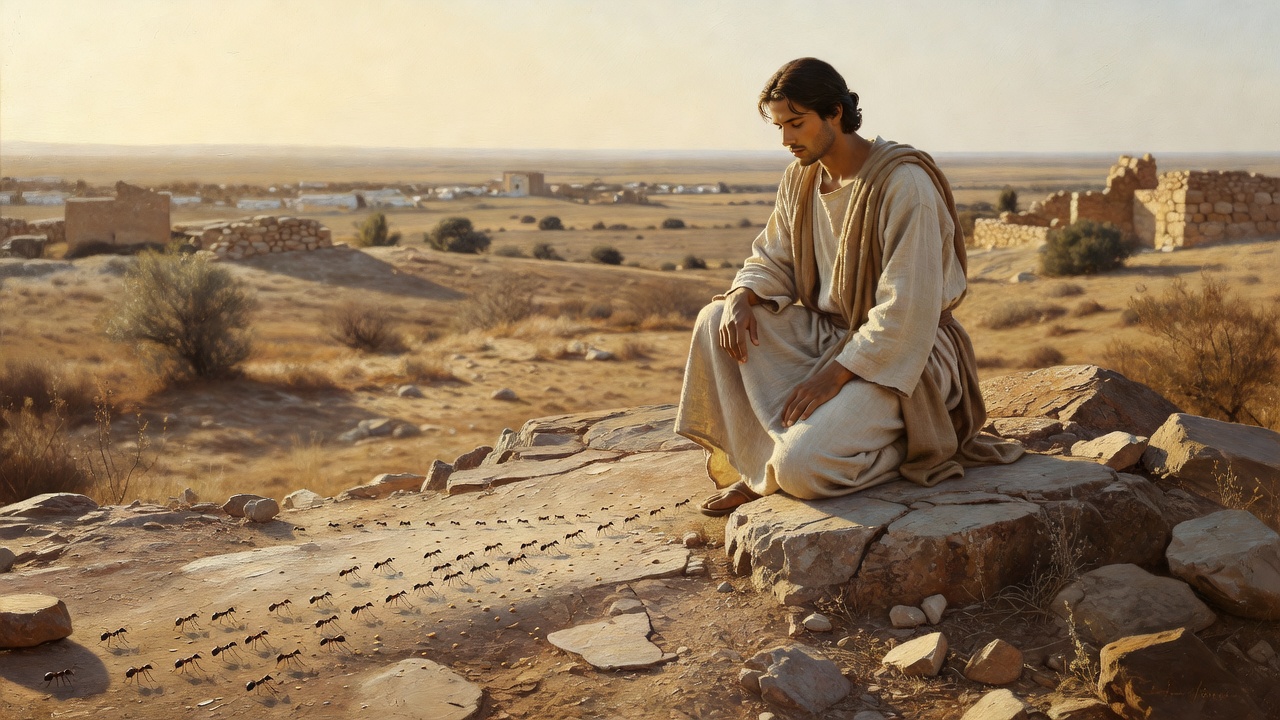
- O capítulo utiliza frequentemente um padrão numérico graduado ('três coisas... quatro que...') para agrupar observações sobre a natureza e o comportamento humano. Agur aplica essa estrutura a maravilhas da criação, perturbações sociais, seres de porte imponente e quatro pequenas criaturas que exibem notável sabedoria: formigas, lebres-das-rochas, gafanhotos e lagartos.Fontes: o próprio texto bíblico
- Agur faz um pedido específico de duas partes, suplicando que não receba nem pobreza nem riquezas, mas apenas a sua porção diária de pão. Ele explica que ter em excesso poderia levar alguém a negar o Senhor, enquanto a extrema pobreza poderia induzir a pessoa a furtar.Fontes: o próprio texto bíblico
Notas escritas com auxílio de IA a partir de fontes abertas (Theographic Bible Metadata, CC BY-SA 4.0; Easton’s Bible Dictionary, domínio público) e revisadas antes de publicar.
Créditos e licença desta tradução
Revised Version with Apocrypha (1895)
The Revised Version of the Holy Bible (1895) with Apocrypha
Public Domain
Language: English
Dialect: archaic British
This work is in the Public Domain. You may copy and use it freely.
2026-10-02
Títulos de seção adaptados da Berean Standard Bible (domínio público); não fazem parte do texto bíblico desta tradução.
Fonte: http://ebible.org/eng-rv/ · eBible.org