Números 6
LXX2012: Septuagint in American English 2012 · Toque num versículo para ver as referências cruzadas.
The Nazirite Vow
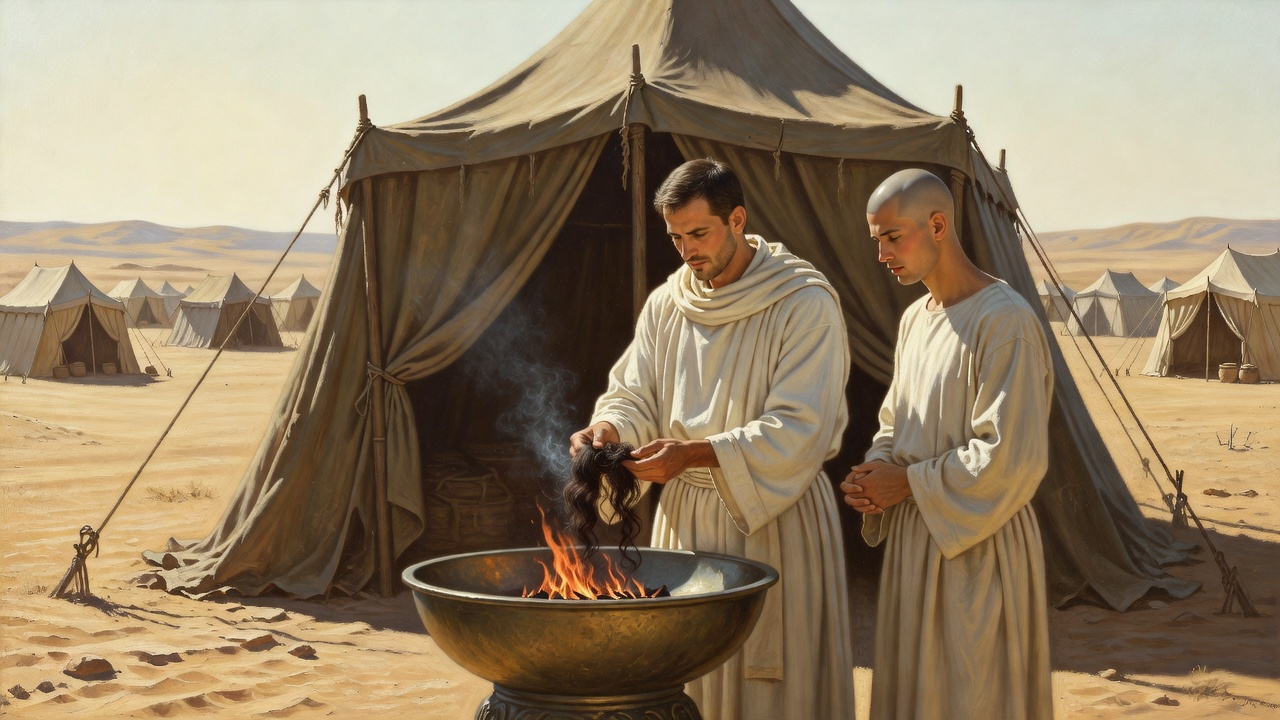
1And the Lord spoke to Moses, saying, 2speak to the children of Israel, and you shall say to them, Whatsoever man or woman shall specially vow a vow to separate oneself with purity to the Lord, 3he shall purely abstain from wine and strong drink; and he shall drink no vinegar of wine or vinegar of strong drink; and whatever is made of the grape he shall not drink; neither shall he eat fresh grapes or raisins, 4all the days of his vow: he shall eat no one of all the things that come from the vine, wine from the grape-stones to the husk, 5all the days of his separation:—a razor shall not come upon his head, until the days be fulfilled which he vowed to the Lord: he shall be holy, cherishing the long hair of the head, 6all the days of his vow to the Lord: he shall not come near to any dead body, 7to his father or his mother, or to his brother or his sister; he shall not defile himself for them, when they have died, because the vow of God is upon him on his head. 8All the days of his vow he shall be holy to the Lord. 9And if any one should die suddenly by him, immediately the head of his vow shall be defiled; and he shall shave his head in whatever day he shall be purified: on the seventh day he shall be shaved. 10And on the eighth day he shall bring two turtledoves, or two young pigeons, to the priest, to the doors of the tabernacle of witness. 11And the priest shall offer one for a sin-offering; and the other for a whole burnt offering; and the priest shall make atonement for him in the things wherein he sinned respecting the dead body, and he shall sanctify his head in that day, 12in which he was consecrated to the Lord, all the days of his vow; and he shall bring a lamb of a year old for a trespass-offering; and the former days shall not be reckoned, because the head of his vow was polluted. 13And this is the law of him that has vowed: in whatever day he shall have fulfilled the days of his vow, he shall himself bring his gift to the doors of the tabernacle of witness. 14And he shall bring his gift to the Lord; one he-lamb of a year old without blemish for a whole burnt offering, and one ewe-lamb of a year old without blemish for a sin-offering, and one ram without blemish for a peace-offering; 15and a basket of unleavened bread of fine flour, even loaves kneaded with oil, and unleavened cakes anointed with oil, and their meat-offering, and their drink-offering. 16And the priest shall bring them before the Lord, and shall offer his sin-offering, and his whole burnt offering. 17And he shall offer the ram as a sacrifice of peace-offering to the Lord with the basket of unleavened bread; and the priest shall offer its meat-offering and its drink-offering. 18And he that has vowed shall shave the head of his consecration by the doors of the tabernacle of witness, and shall put the hairs on the fire which is under the sacrifice of peace-offering. 19And the priest shall take the sodden shoulder of the ram, and one unleavened loaf from the basket, and one unleavened cake, and shall put them on the hands of the votary after he has shaved off his 20And the priest shall present them as an offering before the Lord; it shall be the holy portion for the priest beside the breast of the heave-offering and beside the shoulder of the wave-offering: and afterwards the votary shall drink wine. 21This is the law of the votary who shall have vowed to the Lord his gift to the Lord, concerning his vow, besides what he may be able to afford according to the value of his vow, which he may have vowed according to the law of separation.
Aaron’s Blessing
22And the Lord spoke to Moses, saying, 23Speak to Aaron and to his sons, saying, Thus you⌃ shall bless the children of Israel, saying to them, 24The Lord bless you and keep you; 25the Lord make his face to shine upon you, and have mercy upon you; 26the Lord lift up his countenance upon you, and give you peace. 27And they shall put my name upon the children of Israel, and I the Lord will bless them.
Você sabia?
O Voto de Nazireu e a Bênção Sacerdotal
- O voto de nazireu era um período voluntário de consagração especial a Deus, acessível tanto a homens quanto a mulheres. Durante esse tempo, a pessoa devia abster-se totalmente de produtos derivados da videira e de bebidas fermentadas, deixar o cabelo crescer sem cortar e evitar a contaminação ritual por qualquer cadáver, mesmo de familiares próximos.Fontes: o próprio texto bíblico
- Ao término do período de separação, o nazireu levava sacrifícios à entrada da Tenda do Encontro, rapava o cabelo e o queimava no fogo sob o sacrifício de comunhão. Depois que o sacerdote apresentava as porções prescritas diante de Deus, o voto se encerrava e a pessoa podia voltar a beber vinho.Fontes: o próprio texto bíblico
- O capítulo se encerra com a bênção sacerdotal que Deus ordenou a Moisés transmitir a Arão e a seus filhos. Ao invocar a proteção, o rosto resplandecente, a graça e a paz de Deus, os sacerdotes colocavam o nome divino sobre o povo de Israel.Fontes: o próprio texto bíblico · Moses · Aaron
Notas escritas com auxílio de IA a partir de fontes abertas (Theographic Bible Metadata, CC BY-SA 4.0; Easton’s Bible Dictionary, domínio público) e revisadas antes de publicar.
Créditos e licença desta tradução
LXX2012: Septuagint in American English 2012
The Septuagint with Apocrypha, translated from Greek to English by Sir Lancelot C. L. Brenton and published in 1885, with some language updates (American English)
Public Domain
Language: English
Dialect (if applicable): American
Language in English: English
Translation by:
Sir Lancelot Charles Lee Brenton
Michael Paul Johnson
LXX2012: Septuagint in English 2012
This is a translation of the Old Testament and Apocrypha/Deuterocanon from Hebrew to Greek to 19th Century British English, with some updates of spelling and word usage to contemporary American English. The original English translation was done by Sir Lancelot Charles Lee Brenton and published by Samuel Bagster & Sons, Ltd., in London in 1851. It has entered the Public Domain due to the passage of sufficient time. In the process of scanning and typing the text, the original poetry and prose formatting, as well as peripheral material like introductions and notes, have been omitted.
This edition of the Septuagint has some language updates. Brenton's word order and punctuation has been mostly retained, meaning that quotation marks are not used, and sentences within quotes may not start with capital letters, as was standard usage in 1851. Names transliterated from Greek to those transliterated from Hebrew in the common English Bibles often differ. These language updates are dedicated to the Public Domain by the author of those edits, Michael Paul Johnson. Therefore this edition may be freely copied, published, etc.
Before considering making changes to the text of this work, I recommend that you consult with God, because this is really His Book.
If you find errors in the text, please report them so that we can correct them.
Donations to help with the expenses of operating this web site and thus help others have free access to the Word of God may be made to us, but are not required. Please see http://MLJohnson.org/partner/ for more about that.
Títulos de seção adaptados da Berean Standard Bible (domínio público); não fazem parte do texto bíblico desta tradução.
Fonte: http://ebible.org/eng-lxx2012/ · eBible.org