Números 19
LXX2012: Septuagint in American English 2012 · Toque num versículo para ver as referências cruzadas.
The Red Heifer
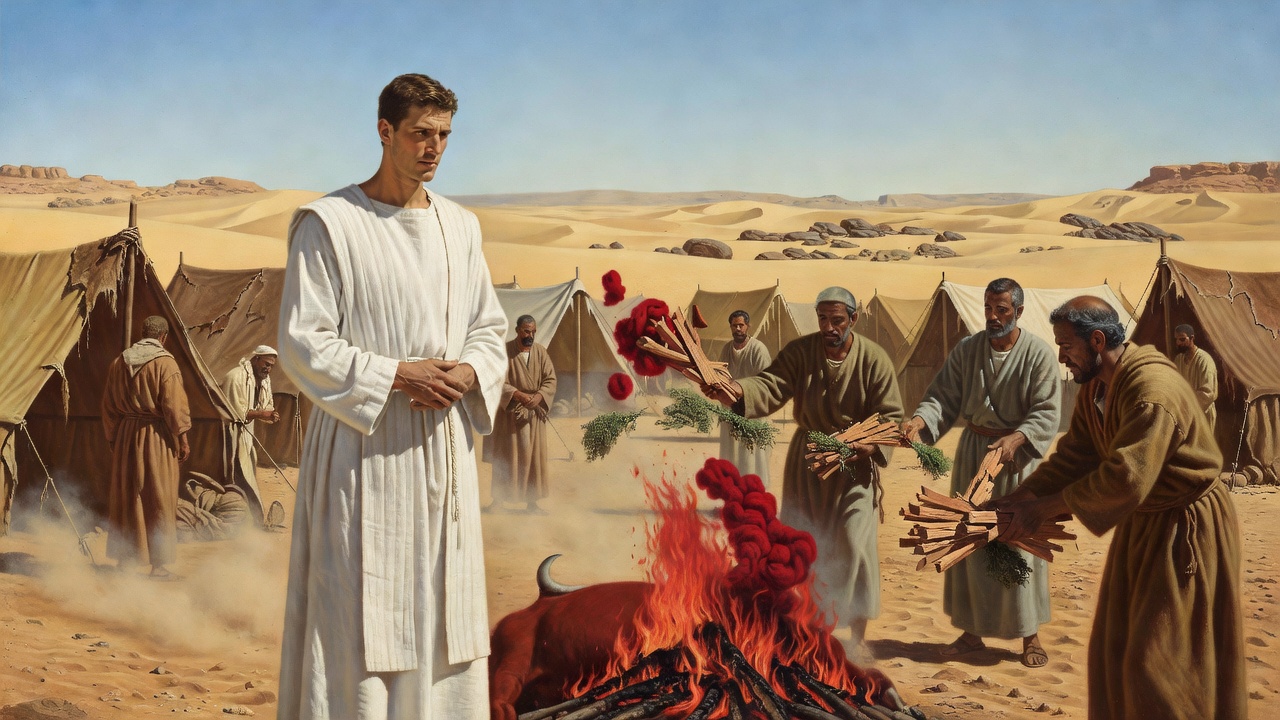
1And the Lord spoke to Moses and Aaron, saying, 2This is the constitution of the law, as the Lord has commanded, saying, Speak to the sons of Israel, and let them take for you a red heifer without spot, which has no spot on her, and on which no yoke has been put. 3And you shall give her to Eleazar the priest; and they shall bring her out of the camp into a clean place, and shall kill her before his face. 4And Eleazar shall take of her blood, and sprinkle of her blood seven times in front of the tabernacle of witness. 5And they shall burn her to ashes before him; and her skin and her flesh and her blood, with her dung, shall be consumed. 6And the priest shall take cedar wood and hyssop and scarlet wool, and they shall cast them into the midst of the burning of the heifer. 7And the priest shall wash his garments, and bathe his body in water, and afterwards he shall go into the camp, and the priest shall be unclean till evening. 8And he that burns her shall wash his garments, and bathe his body, and shall be unclean till evening. 9And a clean man shall gather up the ashes of the heifer, and lay them up in a clean place outside the camp; and they shall be for the congregation of the children of Israel to keep: it is the water of sprinkling, a purification. 10And he that gathers up the ashes of the heifer shall wash his garments, and shall be unclean until evening; and it shall be a perpetual statute for the children of Israel and for the strangers joined to them.
Purification of the Unclean
11He that touches the dead body of any man, shall be unclean seven days. 12He shall be purified on the third day and the seventh day, and shall be clean; but if he be not purged on the third day and the seventh day, he shall not be clean. 13Every one that touches the carcass of the person of a man, if he should have died, and the other not have been purified, has defiled the tabernacle of the Lord: that soul shall be cut off from Israel, because the water of sprinkling has not been sprinkled upon him; he is unclean; his uncleanness is yet upon him. 14And this is the law; if a man die in a house, every one that goes into the house, and all things in the house, shall be unclean seven days. 15And every open vessel which has not a covering bound upon it, shall be unclean. 16And every one who shall touch a man slain by violence, or a corpse, or human bone, or sepulchre, shall be unclean seven days. 17And they shall take for the unclean of the burnt ashes of purification, and they shall pour upon them running water into a vessel. 18And a clean man shall take hyssop, and dip it into the water, and sprinkle it upon the house, and the furniture, and all the souls that are therein, and upon him that touched the human bone, or the slain man, or the corpse, or the tomb. 19And the clean man shall sprinkle the water on the unclean on the third day and on the seventh day, and on the seventh day he shall purify himself; and the other shall wash his garments, and bathe himself in water, and shall be unclean until evening. 20And whatever man shall be defiled and shall not purify himself, that soul shall be cut off from the midst of the congregation, because he has defiled the holy things of the Lord, because the water of sprinkling has not been sprinkled upon him; he is unclean. 21And it shall be to you a perpetual statute; and he that sprinkles the water of sprinkling shall wash his garments; and he that touches the water of sprinkling shall be unclean until evening. 22And whatever the unclean man shall touch shall be unclean, and the soul that touches it shall be unclean till evening.
Você sabia?
A novilha vermelha e a purificação da impureza
- Diferente dos sacrifícios habituais oferecidos no altar do tabernáculo, a novilha vermelha sem defeito e que nunca havia levado jugo era levada para fora do acampamento. Ali era sacrificada na presença do sacerdote Eleazar e queimada por inteiro com madeira de cedro, hissopo e lã carmesim.Fontes: o próprio texto bíblico · Eleazar
- As cinzas da novilha eram guardadas fora do acampamento para o preparo da água de purificação. Paradoxalmente, embora essa mistura purificasse os que haviam se tornado impuros pelo contato com a morte, todos os que manuseavam a novilha, recolhiam as cinzas ou aspergissem a água ficavam cerimonialmente impuros até o entardecer.Fontes: o próprio texto bíblico
- O contato com um cadáver, um osso humano, uma sepultura ou o simples fato de estar em uma tenda onde alguém morresse causava sete dias de impureza cerimonial. Para a purificação, a pessoa precisava ser aspergida com a água de purificação no terceiro e no sétimo dia, além de lavar suas roupas e banhar-se.Fontes: o próprio texto bíblico
Notas escritas com auxílio de IA a partir de fontes abertas (Theographic Bible Metadata, CC BY-SA 4.0; Easton’s Bible Dictionary, domínio público) e revisadas antes de publicar.
Créditos e licença desta tradução
LXX2012: Septuagint in American English 2012
The Septuagint with Apocrypha, translated from Greek to English by Sir Lancelot C. L. Brenton and published in 1885, with some language updates (American English)
Public Domain
Language: English
Dialect (if applicable): American
Language in English: English
Translation by:
Sir Lancelot Charles Lee Brenton
Michael Paul Johnson
LXX2012: Septuagint in English 2012
This is a translation of the Old Testament and Apocrypha/Deuterocanon from Hebrew to Greek to 19th Century British English, with some updates of spelling and word usage to contemporary American English. The original English translation was done by Sir Lancelot Charles Lee Brenton and published by Samuel Bagster & Sons, Ltd., in London in 1851. It has entered the Public Domain due to the passage of sufficient time. In the process of scanning and typing the text, the original poetry and prose formatting, as well as peripheral material like introductions and notes, have been omitted.
This edition of the Septuagint has some language updates. Brenton's word order and punctuation has been mostly retained, meaning that quotation marks are not used, and sentences within quotes may not start with capital letters, as was standard usage in 1851. Names transliterated from Greek to those transliterated from Hebrew in the common English Bibles often differ. These language updates are dedicated to the Public Domain by the author of those edits, Michael Paul Johnson. Therefore this edition may be freely copied, published, etc.
Before considering making changes to the text of this work, I recommend that you consult with God, because this is really His Book.
If you find errors in the text, please report them so that we can correct them.
Donations to help with the expenses of operating this web site and thus help others have free access to the Word of God may be made to us, but are not required. Please see http://MLJohnson.org/partner/ for more about that.
Títulos de seção adaptados da Berean Standard Bible (domínio público); não fazem parte do texto bíblico desta tradução.
Fonte: http://ebible.org/eng-lxx2012/ · eBible.org