Números 11
LXX2012: Septuagint in American English 2012 · Toque num versículo para ver as referências cruzadas.
The Complaints of the People
1And the people murmured sinfully before the Lord; and the Lord heard them and was very angry; and fire was kindled among them from the Lord, and devoured a part of the camp. 2And the people cried to Moses: and Moses prayed to the Lord, and the fire was quenched. 3And the name of that place was called Burning; for a fire was kindled among them from the Lord. 4And the mixed multitude among them lusted exceedingly; and they and the children of Israel sat down and wept and said, Who shall give us flesh to eat? 5We remember the fish, which we ate in Egypt freely; and the cucumbers, and the melons, and the leeks, and the garlic, and the onions. 6But now our soul is dried up; our eyes turn to nothing but to the manna. 7And the manna is as coriander seed, and the appearance of it the appearance of hoarfrost. 8And the people went through the field, and gathered, and ground it in the mill, or pounded it in a mortar, and baked it in a pan, and made cakes of it; and the sweetness of it was as the taste of wafer made with oil. 9And when the dew came upon the camp by night, the manna came down upon it.
The Complaint of Moses
10And Moses heard them weeping by their families, every one in his door: and the Lord was very angry; and the thing was evil in the sight of Moses. 11And Moses said to the Lord, Why have you afflicted your servant, and why have I not found grace in your sight, that you should lay the weight of this people upon me? 12Have I conceived all this people, or have I born them? that you say to me, Take them into your bosom, as a nurse would take her suckling, into the land which you swore to their fathers? 13Whence have I flesh to give to all this people? for they weep to me, saying, Give us flesh, that we may eat. 14I shall not be able to bear this people alone, for this thing is too heavy for me. 15And if you do thus to me, kill me utterly, if I have found favor with you, that I may not see my affliction.
Seventy Elders Anointed
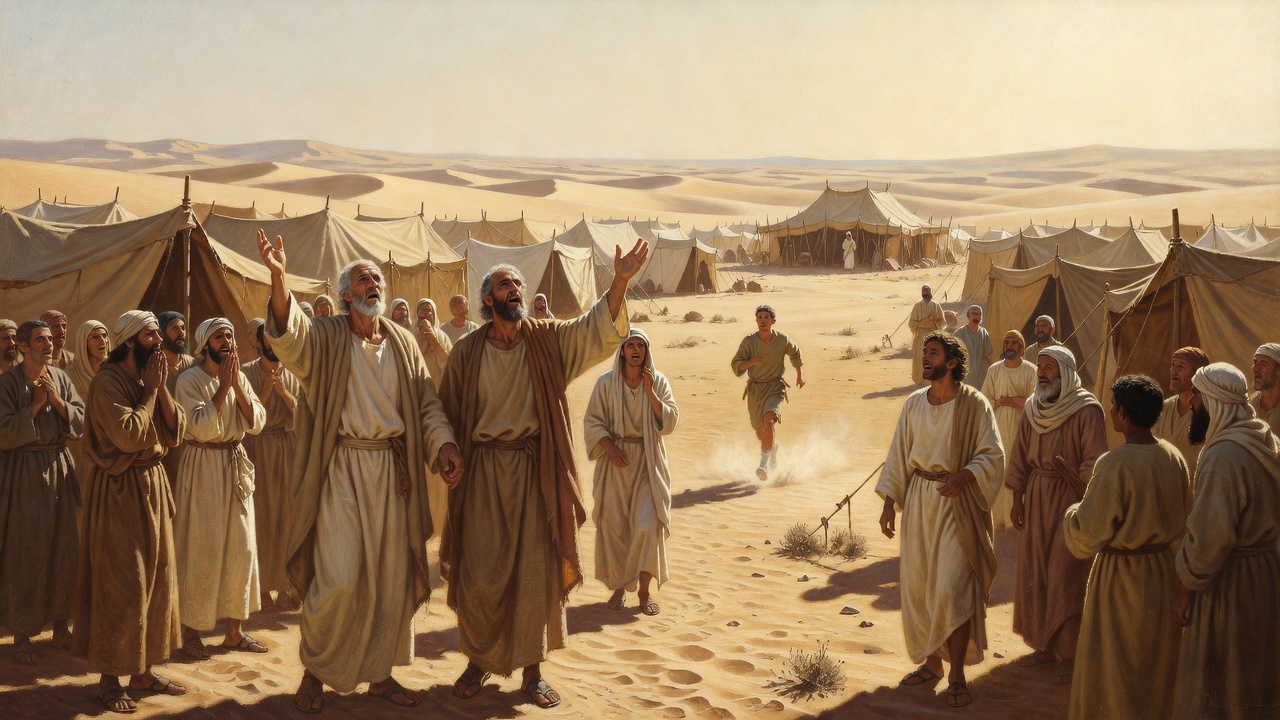
16And the Lord said to Moses, Gather me seventy men from the elders of Israel, whom you yourself know that they are the elders of the people, and their scribes; and you shall bring them to the tabernacle of witness, and they shall stand there with you. 17And I will go down, and speak there with you; and I will take of the spirit that is upon you, and will put it upon them; and they shall bear together with you the burden of the people, and you shall not bear them alone. 18And to the people you shall say, Purify yourselves for the morrow, and you⌃ shall eat flesh; for you⌃ wept before the Lord, saying, Who shall give us flesh to eat? for it was well with us in Egypt: and the Lord shall allow you to eat flesh, and you⌃ shall eat flesh. 19You⌃ shall not eat one day, nor two, nor five days, nor ten days, nor twenty days; 20you⌃ shall eat for a full month, until the flesh come out at your nostrils; and it shall be nausea to you, because you⌃ disobeyed the Lord, who is among you, and wept before him, saying, What had we to do to come out of Egypt? 21And Moses said, The people among whom I am are six hundred thousand footmen; and you said, I will give them flesh to eat, and they shall eat a whole month. 22Shall sheep and oxen be slain for them, and shall it suffice them? or shall all the fish of the sea be gathered together for them, and shall it suffice them? 23And the Lord said to Moses, Shall not the hand of the Lord be fully sufficient? now shall you know whether my word shall come to pass to you or not. 24And Moses went out, and spoke the words of the Lord to the people; and he gathered seventy men of the elders of the people, and he set them round about the tabernacle. 25And the Lord came down in a cloud, and spoke to him, and took of the spirit that was upon him, and put it upon the seventy men that were elders; and when the spirit rested upon them, they prophesied and ceased. 26And there were two men left in the camp, the name of the one was Eldad, and the name of the other Modad; and the spirit rested upon them, and these were of the number of them that were enrolled, but they did not come to the tabernacle; and they prophesied in the camp. 27And a young man ran and told Moses, and spoke, saying, Eldad and Modad prophesy in the camp. 28And Joshua the son of Naue, who attended on Moses, the chosen one, said, My lord Moses, forbid them. 29And Moses said to him, Are you jealous on my account? and would that all the Lord's people were prophets; whenever the Lord shall put his spirit upon them. 30And Moses departed into the camp, himself and the elders of Israel.
The Quail and the Plague
31And there went forth a wind from the Lord, and brought quails over from the sea; and it brought them down upon the camp a day's journey on this side, and a day's journey on that side, round about the camp, as it were two cubits from the earth. 32And the people rose up all the day, and all the night, and all the next day, and gathered quails; he that gathered least, gathered ten measures; and they refreshed themselves round about the camp. 33The flesh was yet between their teeth, before it failed, when the Lord was angry with the people, and the Lord struck the people with a very great plague. 34And the name of that place was called the Graves of Lust; for there they buried the people that lusted. 35The people departed from the Graves of Lust to Aseroth; and the people halted at Aseroth.
Você sabia?
Queixas, codornizes e o Espírito no acampamento
- Os locais mencionados neste capítulo receberam nomes derivados de acontecimentos da viagem: Taberá significa "queimada", nomeada após o fogo consumir a extremidade do acampamento, enquanto Quibrote-Hataavá significa "sepulturas da cobiça" ou do desejo, onde foram enterrados os que desejaram carne.Fontes: Taberah · Kibroth-hattaavah · o próprio texto bíblico
- Embora setenta anciãos tenham sido escolhidos para ajudar Moisés na liderança, Eldade e Medade permaneceram no acampamento em vez de ir à Tenda do Encontro, mas o Espírito repousou sobre eles e profetizaram. Quando Josué pediu a Moisés que os impedisse, Moisés respondeu desejando que todo o povo do Senhor fosse profeta.Fontes: Eldad · Joshua · o próprio texto bíblico
- O texto descreve o maná como semelhante a sementes de coentro e resina, o qual os israelitas recolhiam, moíam em moinhos manuais ou pilavam em almofarizes, coziam em panelas ou assavam em bolos com sabor de massa preparada com azeite.Fontes: o próprio texto bíblico
Notas escritas com auxílio de IA a partir de fontes abertas (Theographic Bible Metadata, CC BY-SA 4.0; Easton’s Bible Dictionary, domínio público) e revisadas antes de publicar.
Lugares deste capítulo
Só aparecem lugares com identificação de alta confiança (90% ou mais segundo as fontes acadêmicas reunidas pelo OpenBible). Mapa da época: DARE (Digital Atlas of the Roman Empire), CC BY 4.0; mapa atual: © colaboradores do OpenStreetMap; lugares: OpenBible.info (CC BY 4.0).
Créditos e licença desta tradução
LXX2012: Septuagint in American English 2012
The Septuagint with Apocrypha, translated from Greek to English by Sir Lancelot C. L. Brenton and published in 1885, with some language updates (American English)
Public Domain
Language: English
Dialect (if applicable): American
Language in English: English
Translation by:
Sir Lancelot Charles Lee Brenton
Michael Paul Johnson
LXX2012: Septuagint in English 2012
This is a translation of the Old Testament and Apocrypha/Deuterocanon from Hebrew to Greek to 19th Century British English, with some updates of spelling and word usage to contemporary American English. The original English translation was done by Sir Lancelot Charles Lee Brenton and published by Samuel Bagster & Sons, Ltd., in London in 1851. It has entered the Public Domain due to the passage of sufficient time. In the process of scanning and typing the text, the original poetry and prose formatting, as well as peripheral material like introductions and notes, have been omitted.
This edition of the Septuagint has some language updates. Brenton's word order and punctuation has been mostly retained, meaning that quotation marks are not used, and sentences within quotes may not start with capital letters, as was standard usage in 1851. Names transliterated from Greek to those transliterated from Hebrew in the common English Bibles often differ. These language updates are dedicated to the Public Domain by the author of those edits, Michael Paul Johnson. Therefore this edition may be freely copied, published, etc.
Before considering making changes to the text of this work, I recommend that you consult with God, because this is really His Book.
If you find errors in the text, please report them so that we can correct them.
Donations to help with the expenses of operating this web site and thus help others have free access to the Word of God may be made to us, but are not required. Please see http://MLJohnson.org/partner/ for more about that.
Títulos de seção adaptados da Berean Standard Bible (domínio público); não fazem parte do texto bíblico desta tradução.
Fonte: http://ebible.org/eng-lxx2012/ · eBible.org