Jeremias 17
LXX2012: Septuagint in American English 2012 · Toque num versículo para ver as referências cruzadas.
The Sin and Punishment of Judah
1Cursed is the man who trusts in man, and will lean his arm of flesh upon him, while his heart departs from the Lord. 6And he shall be as the wild tamarisk in the desert: he shall not see when good comes; but he shall dwell in barren places, and in the wilderness, in a salt land which is not inhabited. 7But blessed is the man who trusts in the Lord, and whose hope the Lord shall be. 8And he shall be as a thriving tree by the waters, and he shall cast forth his root toward a moist place: he shall not fear when heat comes, and there shall be upon him shady branches: he shall not fear in a year of drought, and he shall not fail to bear fruit. 9The heart is deep beyond all things, and it is the man, and who can know him? 10I the Lord try the hearts, and prove the reins, to give to every one according to his ways, and according to the fruits of his devices. 11The partridge utters her voice, she gathers eggs which she did not lay; so is a man gaining his wealth unjustly; in the midst of his days his riches shall leave him, and at his latter end he will be a fool.
Jeremiah’s Prayer for Deliverance
12An exalted throne of glory is our sanctuary. 13O Lord, the hope of Israel, let all that have left you be ashamed, let them that have revolted be written on the earth, because they have forsaken the fountain of life, the Lord. 14Heal me, O Lord, and I shall be healed; save me, and I shall be saved; for you are my boast. 15Behold, they say to me, Where is the word of the Lord? let it come. 16But I have not been weary of following you, nor have I desired the day of man; you know; the words that proceed out of my lips are before your face. 17Be not to me a stranger, but spare me in the evil day. 18Let them that persecute me be ashamed, but let me not be ashamed: let them be alarmed, but let me not be alarmed: bring upon them the evil day, crush them with double destruction.
Restoring the Sabbath
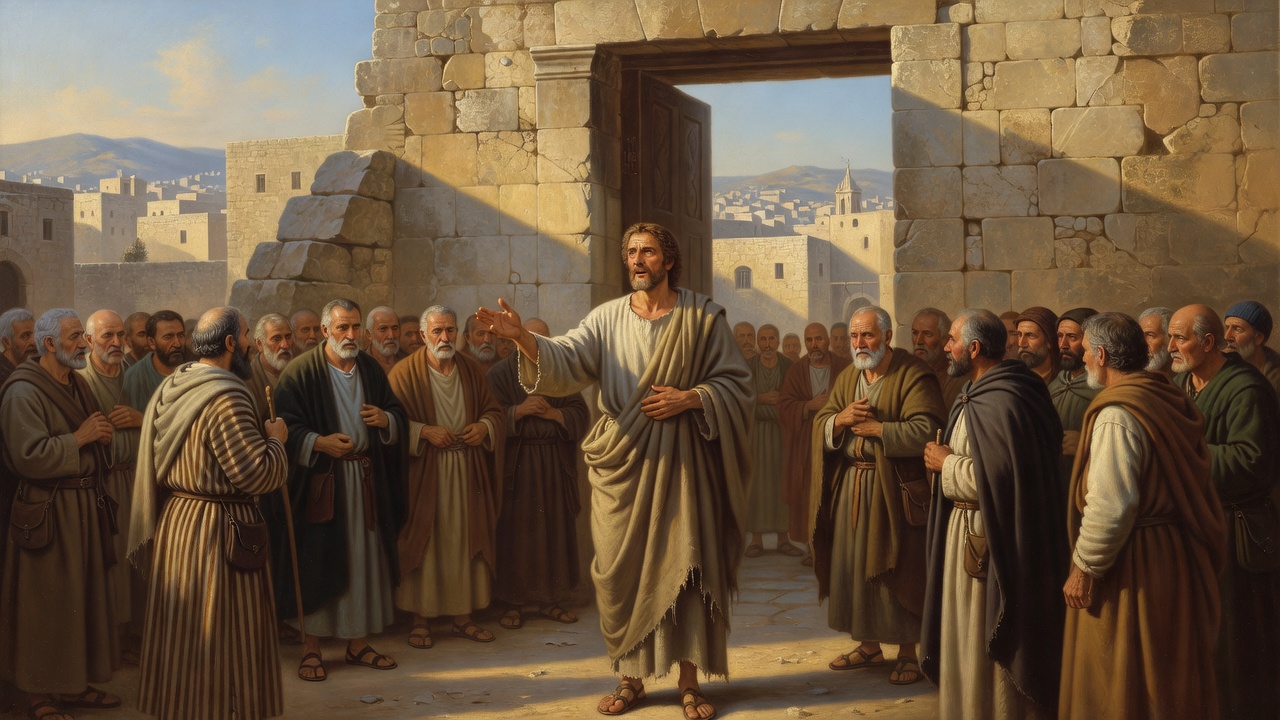
19Thus says the Lord; Go and stand in the gates of the children of your people, by which the kings of Juda enter, and by which they go out, and in all the gates of Jerusalem: 20and you shall say to them, Hear the word of the Lord, you⌃ kings of Juda, and all Judea, and all Jerusalem, all who go in at these gates: 21thus says the Lord; Take heed to your souls, and take up no burdens on the sabbath-day, and go not forth through the gates of Jerusalem; 22and carry forth no burdens out of your houses on the sabbath-day, and you⌃ shall do no work: sanctify the sabbath-day, as I commanded your fathers. 23But they listened not, and inclined not their ear, but stiffened their neck more than their fathers did, so as not to hear me, and not to receive correction. 24And it shall come to pass, if you⌃ will listen to me, says the Lord, to carry in no burdens through the gates of this city on the sabbath-day, and to sanctify the sabbath-day, so as to do no work upon it, 25that there shall enter through the gates of this city kings and princes sitting on the throne of David, and riding on their chariots and horses, they, and their princes, the men of Juda, and the dwellers in Jerusalem: and this city shall be inhabited for ever. 26And men shall come out of the cities of Juda, and from round about Jerusalem, and out of the land of Benjamin, and out of the plain country, and from the hill country, and from the south country, bringing whole burnt offerings, and sacrifices, and incense, and manna, and frankincense, bringing praise to the house of the Lord. 27But it shall come to pass, if you⌃ will not listen to me to sanctify the sabbath-day, to bear no burdens, nor go in with them by the gates of Jerusalem on the sabbath-day; then will I kindle a fire in the gates thereof, and it shall devour the streets of Jerusalem, and shall not be quenched.
Você sabia?
Confiança, o Coração e o Sábado
- O estilete de ferro e a ponta de diamante eram ferramentas antigas usadas para gravar inscrições profundas e permanentes em pedra ou metal. Jeremias usa essa imagem para destacar que a idolatria de Judá não era superficial, mas estava profundamente gravada em seus corações e nas pontas de seus altares.Fontes: o próprio texto bíblico
- Jeremias contrasta um arbusto solitário no deserto seco e salgado com uma árvore viçosa plantada junto a um riacho. A árvore cujas raízes alcançam a água permanece verde e continua dando fruto mesmo em anos de seca, servindo de símbolo para quem confia em Deus em vez de confiar na força humana.Fontes: o próprio texto bíblico
- Jeremias recebeu a ordem de proclamar a palavra de Deus nas portas de Jerusalém, proibindo expressamente o transporte de cargas no dia de sábado. A santificação do sábado garantia a permanência de reis no trono de Davi e a vinda de adoradores das terras de Benjamim, de Judá e do Neguebe.Fontes: o próprio texto bíblico · David · Benjamin (patriarch) · Jerusalem
Notas escritas com auxílio de IA a partir de fontes abertas (Theographic Bible Metadata, CC BY-SA 4.0; Easton’s Bible Dictionary, domínio público) e revisadas antes de publicar.
Lugares deste capítulo
- Arabah · 30.417, 35.151 · versículo 6
- Jerusalem · 31.777, 35.234 · versículos 19, 20, 21, 25, 26, 27
- People’s Gate · Hoje: in Jerusalem · 31.777, 35.234 · versículo 19
- Negeb · 31.245, 34.841 · versículo 26
- Shephelah · 31.692, 34.875 · versículo 26
Só aparecem lugares com identificação de alta confiança (90% ou mais segundo as fontes acadêmicas reunidas pelo OpenBible). Mapa da época: DARE (Digital Atlas of the Roman Empire), CC BY 4.0; mapa atual: © colaboradores do OpenStreetMap; lugares: OpenBible.info (CC BY 4.0).
Créditos e licença desta tradução
LXX2012: Septuagint in American English 2012
The Septuagint with Apocrypha, translated from Greek to English by Sir Lancelot C. L. Brenton and published in 1885, with some language updates (American English)
Public Domain
Language: English
Dialect (if applicable): American
Language in English: English
Translation by:
Sir Lancelot Charles Lee Brenton
Michael Paul Johnson
LXX2012: Septuagint in English 2012
This is a translation of the Old Testament and Apocrypha/Deuterocanon from Hebrew to Greek to 19th Century British English, with some updates of spelling and word usage to contemporary American English. The original English translation was done by Sir Lancelot Charles Lee Brenton and published by Samuel Bagster & Sons, Ltd., in London in 1851. It has entered the Public Domain due to the passage of sufficient time. In the process of scanning and typing the text, the original poetry and prose formatting, as well as peripheral material like introductions and notes, have been omitted.
This edition of the Septuagint has some language updates. Brenton's word order and punctuation has been mostly retained, meaning that quotation marks are not used, and sentences within quotes may not start with capital letters, as was standard usage in 1851. Names transliterated from Greek to those transliterated from Hebrew in the common English Bibles often differ. These language updates are dedicated to the Public Domain by the author of those edits, Michael Paul Johnson. Therefore this edition may be freely copied, published, etc.
Before considering making changes to the text of this work, I recommend that you consult with God, because this is really His Book.
If you find errors in the text, please report them so that we can correct them.
Donations to help with the expenses of operating this web site and thus help others have free access to the Word of God may be made to us, but are not required. Please see http://MLJohnson.org/partner/ for more about that.
Títulos de seção adaptados da Berean Standard Bible (domínio público); não fazem parte do texto bíblico desta tradução.
Fonte: http://ebible.org/eng-lxx2012/ · eBible.org