Gênesis 48
LXX2012: Septuagint in American English 2012 · Toque num versículo para ver as referências cruzadas.
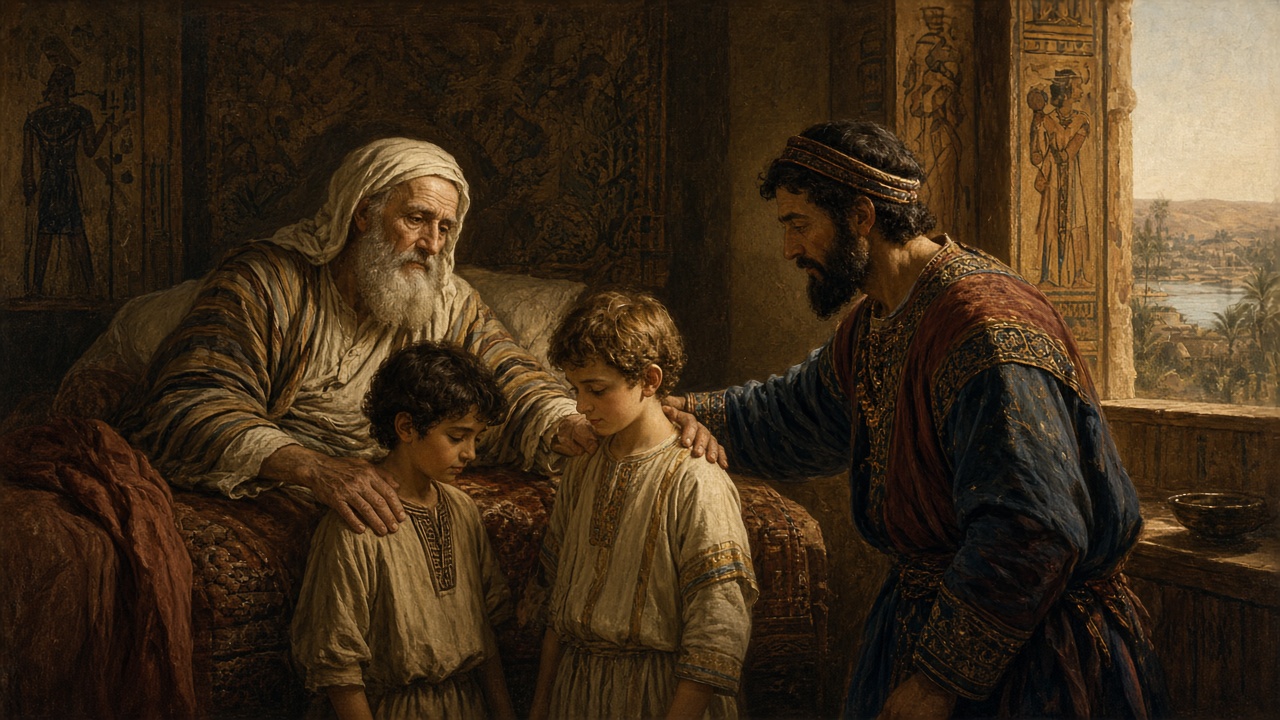
Jacob Blesses Ephraim and Manasseh
1And it came to pass after these things, that it was reported to Joseph, Behold, your father is ill; and, having taken his two sons, Manasse and Ephraim, he came to Jacob. 2And it was reported to Jacob, saying, Behold, your son Joseph comes to you; and Israel having strengthened himself, sat upon the bed. 3And Jacob said to Joseph, My God appeared to me in Luza, in the land of Chanaan, and blessed me, 4and said to me, Behold, I will increase you, and multiply you, and will make of you multitudes of nations; and I will give this land to you, and to your seed after you, for an everlasting possession. 5Now then your two sons, who were born to you in the land of Egypt, before I came to you into Egypt, are mine; Ephraim and Manasse, as Ruben and Symeon they shall be mine. 6And the children which you shall beget hereafter, shall be in the name of their brethren; they shall be named after their inheritances. 7And as for me, when I came out of Mesopotamia of Syria, Rachel, your mother, died in the land of Chanaan, as I drew near to the horse-course of Chabratha of the land of Chanaan, so as to come to Ephratha; and I buried her in the road of the course; this is Bethlehem. 8And when Israel saw the sons of Joseph, he said, Who are these to you? 9And Joseph said to his father, They are my sons, whom God gave me here; and Jacob said, Bring me them, that I may bless them. 10Now the eyes of Israel were dim through age, and he could not see; and he brought them near to him, and he kissed them, and embraced them. 11And Israel said to Joseph, Behold, I have not been deprived of seeing your face, and behold! God has showed me your seed also. 12And Joseph brought them out from between his knees, and they did reverence to him, with their face to the ground. 13And Joseph took his two sons, both Ephraim in his right hand, but on the left of Israel, and Manasse on his left hand, but on the right of Israel, and brought them near to him. 14But Israel having stretched out his right hand, laid it on the head of Ephraim, and he was the younger; and his left hand on the head of Manasse, guiding his hands crosswise. 15And he blessed them and said, The God in whose sight my fathers were well pleasing, even Abraam and Isaac, the God who continues to feed me from my youth until this day; 16the angel who delivers me from all evils, bless these boys, and my name shall be called upon them, and the name of my fathers, Abraam and Isaac; and let them be increased to a great multitude on the earth. 17And Joseph having seen that his father put his right hand on the head of Ephraim—it seemed grievous to him; and Joseph took hold of the hand of his father, to remove it from the head of Ephraim to the head of Manasse. 18And Joseph said to his father, Not so, father; for this is the firstborn; lay your right-hand upon his head. 19And he would not, but said, I know it, son, I know it; he also shall be a people, and he shall be exalted, but his younger brother shall be greater than he, and his seed shall become a multitude of nations. 20And he blessed them in that day, saying, In you shall Israel be blessed, saying, God make you as Ephraim and Manasse; and he set Ephraim before Manasse. 21And Israel said to Joseph, Behold, I die; and God shall be with you, and restore you to the land of your fathers. 22And I give to you Sicima, a select portion above your brethren, which I took out of the hand of the Amorites with my sword and bow.
Você sabia?
Adoção e bênção de Efraim e Manassés
- Jacó considera seus os dois filhos de José, nascidos no Egito, no mesmo nível de Rúben e Simeão, filhos de Lia. Os filhos que nascessem a José depois deles continuariam sendo de José e seriam chamados pelo nome dos irmãos no território que herdassem.Fontes: o próprio texto bíblico · Manasseh (son of Joseph) · Reuben · Simeon
- Manassés era o filho mais velho e Efraim o mais novo, nascido no Egito. O nome Efraim significa dupla fecundidade, porque Deus o tornara fecundo na terra da sua aflição. Embora Israel mal pudesse ver por causa da idade, cruzou as mãos, pôs a direita sobre Efraim e insistiu que o irmão mais novo seria maior.Fontes: o próprio texto bíblico · Ephraim · Manasseh (son of Joseph)
- Jacó recorda que Deus Todo-Poderoso lhe apareceu em Luz, na terra de Canaã, e ali o abençoou. Luz era o nome antigo de uma cidade real cananeia perto de Betel, onde Jacó parou e recebeu uma visão profética. Ele também se lembra de Raquel, mãe de José, que morreu, para sua tristeza, no caminho de volta de Padã — nome que aparece só neste versículo, para designar Padã-Arã — e que ele sepultou à beira da estrada de Efrata, isto é, Belém.Fontes: o próprio texto bíblico · Luz · Paddan · Rachel
Notas escritas com auxílio de IA a partir de fontes abertas (Theographic Bible Metadata, CC BY-SA 4.0; Easton’s Bible Dictionary, domínio público) e revisadas antes de publicar.
Lugares deste capítulo
- Canaan · 32.767, 35.333 · versículos 3, 4, 7, 21
- Luz · Hoje: Beitin · 31.923, 35.241 · versículo 3
- Egypt · 30.129, 31.308 · versículos 5, 9
- Bethlehem · 31.704, 35.208 · versículo 7
- Ephrath · Hoje: Bethlehem · 31.704, 35.208 · versículo 7
Só aparecem lugares com identificação de alta confiança (90% ou mais segundo as fontes acadêmicas reunidas pelo OpenBible). Mapa da época: DARE (Digital Atlas of the Roman Empire), CC BY 4.0; mapa atual: © colaboradores do OpenStreetMap; lugares: OpenBible.info (CC BY 4.0).
Créditos e licença desta tradução
LXX2012: Septuagint in American English 2012
The Septuagint with Apocrypha, translated from Greek to English by Sir Lancelot C. L. Brenton and published in 1885, with some language updates (American English)
Public Domain
Language: English
Dialect (if applicable): American
Language in English: English
Translation by:
Sir Lancelot Charles Lee Brenton
Michael Paul Johnson
LXX2012: Septuagint in English 2012
This is a translation of the Old Testament and Apocrypha/Deuterocanon from Hebrew to Greek to 19th Century British English, with some updates of spelling and word usage to contemporary American English. The original English translation was done by Sir Lancelot Charles Lee Brenton and published by Samuel Bagster & Sons, Ltd., in London in 1851. It has entered the Public Domain due to the passage of sufficient time. In the process of scanning and typing the text, the original poetry and prose formatting, as well as peripheral material like introductions and notes, have been omitted.
This edition of the Septuagint has some language updates. Brenton's word order and punctuation has been mostly retained, meaning that quotation marks are not used, and sentences within quotes may not start with capital letters, as was standard usage in 1851. Names transliterated from Greek to those transliterated from Hebrew in the common English Bibles often differ. These language updates are dedicated to the Public Domain by the author of those edits, Michael Paul Johnson. Therefore this edition may be freely copied, published, etc.
Before considering making changes to the text of this work, I recommend that you consult with God, because this is really His Book.
If you find errors in the text, please report them so that we can correct them.
Donations to help with the expenses of operating this web site and thus help others have free access to the Word of God may be made to us, but are not required. Please see http://MLJohnson.org/partner/ for more about that.
Títulos de seção adaptados da Berean Standard Bible (domínio público); não fazem parte do texto bíblico desta tradução.
Fonte: http://ebible.org/eng-lxx2012/ · eBible.org