Êxodo 8
LXX2012: Septuagint in American English 2012 · Toque num versículo para ver as referências cruzadas.
The Second Plague: Frogs
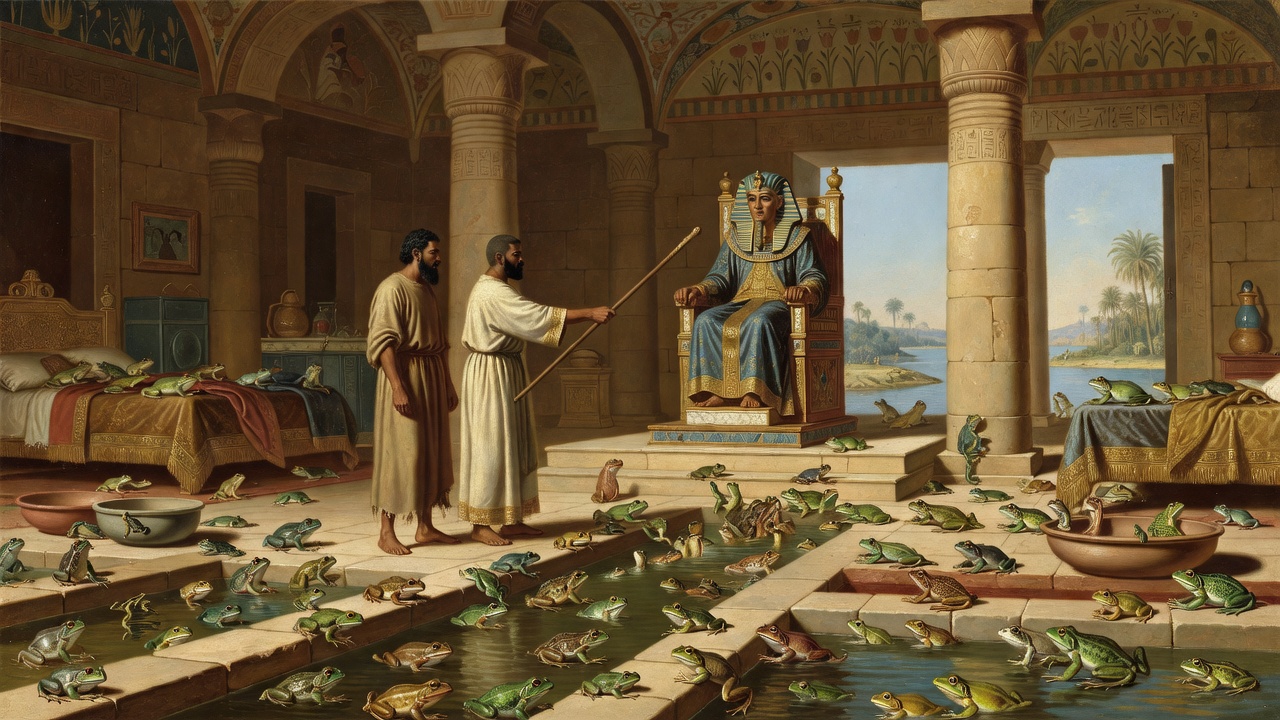
1And the Lord said to Moses, Go in to Pharao, and you shall say to him, These things says the Lord: send forth my people, that they may serve me. 2And if you will not send them forth, behold, I afflict all your borders with frogs: 3and the river shall teem with frogs, and they shall go up and enter into your houses, and into your bed-chambers, and upon your beds, and upon the houses of your servants, and of your people and on your dough, and on your ovens. 4And upon you, and upon your servants, and upon your people, shall the frogs come up. 5And the Lord said to Moses, Say to Aaron your brother, Stretch forth with the hand your rod over the rivers, and over the canals, and over the pools, and bring up the frogs. 6And Aaron stretched forth his hand over the waters of Egypt, and brought up the frogs: and the frog was brought up, and covered the land of Egypt. 7And the charmers of the Egyptians also did likewise with their sorceries, and brought up the frogs on the land of Egypt. 8And Pharao called Moses and Aaron, and said, Pray for me to the Lord, and let him take away the frogs from me and from my people; and I will send them away, and they shall sacrifice to the Lord. 9And Moses said to Pharao, Appoint me a time when I shall pray for you, and for your servants, and for your people, to cause the frogs to disappear from you, and from your people, and from your houses, only in the river shall they be left behind. 10And he said, On the morrow: he said therefore, As you have said; that you may know, that there is no other God but the Lord. 11And the frogs shall be removed away from you, and from your houses and from the villages, and from your servants, and from your people, only in the river they shall be left. 12And Moses and Aaron went forth from Pharao, and Moses cried to the Lord concerning the restriction of the frogs, as Pharao appointed him. 13And the Lord did as Moses said, and the frogs died out of the houses, and out of the villages, and out of the fields. 14And they gathered them together in heaps, and the land stank. 15And when Pharao saw that there was relief, his heart was hardened, and he did not listen to them, as the Lord spoke.
The Third Plague: Gnats
16And the Lord said to Moses, Say to Aaron, Stretch forth your rod with your hand and strike the dust of the earth; and there shall be lice both upon man, and upon quadrupeds, and in all the land of Egypt. 17So Aaron stretched out his rod with his hand, and struck the dust of the earth; and the lice were on men and on quadrupeds, and in all the dust of the earth there were lice. 18And the charmers also did so with their sorceries, to bring forth the louse, and they could not. And the lice were both on the men and on the quadrupeds. 19So the charmers said to Pharao, This is the finger of God. But the heart of Pharao was hardened, and he listened not to them, as the Lord said.
The Fourth Plague: Flies
20And the Lord said to Moses, Rise up early in the morning, and stand before Pharao: and behold, he will go forth to the water, and you shall say to him, These things says the Lord: Send away my people, that they may serve me in the wilderness. 21And if you will not let my people go, behold, I send upon you, and upon your servants, and upon your people, and upon your houses, the dog-fly; and the houses of the Egyptians shall be filled with the dog-fly, even throughout the land upon which they are. 22and I will distinguish marvelously in that day the land of Gesem, on which my people dwell, in which the dog-fly shall not be: that you may know that I am the Lord the God of all the earth. 23And I will put a difference between my people and your people, and on the morrow shall this be on the land. And the Lord did thus. 24And the dog-fly came in abundance into the houses of Pharao, and into the houses of his servants, and into all the land of Egypt; and the land was destroyed by the dog-fly. 25And Pharao called Moses and Aaron, saying, Go and sacrifice to the Lord your God in the land. 26And Moses said, It can’t be so, for we shall sacrifice to the Lord our God the abominations of the Egyptians; for if we sacrifice the abominations of the Egyptians before them, we shall be stoned. 27We will go a journey of three days into the wilderness, and we will sacrifice to the Lord our God, as the Lord said to us. 28And Pharao said, I will let you go, and do you⌃ sacrifice to your God in the wilderness, but do not go very far away: pray then for me to the Lord. 29And Moses said, I then will go forth from you and pray to God, and the dog-fly shall depart both from your servants, and from your people to-morrow. Do not you, Pharao, deceive again, so as not to send the people away to do sacrifice to the Lord. 30And Moses went out from Pharao, and prayed to God. 31And the Lord did as Moses said, and removed the dog-fly from Pharao, and from his servants, and from his people, and there was not one left. 32And Pharao hardened his heart, even on this occasion, and he would not send the people away.
Você sabia?
Três pragas sobre o Egito
- As rãs deste capítulo sobem do Nilo, um nome que o Antigo Testamento não usa. O Easton's Bible Dictionary diz que o rio aparece como Sihor, “a corrente negra”, ou simplesmente “o rio”, e que o Nilo Branco e o Nilo Azul se unem em Cartum, percorrem em seguida 1.800 milhas e entram no Mediterrâneo por dois braços. Arão estende o cajado sobre os rios, os canais e as lagoas, e as rãs cobrem a terra do Egito.Fontes: Nile · o próprio texto bíblico
- Quando as moscas enchem as casas dos egípcios e arruínam a terra, o capítulo diz que nenhuma será encontrada em Gósen, onde vivem os israelitas, como distinção entre os dois povos. O Easton's Bible Dictionary descreve Gósen como um distrito a leste do Nilo, aparentemente não longe da residência real, também chamado terra de Ramessés porque Pitom e Ramessés ficavam dentro de suas fronteiras, e também associa o distrito a Zoã, ou Tânis. O mesmo verbete a chama de “o melhor da terra”.Fontes: Goshen · o próprio texto bíblico
- Moisés e Arão falam com o faraó pessoalmente. O Easton's Bible Dictionary (1897) situa o faraó do Êxodo em Zoã, cenário das entrevistas com eles registradas em Êxodo, mas deixa a identidade em aberto entre Menephtah, ali chamado o décimo quarto e mais velho filho sobrevivente de Ramessés II, e Seti II, e acrescenta que alguns consideram que as evidências favorecem Seti II.Fontes: Pharaoh (of the Exodus) · o próprio texto bíblico
Notas escritas com auxílio de IA a partir de fontes abertas (Theographic Bible Metadata, CC BY-SA 4.0; Easton’s Bible Dictionary, domínio público) e revisadas antes de publicar.
Lugares deste capítulo
- Nile · Hoje: Nile River · 31.465, 30.367 · versículos 3, 9, 11
- Egypt · 30.129, 31.308 · versículos 5, 6, 7, 16, 17, 21, 24
- Goshen · Hoje: Goshen 1 · 30.799, 31.834 · versículo 22
Só aparecem lugares com identificação de alta confiança (90% ou mais segundo as fontes acadêmicas reunidas pelo OpenBible). Mapa da época: DARE (Digital Atlas of the Roman Empire), CC BY 4.0; mapa atual: © colaboradores do OpenStreetMap; lugares: OpenBible.info (CC BY 4.0).
Créditos e licença desta tradução
LXX2012: Septuagint in American English 2012
The Septuagint with Apocrypha, translated from Greek to English by Sir Lancelot C. L. Brenton and published in 1885, with some language updates (American English)
Public Domain
Language: English
Dialect (if applicable): American
Language in English: English
Translation by:
Sir Lancelot Charles Lee Brenton
Michael Paul Johnson
LXX2012: Septuagint in English 2012
This is a translation of the Old Testament and Apocrypha/Deuterocanon from Hebrew to Greek to 19th Century British English, with some updates of spelling and word usage to contemporary American English. The original English translation was done by Sir Lancelot Charles Lee Brenton and published by Samuel Bagster & Sons, Ltd., in London in 1851. It has entered the Public Domain due to the passage of sufficient time. In the process of scanning and typing the text, the original poetry and prose formatting, as well as peripheral material like introductions and notes, have been omitted.
This edition of the Septuagint has some language updates. Brenton's word order and punctuation has been mostly retained, meaning that quotation marks are not used, and sentences within quotes may not start with capital letters, as was standard usage in 1851. Names transliterated from Greek to those transliterated from Hebrew in the common English Bibles often differ. These language updates are dedicated to the Public Domain by the author of those edits, Michael Paul Johnson. Therefore this edition may be freely copied, published, etc.
Before considering making changes to the text of this work, I recommend that you consult with God, because this is really His Book.
If you find errors in the text, please report them so that we can correct them.
Donations to help with the expenses of operating this web site and thus help others have free access to the Word of God may be made to us, but are not required. Please see http://MLJohnson.org/partner/ for more about that.
Títulos de seção adaptados da Berean Standard Bible (domínio público); não fazem parte do texto bíblico desta tradução.
Fonte: http://ebible.org/eng-lxx2012/ · eBible.org