Êxodo 14
LXX2012: Septuagint in American English 2012 · Toque num versículo para ver as referências cruzadas.
Pharaoh Pursues the Israelites
1And the Lord spoke to Moses, saying, 2Speak to the children of Israel, and let them turn and encamp before the village, between Magdol and the sea, opposite Beel-sepphon: before them shall you encamp by the sea. 3And Pharao will say to his people, As for these children of Israel, they are wandering in the land, for the wilderness has shut them in. 4And I will harden the heart of Pharao, and he shall pursue after them; and I will be glorified in Pharao, and in all his host, and all the Egyptians shall know that I am the Lord. And they did so. 5And it was reported to the king of the Egyptians that the people had fled: and the heart of Pharao was turned, and that of his servants against the people; and they said, What is this that we have done, to let the children of Israel go, so that they should not serve us? 6So Pharao yoked his chariots, and led off all his people with himself: 7having also taken six hundred chosen chariots, and all the cavalry of the Egyptians, and rulers over all. 8And the Lord hardened the heart of Pharao king of Egypt, and of his servants, and he pursued after the children of Israel; and the children of Israel went forth with a high hand. 9And the Egyptians pursued after them, and found them encamped by the sea; and all the cavalry and the chariots of Pharao, and the horsemen, and his host were before the village, over against Beel-sepphon. 10And Pharao approached, and the children of Israel having looked up, saw, and the Egyptians encamped behind them: and they were very greatly terrified, and the children of Israel cried to the Lord; 11and said to Moses, Because there were no graves in the land of Egypt, have you brought us forth to kill us in the wilderness? What is this that you have done to us, having brought us out of Egypt? 12Is not this the word which we spoke to you in Egypt, saying, Let us alone that we may serve the Egyptians? for it is better for us to serve the Egyptians than to die in this wilderness. 13And Moses said to the people, Be of good courage: stand and see the salvation which is from the Lord, which he will work for us this day; for as you⌃ have seen the Egyptians today, you⌃ shall see them again no more for ever. 14The Lord shall fight for you, and you⌃ shall hold your peace.
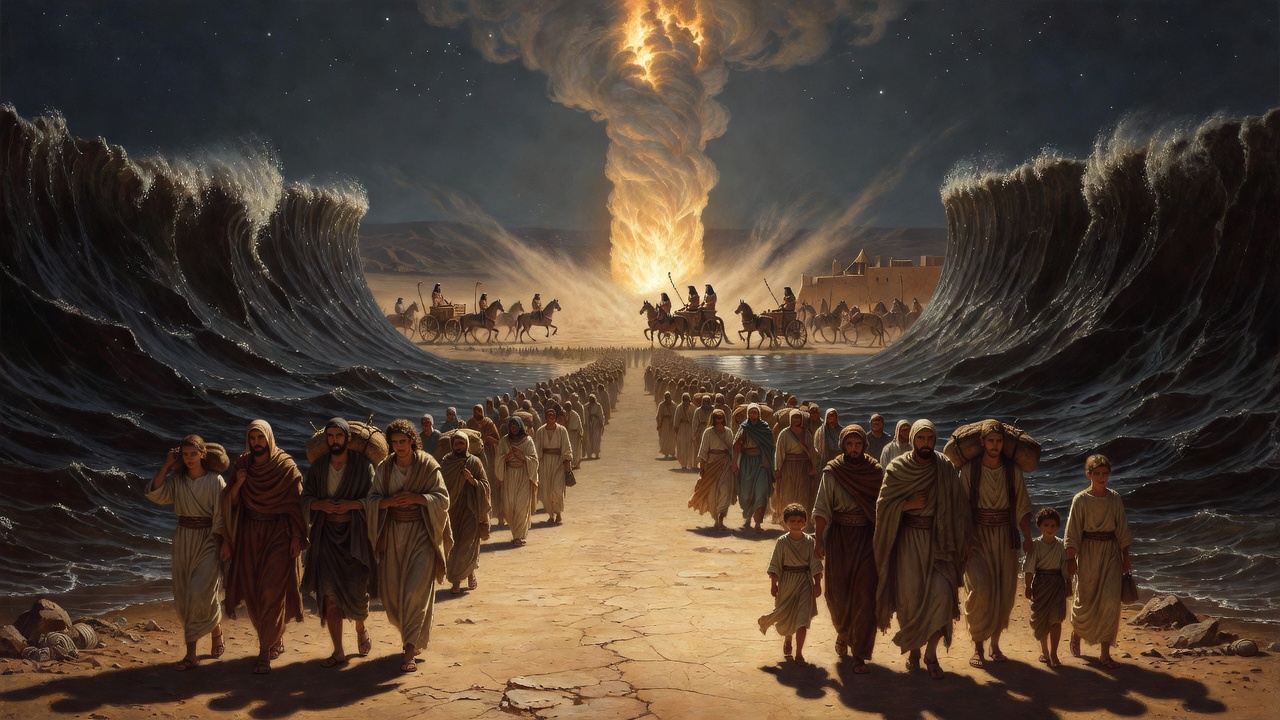
Parting the Red Sea
15and the Lord said to Moses, Why do you cry to me? speak to the children of Israel, and let them proceed. 16And do you lift up your rod, and stretch forth your hand over the sea, and divide it, and let the children of Israel enter into the midst of the sea on the dry land. 17And behold! I will harden the heart of Pharao and of all the Egyptians, and they shall go in after them; and I will be glorified upon Pharao, and on all his host, and on his chariots and his horses. 18And all the Egyptians shall know that I am the Lord, when I am glorified upon Pharao and upon his chariots and his horses. 19And the angel of God that went before the camp of the children of Israel removed and went behind, and the pillar of the cloud also removed from before them and stood behind them. 20And it went between the camp of the Egyptians and the camp of Israel, and stood; and there was darkness and blackness; and the night passed, and they came not near to one another during the whole night. 21And Moses stretched forth his hand over the sea, and the Lord carried back the sea with a strong south wind all the night, and made the sea dry, and the water was divided. 22And the children of Israel went into the midst of the sea on the dry land, and the water of it was a wall on the right hand and a wall on the left. 23And the Egyptians pursued them and went in after them, and every horse of Pharao, and his chariots, and his horsemen, into the midst of the sea. 24And it came to pass in the morning watch that the Lord looked forth on the camp of the Egyptians through the pillar of fire and cloud, and troubled the camp of the Egyptians, 25and bound the axle-trees of their chariots, and caused them to go with difficulty; and the Egyptians said, Let us flee from the face of Israel, for the Lord fights for them against the Egyptians. 26And the Lord said to Moses, Stretch forth your hand over the sea, and let the water be turned back to its place, and let it cover the Egyptians coming both upon the chariots and the riders. 27And Moses stretched forth his hand over the sea, and the water returned to its place toward day; and the Egyptians fled from the water, and the Lord shook off the Egyptians in the midst of the sea. 28and the water returned and covered the chariots and the riders, and all the forces of Pharao, who entered after them into the sea: and there was not left of them even one. 29But the children of Israel went along dry land in the midst of the sea, and the water was to them a wall on the right hand, and a wall on the left. 30So the Lord delivered Israel in that day from the hand of the Egyptians, and Israel saw the Egyptians dead by the shore of the sea. 31And Israel saw the mighty hand, the things which the Lord did to the Egyptians; and the people feared the Lord, and they believed God and Moses his servant.
Você sabia?
Israel encurralado entre o faraó e o mar
- Israel recebeu ordem de voltar atrás e acampar diante de Pi-Hairote, entre Migdol e o mar, bem em frente a Baal-Zefom, para que o faraó pensasse que o deserto os havia encurralado. Pi-Hairote significa lugar onde crescem os juncos, embora a Septuaginta e o copta leiam fazenda, e Baal-Zefom significa Baal do norte.Fontes: o próprio texto bíblico · Pi-hahiroth · Baal-zephon
- O dicionário bíblico de Easton (1897) descreve Baal-Zefom como uma cidade egípcia à beira do golfo de Suez, provavelmente o atual Jebel Deraj ou Kulalah, na margem ocidental, e observa que Baal-zapuna, dos egípcios, era um lugar de culto. Alguns identificaram Pi-Hairote com Ajrud, uma fortaleza entre Etã e Suez. O verbete de Pi-Hairote acrescenta que a condição do istmo de Suez na época do Êxodo não é conhecida com exatidão, de modo que Pi-Hairote e os outros acampamentos de Israel no Egito não podem ser localizados com certeza; o istmo foi formado por depósitos do Nilo.Fontes: Baal-zephon · Pi-hahiroth
- O dicionário bíblico de Easton (1897) diz que o faraó do Êxodo foi provavelmente Menephtah I, o décimo quarto e mais velho filho sobrevivente de Ramsés II, e que ele residia em Zoã, onde ocorreram as entrevistas com Moisés e Arão registradas em Êxodo. O mesmo verbete ainda trata como questão aberta se esse rei foi Seti II ou seu pai Menephtah, e observa que alguns julgam que o peso das evidências favorece Seti II.Fontes: Pharaoh (of the Exodus)
Notas escritas com auxílio de IA a partir de fontes abertas (Theographic Bible Metadata, CC BY-SA 4.0; Easton’s Bible Dictionary, domínio público) e revisadas antes de publicar.
Lugares deste capítulo
Só aparecem lugares com identificação de alta confiança (90% ou mais segundo as fontes acadêmicas reunidas pelo OpenBible). Mapa da época: DARE (Digital Atlas of the Roman Empire), CC BY 4.0; mapa atual: © colaboradores do OpenStreetMap; lugares: OpenBible.info (CC BY 4.0).
Créditos e licença desta tradução
LXX2012: Septuagint in American English 2012
The Septuagint with Apocrypha, translated from Greek to English by Sir Lancelot C. L. Brenton and published in 1885, with some language updates (American English)
Public Domain
Language: English
Dialect (if applicable): American
Language in English: English
Translation by:
Sir Lancelot Charles Lee Brenton
Michael Paul Johnson
LXX2012: Septuagint in English 2012
This is a translation of the Old Testament and Apocrypha/Deuterocanon from Hebrew to Greek to 19th Century British English, with some updates of spelling and word usage to contemporary American English. The original English translation was done by Sir Lancelot Charles Lee Brenton and published by Samuel Bagster & Sons, Ltd., in London in 1851. It has entered the Public Domain due to the passage of sufficient time. In the process of scanning and typing the text, the original poetry and prose formatting, as well as peripheral material like introductions and notes, have been omitted.
This edition of the Septuagint has some language updates. Brenton's word order and punctuation has been mostly retained, meaning that quotation marks are not used, and sentences within quotes may not start with capital letters, as was standard usage in 1851. Names transliterated from Greek to those transliterated from Hebrew in the common English Bibles often differ. These language updates are dedicated to the Public Domain by the author of those edits, Michael Paul Johnson. Therefore this edition may be freely copied, published, etc.
Before considering making changes to the text of this work, I recommend that you consult with God, because this is really His Book.
If you find errors in the text, please report them so that we can correct them.
Donations to help with the expenses of operating this web site and thus help others have free access to the Word of God may be made to us, but are not required. Please see http://MLJohnson.org/partner/ for more about that.
Títulos de seção adaptados da Berean Standard Bible (domínio público); não fazem parte do texto bíblico desta tradução.
Fonte: http://ebible.org/eng-lxx2012/ · eBible.org