2 Samuel 8
LXX2012: Septuagint in American English 2012 · Toque num versículo para ver as referências cruzadas.
David’s Triumphs
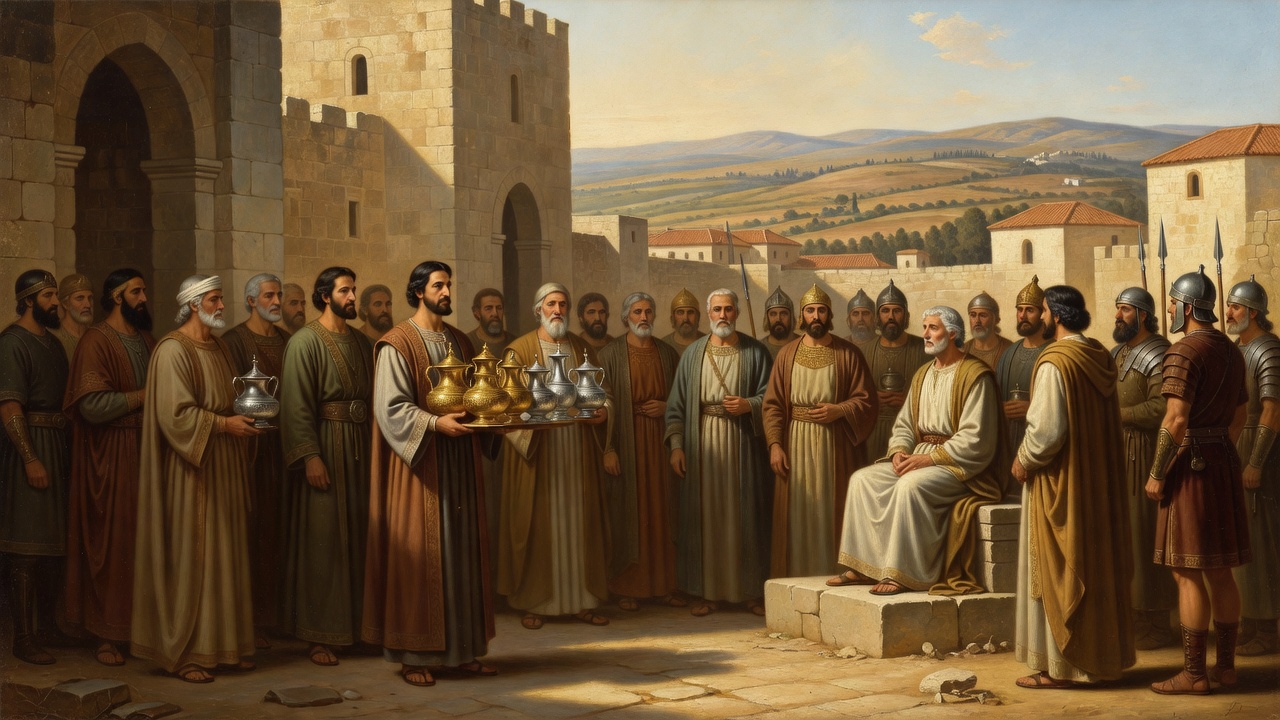
1And it came to pass after this, that David struck the Philistines, and put them to flight, and David took the tribute from out of the hand of the Philistines. 2And David struck Moab, and measured them out with lines, having laid them down on the ground: and there were two lines for slaying, and two lines he kept alive: and Moab became servants to David, yielding tribute. 3And David struck Adraazar the son of Raab king of Suba, as he went to extend his power to the river Euphrates. 4And David took a thousand of his chariots, and seven thousand horsemen, and twenty thousand footmen: and David houghed all his chariot horses, and he reserved to himself one hundred chariots. 5And Syria of Damascus comes to help Adraazar king of Suba, and David struck twenty-two thousand men belonging to the Syrian. 6And David placed a garrison in Syria near Damascus, and the Syrians became servants and tributaries to David: and the Lord preserved David wherever he went. 7And David took the golden bracelets which were on the servants of Adraazar king of Suba, and brought them to Jerusalem. And Susakim king of Egypt took them, when he went up to Jerusalem in the days of Roboam son of Solomon. 8And king David took from Metebac, and from the choice cities of Adraazar, very much brass: with that Solomon made the brazen sea, and the pillars, and the lavers, and all the furniture. 9And You the king of Hemath heard that David had struck all the host of Adraazar. 10And You sent Jedduram his son to king David, to ask him of his welfare, and to congratulate him on his fighting against Adraazar and striking him, for he was an enemy to Adraazar: and in his hands were vessels of silver, and vessels of gold, and vessels of brass. 11And these king David consecrated to the Lord, with the silver and with the gold which he consecrated out of all the cities which he conquered, 12out of Idumea, and out of Moab, and from the children of Ammon, and from the Philistines, and from Amalec, and from the spoils of Adraazar son of Raab king of Suba. 13And David made himself a name: and when he returned he struck Idumea in Gebelem to the number of eighteen thousand. 14And he set garrisons in Idumea, even in all Idumea: and all the Idumeans were servants to the king. And the Lord preserved David wherever he went.
David’s Officers
15And David reigned over all Israel: and David wrought judgment and justice over all his people. 16And Joab the son of Saruia was over the host; and Josaphat the son of Achilud was keeper of the records. 17And Sadoc the son of Achitob, and Achimelech son of Abiathar, were priests; and Sasa was the scribe, 18and Banaeas son of Jodae was councillor, and the Chelethite and the Phelethite, and the sons of David, were princes of the court.
Você sabia?
As Conquistas e a Administração de Davi
- A expressão Metegue-Amá em 2 Samuel 8:1 significa literalmente "o freio da cidade-mãe", uma designação figurativa para a conquista de uma cidade principal, identificada no relato paralelo de 1 Crônicas 18:1 como Gate.Fontes: Metheg-ammah · o próprio texto bíblico
- Hadadezer de Zobá governava um reino arameu que se estendia em direção ao rio Eufrates. A vitória de Davi sobre ele consolidou o controle sobre Damasco e levou o rei Toí de Hamate, antigo rival de Hadadezer, a enviar seu filho Jorão com presentes de ouro, prata e bronze.Fontes: Zobah · Toi · Joram · o próprio texto bíblico
- O capítulo descreve o governo centralizado de Davi, nomeando Joabe como comandante do exército, Josafá como arquivista, Zadoque e Aimeleque como sacerdotes, Seraías como escrivão e Benaia sobre os quereteus e peleteus.Fontes: Joab · o próprio texto bíblico
Notas escritas com auxílio de IA a partir de fontes abertas (Theographic Bible Metadata, CC BY-SA 4.0; Easton’s Bible Dictionary, domínio público) e revisadas antes de publicar.
Lugares deste capítulo
- Moab · Hoje: Moab 1 · 31.181, 35.701 · versículos 2, 12
- Euphrates · Hoje: Euphrates River · 31.004, 47.442 · versículo 3
- Zobah · 33.935, 36.151 · versículos 3, 5, 12
- Damascus · 33.511, 36.306 · versículos 5, 6
- Syria · Hoje: Aram · 33.511, 36.306 · versículo 5
- Aram · 33.511, 36.306 · versículo 6
- Jerusalem · 31.777, 35.234 · versículo 7
- Hamath · Hoje: Hama · 35.136, 36.750 · versículo 9
- Amalek · 30.648, 34.422 · versículo 12
- Ammon · 31.955, 35.934 · versículo 12
- Edom · 30.746, 35.604 · versículos 12, 13, 14
- Philistia · 31.664, 34.546 · versículo 12
Só aparecem lugares com identificação de alta confiança (90% ou mais segundo as fontes acadêmicas reunidas pelo OpenBible). Mapa da época: DARE (Digital Atlas of the Roman Empire), CC BY 4.0; mapa atual: © colaboradores do OpenStreetMap; lugares: OpenBible.info (CC BY 4.0).
Créditos e licença desta tradução
LXX2012: Septuagint in American English 2012
The Septuagint with Apocrypha, translated from Greek to English by Sir Lancelot C. L. Brenton and published in 1885, with some language updates (American English)
Public Domain
Language: English
Dialect (if applicable): American
Language in English: English
Translation by:
Sir Lancelot Charles Lee Brenton
Michael Paul Johnson
LXX2012: Septuagint in English 2012
This is a translation of the Old Testament and Apocrypha/Deuterocanon from Hebrew to Greek to 19th Century British English, with some updates of spelling and word usage to contemporary American English. The original English translation was done by Sir Lancelot Charles Lee Brenton and published by Samuel Bagster & Sons, Ltd., in London in 1851. It has entered the Public Domain due to the passage of sufficient time. In the process of scanning and typing the text, the original poetry and prose formatting, as well as peripheral material like introductions and notes, have been omitted.
This edition of the Septuagint has some language updates. Brenton's word order and punctuation has been mostly retained, meaning that quotation marks are not used, and sentences within quotes may not start with capital letters, as was standard usage in 1851. Names transliterated from Greek to those transliterated from Hebrew in the common English Bibles often differ. These language updates are dedicated to the Public Domain by the author of those edits, Michael Paul Johnson. Therefore this edition may be freely copied, published, etc.
Before considering making changes to the text of this work, I recommend that you consult with God, because this is really His Book.
If you find errors in the text, please report them so that we can correct them.
Donations to help with the expenses of operating this web site and thus help others have free access to the Word of God may be made to us, but are not required. Please see http://MLJohnson.org/partner/ for more about that.
Títulos de seção adaptados da Berean Standard Bible (domínio público); não fazem parte do texto bíblico desta tradução.
Fonte: http://ebible.org/eng-lxx2012/ · eBible.org