2 Samuel 2
LXX2012: Septuagint in American English 2012 · Toque num versículo para ver as referências cruzadas.
David Anointed King of Judah
1And it came to pass after this that David enquired of the Lord, saying, Shall I go up into one of the cities of Juda? and the Lord said to him, Go up. And David said, Whither shall I go up? and he said, To Chebron. 2And David went up there to Chebron, he and both his wives, Achinaam the Jezraelitess, and Abigaia the wife of Nabal the Carmelite, 3and the men that were with him, every one and his family; and they lived in the cities of Chebron. 4And the men of Judea come, and anoint David there to reign over the house of Juda; and they reported to David, saying, The men of Jabis of the country of Galaad have buried Saul. 5And David sent messengers to the rulers of Jabis of the country of Galaad, and David said to them, Blessed be you⌃ of the Lord, because you⌃ have wrought this mercy toward your lord, even toward Saul the anointed of the Lord, and you⌃ have buried him and Jonathan his son. 6And now may the Lord deal in mercy and truth towards you: and I also will requite towards you this good deed, because you⌃ have done this. 7And now let your hands be made strong, and be valiant; for your master Saul is dead, and moreover the house of Juda have anointed me to be king over them.
Ish-bosheth Made King of Israel
8But Abenner, the son of Ner, the commander-in-chief of Saul's army, took Jebosthe son of Saul, and brought him up from the camp to Manaem 9and made him king over the land of Galaad, and over Thasiri, and over Jezrael, and over Ephraim, and over Benjamin, and over all Israel. 10Jebosthe, Saul's son was forty years old, when he reigned over Israel; and he reigned two years, but not over the house of Juda, who followed David. 11And the days which David reigned in Chebron over the house of Juda were seven years and six months.
The Battle of Gibeon
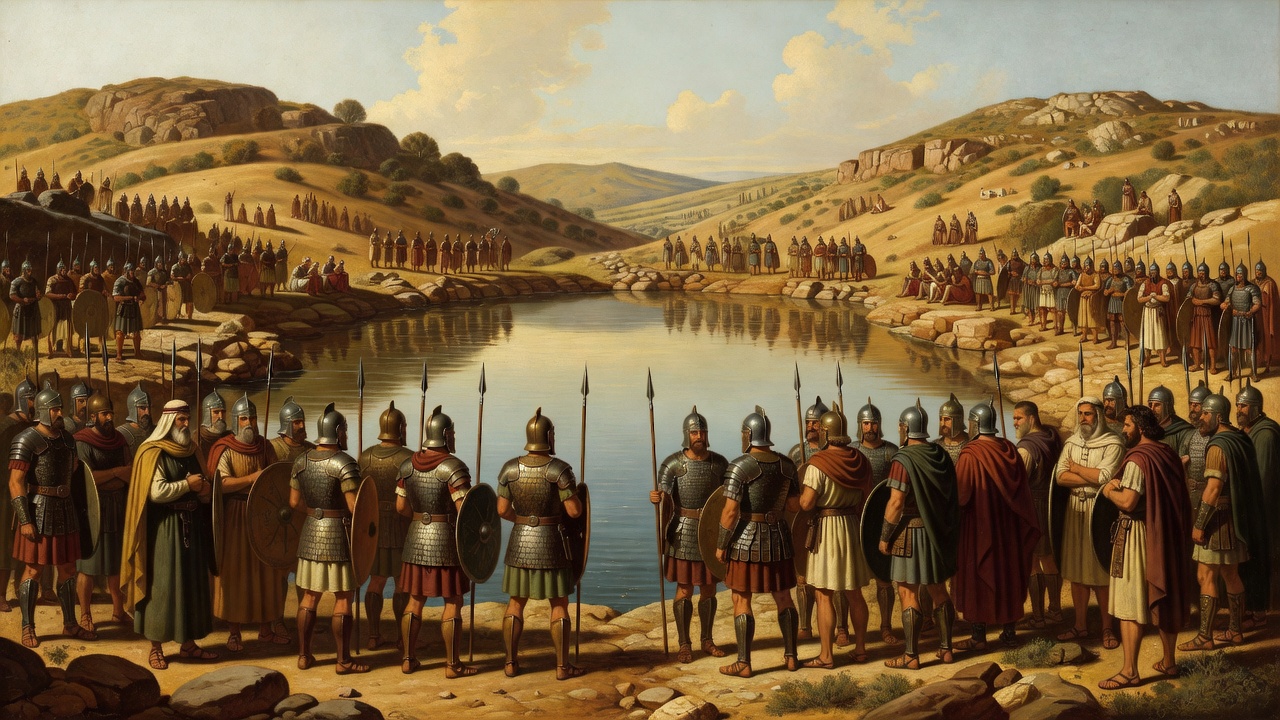
12And Abenner the son of Ner went forth, and the servants of Jebosthe the son of Saul, from Manaem to Gabaon. 13And Joab the son of Saruia, and the servants of David, went forth from Chebron, and met them at the fountain of Gabaon, at the same place: and these sat down by the fountain on this side, and those by the fountain on that side. 14And Abenner said to Joab, Let now the young men arise, and play before us. And Joab said, Let them arise. 15And there arose and passed over by number twelve of the children of Benjamin, belonging to Jebosthe the son of Saul, and twelve of the servants of David. 16And they seized every one the head of his neighbor with his hand, and his sword was thrust into the side of his neighbor, and they fall down together: and the name of that place was called The portion of the treacherous ones, which is in Gabaon. 17And the battle was very severe on that day; and Abenner and the men of Israel were worsted before the servants of David. 18And there were there the three sons of Saruia, Joab, and Abessa, and Asael: and Asael was swift in his feet as a roe in the field. 19And Asael followed after Abenner, and turned not to go to the right hand or to the left from following Abenner. 20And Abenner looked behind him, and said, Are you Asael himself? and he said, I am. 21And Abenner said to him, Turn you to the right hand or to the left, and lay hold for yourself on one of the young men, and take to yourself his armor: but Asel would not turn back from following him. 22And Abenner said yet again to Asael, Stand aloof from me, lest I strike you to the ground? and how should I lift up my face to Joab? 23And what does this mean? return to Joab your brother? But he would not stand aloof; and Abenner smites him with the hinder end of the spear on the loins, and the spear went out behind him, and he falls there and dies on the spot: and it came to pass that every one that came to the place where Asael fell and died, stood still. 24And Joab and Abessa pursued after Abenner, and the sun went down: and they went as far as the hill of Amman, which is in the front of Gai, by the desert way of Gabaon. 25And the children of Benjamin who followed Abenner gather themselves together, and they formed themselves into one body, and stood on the top of a hill. 26And Abenner called Joab, and said, Shall the sword devour perpetually? know you not that it will be bitter at last? How long then will you refuse to tell the people to turn from following our brethren? 27And Joab said, As the Lord lives, if you had not spoken, even from the morning the people had gone up every one from following his brother. 28And Joab sounded the trumpet, and all the people departed, and did not pursue after Israel, and did not fight any longer. 29And Abenner and his men departed at evening, and went all that night, and crossed over Jordan, and went along the whole adjacent country, and they come to the camp. 30And Joab returned from following Abenner, and he assembled all the people, and there were missing of the people of David, nineteen men, and Asael. 31And the servants of David struck of the children of Benjamin, of the men of Abenner, three hundred and sixty men belonging to him. 32And they take up Asael, and bury him in the tomb of his father in Bethleem. And Joab and the men with him went all the night, and the morning rose upon them in Chebron.
Você sabia?
Dois reis e o confronto em Gibeão
- Após a morte de Saul, a nação se dividiu em dois reinos rivais. A tribo de Judá ungiu Davi como rei na cidade de Hebrom, ao sul, enquanto Abner, general de Saul, estabeleceu Isbosete, filho sobrevivente de Saul, para governar as tribos do norte a partir de Maanaim, a leste do rio Jordão.Fontes: o próprio texto bíblico · Abner · Ish-bosheth · Mahanaim
- Os principais comandantes militares de Davi — Joabe, Abisai e Asael — eram filhos de Zeruia, irmã de Davi. Esse estreito vínculo familiar colocou os sobrinhos de Davi no comando das forças de Judá durante as hostilidades contra a casa de Saul.Fontes: o próprio texto bíblico · Joab · Zeruiah · Asahel
- O conflito civil se intensificou junto ao açude de Gibeão por meio de um combate representativo entre doze guerreiros de Benjamim e doze das forças de Davi. Como todos os vinte e quatro lutadores morreram juntos na luta, o local recebeu o nome de Helcate-Hazurim antes de eclodir a batalha generalizada.Fontes: o próprio texto bíblico · Gibeon
Notas escritas com auxílio de IA a partir de fontes abertas (Theographic Bible Metadata, CC BY-SA 4.0; Easton’s Bible Dictionary, domínio público) e revisadas antes de publicar.
Lugares deste capítulo
- Hebron · Hoje: Tel Rumeida · 31.525, 35.102 · versículos 1, 3, 4, 11, 32
- Gilead · Hoje: Gilead 1 · 32.187, 35.692 · versículo 9
- Gibeon · Hoje: El Jib · 31.847, 35.183 · versículos 12, 13, 16, 24
- Helkath-hazzurim · Hoje: within 500 m of El Jib · 31.847, 35.183 · versículo 16
- Arabah · 30.417, 35.151 · versículo 29
- Jordan · Hoje: Jordan River · 31.761, 35.558 · versículo 29
- Bethlehem · 31.704, 35.208 · versículo 32
Só aparecem lugares com identificação de alta confiança (90% ou mais segundo as fontes acadêmicas reunidas pelo OpenBible). Mapa da época: DARE (Digital Atlas of the Roman Empire), CC BY 4.0; mapa atual: © colaboradores do OpenStreetMap; lugares: OpenBible.info (CC BY 4.0).
Créditos e licença desta tradução
LXX2012: Septuagint in American English 2012
The Septuagint with Apocrypha, translated from Greek to English by Sir Lancelot C. L. Brenton and published in 1885, with some language updates (American English)
Public Domain
Language: English
Dialect (if applicable): American
Language in English: English
Translation by:
Sir Lancelot Charles Lee Brenton
Michael Paul Johnson
LXX2012: Septuagint in English 2012
This is a translation of the Old Testament and Apocrypha/Deuterocanon from Hebrew to Greek to 19th Century British English, with some updates of spelling and word usage to contemporary American English. The original English translation was done by Sir Lancelot Charles Lee Brenton and published by Samuel Bagster & Sons, Ltd., in London in 1851. It has entered the Public Domain due to the passage of sufficient time. In the process of scanning and typing the text, the original poetry and prose formatting, as well as peripheral material like introductions and notes, have been omitted.
This edition of the Septuagint has some language updates. Brenton's word order and punctuation has been mostly retained, meaning that quotation marks are not used, and sentences within quotes may not start with capital letters, as was standard usage in 1851. Names transliterated from Greek to those transliterated from Hebrew in the common English Bibles often differ. These language updates are dedicated to the Public Domain by the author of those edits, Michael Paul Johnson. Therefore this edition may be freely copied, published, etc.
Before considering making changes to the text of this work, I recommend that you consult with God, because this is really His Book.
If you find errors in the text, please report them so that we can correct them.
Donations to help with the expenses of operating this web site and thus help others have free access to the Word of God may be made to us, but are not required. Please see http://MLJohnson.org/partner/ for more about that.
Títulos de seção adaptados da Berean Standard Bible (domínio público); não fazem parte do texto bíblico desta tradução.
Fonte: http://ebible.org/eng-lxx2012/ · eBible.org