1 Reis 10
LXX2012: Septuagint in American English 2012 · Toque num versículo para ver as referências cruzadas.
The Queen of Sheba
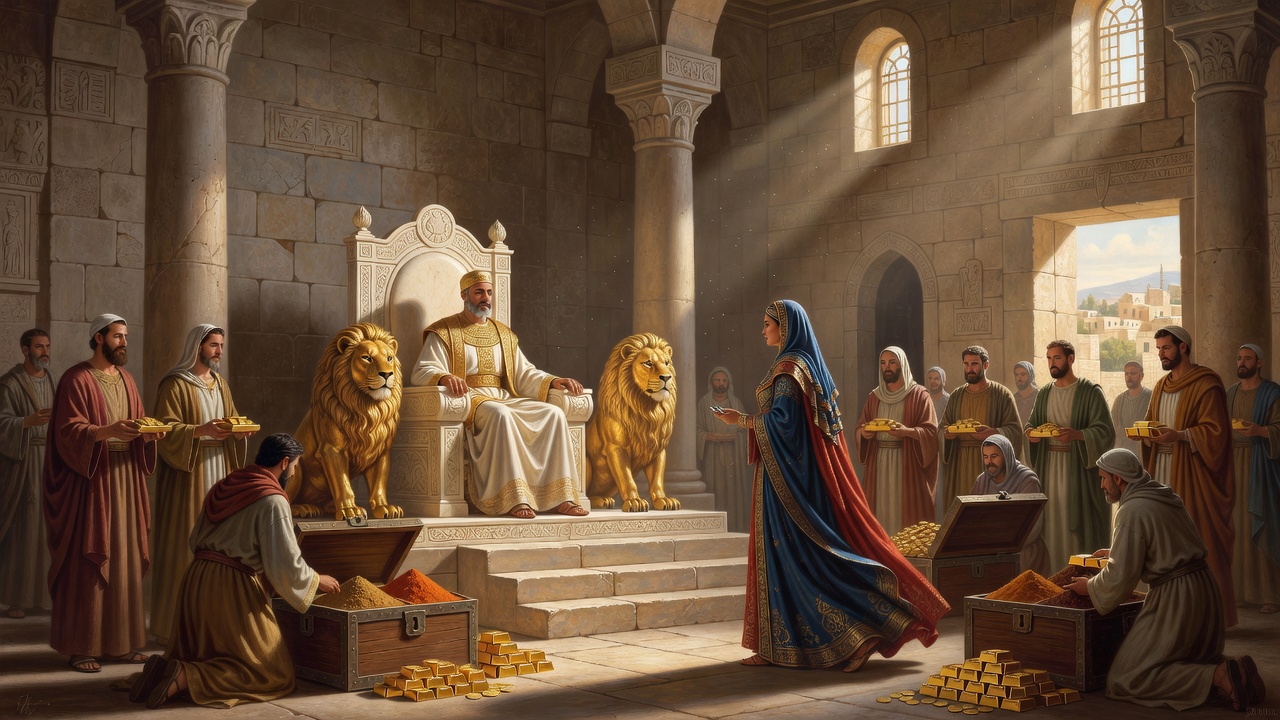
1And the queen of Saba heard of the name of Solomon, and the name of the Lord, and she came to try him with riddles. 2And she came to Jerusalem with a very great train; and there came camels bearing spices, and very much gold, and precious stones: and she came in to Solomon, and told him all that was in her heart. 3And Solomon answered all her questions: and there was not a question overlooked by the king which he did not answer her. 4And the queen of Saba saw all the wisdom of Solomon, and the house which he built, 5and the provision of Solomon and the sitting of his attendants, and the standing of his servants, and his raiment, and his cupbearers, and his whole burnt offering which he offered in the house of the Lord, and she was utterly amazed. 6And she said to king Solomon, It was a true report which I heard in my land of your words and your wisdom. 7But I believed not them that told me, until I came and my eyes saw: and, behold, the words as they reported to me are not the half: you have exceeded in goodness all the report which I heard in my land. 8Blessed are your wives, blessed are these your servants who stand before you continually, who hear all your wisdom. 9Blessed be the Lord your God, who has taken pleasure in you, to set you upon the throne of Israel, because the Lord loved Israel to establish him for ever; and he has made you king over them, to execute judgment with justice, and in their causes. 10And she gave to Solomon one hundred and twenty talents of gold, and very many spices, and precious stones: there had not come any other spices so abundant as those which the queen of Saba gave to king Solomon. 11And the ship of Chiram which brought the gold from Suphir, brought very much hewn timber and precious stones. 12And the king made the hewn timber into buttresses of the house of the Lord and the king's house, and lyres and harps for singers: such hewn timber had not come upon the earth, nor have been seen anywhere until this day. 13And king Solomon gave to the queen of Saba all that she desired, whatever she asked, besides all that he had given her by the hand of king Solomon: and she returned, and came into her own land, she and her servants.
Solomon’s Wealth and Splendor
14And the weight of gold that came to Solomon in one year was six hundred and sixty-six talents of gold. 15Besides the tributes of them that were subjects, both merchants and all the kings of the country beyond the river, and of the princes of the land. 16And Solomon made three hundred spears of beaten gold: three hundred shekels of gold were upon one spear. 17And three hundred shields of beaten gold: and three pounds of gold were in one shield: and the king put them in the house of the forest of Lebanon. 18And the king made a great ivory throne, and gilded it with pure gold. 19The throne had six steps, and calves in bold relief to the throne behind it, and side-pieces on either hand of the place of the seat, and two lions standing by the side-pieces, 20and twelve lions standing there on the six steps on either side: it was not so done in any other kingdom. 21And all the vessels made by Solomon were of gold, and the lavers were golden, and all the vessels of the house of the forest of Lebanon were of pure gold; there was no silver, for it was not accounted of in the days of Solomon. 22For Solomon had a ship of Tharsis in the sea with the ships of Chiram: one ship came to the king every three years out of Tharsis, laden with gold and silver, and wrought stones, and hewn stones.
This was the arrangement of the provision which king Solomon fetched to build the house of the Lord, and the house of the king, and the wall of Jerusalem, and the citadel; to fortify the city of David, and Assur, and Magdal, and Gazer, and Baethoron the upper, and Jethermath, and all the cities of the chariots, and all the cities of the horsemen, and the fortification of Solomon which he purposed to build in Jerusalem and in all the land, so that none of the people should rule over him that was left of the Chettite and the Amorite, and the Pherezite, and the Chananite, and the Evite, and the Jebusite, and the Gergesite, who were not of the children of Israel, their descendants who had been left with him in the land, whom the children of Israel could not utterly destroy; and Solomon made them tributaries until this day. But of the children of Israel Solomon made nothing; for they were the warriors, and his servants and rulers, and captains of the third order, and the captains of his chariots, and his horsemen. 23And Solomon increased beyond all the kings of the earth in wealth and wisdom. 24And all the kings of the earth sought the presence of Solomon, to hear his wisdom which the Lord had put into his heart. 25And they brought every one their gifts, vessels of gold, and raiment, and stacte, and spices, and horses, and mules, a rate year by year. 26And Solomon had four thousand mares for his chariots, and twelve thousand horsemen: and he put them in the cities of his chariots, and with the king in Jerusalem: and he ruled over all the kings from the river to the land of the Philistines, and to the borders of Egypt. 27And the king made gold and silver in Jerusalem as stones, and he made cedars as the sycamores in the plain for multitude. 28And the goings forth of Solomon's horsemen was also out of Egypt, and the king's merchants were of Thecue; and they received them out of Thecue at a price. 29And that which proceeded out of Egypt went up thus, even a chariot for one hundred shekels of silver, and a horse for fifty shekels of silver: and thus for all the kings of the Chettians, and the kings of Syria, they came out by sea.
Você sabia?
O Esplendor de Salomão e a Rainha de Sabá
- Sabá é identificada com Sabá no sul da Arábia, um reino famoso no mundo antigo pelo lucrativo comércio de especiarias e aromas. A visita da rainha com uma grande caravana de camelos trazendo especiarias, ouro e pedras preciosas refletia interesses diplomáticos e a riqueza comercial de sua região.Fontes: Sheba · o próprio texto bíblico
- Salomão aliou-se ao rei Hirão de Tiro para realizar expedições marítimas a terras distantes como Ofir e Társis. Essas frotas retornavam com mercadorias raras, incluindo madeira de almugue, marfim, pedras preciosas e ouro, enriquecendo ainda mais a corte real em Jerusalém.Fontes: Hiram · Ophir · Tarshish · o próprio texto bíblico
- O texto bíblico descreve o elaborado trono de marfim de Salomão revestido de ouro puro, situado sobre seis degraus ladeados por doze leões esculpidos. Essa mobília extravagante e os recipientes de ouro para beber destacavam a prosperidade sem precedentes de seu reinado.Fontes: o próprio texto bíblico
Notas escritas com auxílio de IA a partir de fontes abertas (Theographic Bible Metadata, CC BY-SA 4.0; Easton’s Bible Dictionary, domínio público) e revisadas antes de publicar.
Lugares deste capítulo
- Sheba · 15.348, 44.206 · versículos 1, 4, 10, 13
- Jerusalem · 31.777, 35.234 · versículos 2, 26, 27
- Arabia · Hoje: Arabian Peninsula · 23.000, 46.000 · versículo 15
- House of the Forest of Lebanon · Hoje: in Jerusalem · 31.777, 35.234 · versículos 17, 21
- Shephelah · 31.692, 34.875 · versículo 27
- Egypt · 30.129, 31.308 · versículos 28, 29
- Syria · Hoje: Aram · 33.511, 36.306 · versículo 29
Só aparecem lugares com identificação de alta confiança (90% ou mais segundo as fontes acadêmicas reunidas pelo OpenBible). Mapa da época: DARE (Digital Atlas of the Roman Empire), CC BY 4.0; mapa atual: © colaboradores do OpenStreetMap; lugares: OpenBible.info (CC BY 4.0).
Créditos e licença desta tradução
LXX2012: Septuagint in American English 2012
The Septuagint with Apocrypha, translated from Greek to English by Sir Lancelot C. L. Brenton and published in 1885, with some language updates (American English)
Public Domain
Language: English
Dialect (if applicable): American
Language in English: English
Translation by:
Sir Lancelot Charles Lee Brenton
Michael Paul Johnson
LXX2012: Septuagint in English 2012
This is a translation of the Old Testament and Apocrypha/Deuterocanon from Hebrew to Greek to 19th Century British English, with some updates of spelling and word usage to contemporary American English. The original English translation was done by Sir Lancelot Charles Lee Brenton and published by Samuel Bagster & Sons, Ltd., in London in 1851. It has entered the Public Domain due to the passage of sufficient time. In the process of scanning and typing the text, the original poetry and prose formatting, as well as peripheral material like introductions and notes, have been omitted.
This edition of the Septuagint has some language updates. Brenton's word order and punctuation has been mostly retained, meaning that quotation marks are not used, and sentences within quotes may not start with capital letters, as was standard usage in 1851. Names transliterated from Greek to those transliterated from Hebrew in the common English Bibles often differ. These language updates are dedicated to the Public Domain by the author of those edits, Michael Paul Johnson. Therefore this edition may be freely copied, published, etc.
Before considering making changes to the text of this work, I recommend that you consult with God, because this is really His Book.
If you find errors in the text, please report them so that we can correct them.
Donations to help with the expenses of operating this web site and thus help others have free access to the Word of God may be made to us, but are not required. Please see http://MLJohnson.org/partner/ for more about that.
Títulos de seção adaptados da Berean Standard Bible (domínio público); não fazem parte do texto bíblico desta tradução.
Fonte: http://ebible.org/eng-lxx2012/ · eBible.org