Jó 14
American Standard Version (1901) · Toque num versículo para ver as referências cruzadas.
Job Laments the Finality of Death
1Man, that is born of a woman,
Is of few days, and full of trouble.
2He cometh forth like a flower, and is cut down:
He fleeth also as a shadow, and continueth not.
3And dost thou open thine eyes upon such a one,
And bringest me into judgment with thee?
4Who can bring a clean thing out of an unclean? not one.
5Seeing his days are determined,
The number of his months is with thee,
And thou hast appointed his bounds that he cannot pass;
6Look away from him, that he may rest,
Till he shall accomplish, as a hireling, his day.
7For there is hope of a tree,
If it be cut down, that it will sprout again,
And that the tender branch thereof will not cease.
8Though the root thereof wax old in the earth,
And the stock thereof die in the ground;
9Yet through the scent of water it will bud,
And put forth boughs like a plant.
10But man dieth, and is laid low:
Yea, man giveth up the ghost, and where is he?
11As the waters fail from the sea,
And the river wasteth and drieth up;
12So man lieth down and riseth not:
Till the heavens be no more, they shall not awake,
Nor be roused out of their sleep.
13Oh that thou wouldest hide me in Sheol,
That thou wouldest keep me secret, until thy wrath be past,
That thou wouldest appoint me a set time, and remember me!
14If a man die, shall he live again?
All the days of my warfare would I wait,
Till my release should come.
15Thou wouldest call, and I would answer thee:
Thou wouldest have a desire to the work of thy hands.
16But now thou numberest my steps:
Dost thou not watch over my sin?
17My transgression is sealed up in a bag,
And thou fastenest up mine iniquity.
18But the mountain falling cometh to nought;
And the rock is removed out of its place;
19The waters wear the stones;
The overflowings thereof wash away the dust of the earth:
So thou destroyest the hope of man.
20Thou prevailest for ever against him, and he passeth;
Thou changest his countenance, and sendest him away.
21His sons come to honor, and he knoweth it not;
And they are brought low, but he perceiveth it not of them.
22But his flesh upon him hath pain,
And his soul within him mourneth.
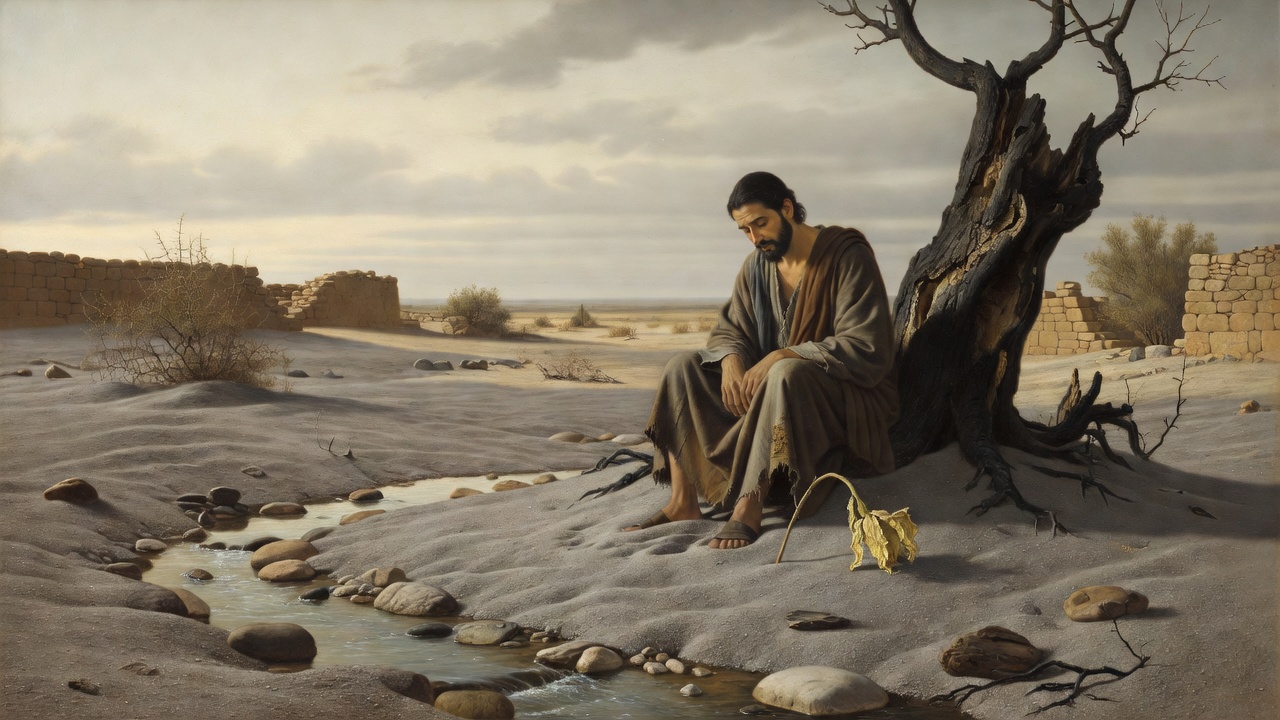
Você sabia?
A Fragilidade da Vida e a Esperança de Renovação
- Neste discurso, Jó contrasta o destino dos mortais com o de uma árvore. Enquanto uma árvore cortada pode brotar novamente ao menor cheiro de água, mesmo que seu tronco pareça morto, o ser humano morre, se deita e não volta a se levantar nesta terra.Fontes: o próprio texto bíblico
- Jó contempla o Sheol como um possível refúgio onde poderia ficar oculto até passar a ira divina, imaginando um momento em que Deus guardaria suas transgressões em um saco selado e chamaria pela obra de Suas mãos.Fontes: o próprio texto bíblico
- Para ilustrar a brevidade e o desgaste da existência humana, o capítulo recorre a metáforas naturais de erosão e efemeridade, comparando a vida a uma sombra passageira, a uma flor murcha e a rochas desgastadas pela água.Fontes: o próprio texto bíblico
Notas escritas com auxílio de IA a partir de fontes abertas (Theographic Bible Metadata, CC BY-SA 4.0; Easton’s Bible Dictionary, domínio público) e revisadas antes de publicar.
Créditos e licença desta tradução
American Standard Version (1901)
The American Standard Version of the Holy Bible, first published in 1901.
Public Domain
Language: English
Dialect: Archaic American
This public domain Bible translation is brought to you courtesy of eBible.org.
If you would like to make a donation to help keep free Bible access like this going, please visit https://eBible.org/give.php .
2026-10-02
Títulos de seção adaptados da Berean Standard Bible (domínio público); não fazem parte do texto bíblico desta tradução.
Fonte: http://ebible.org/eng-asv/ · eBible.org