Ezequiel 19
American Standard Version (1901) · Toque num versículo para ver as referências cruzadas.
A Lament for the Princes of Israel
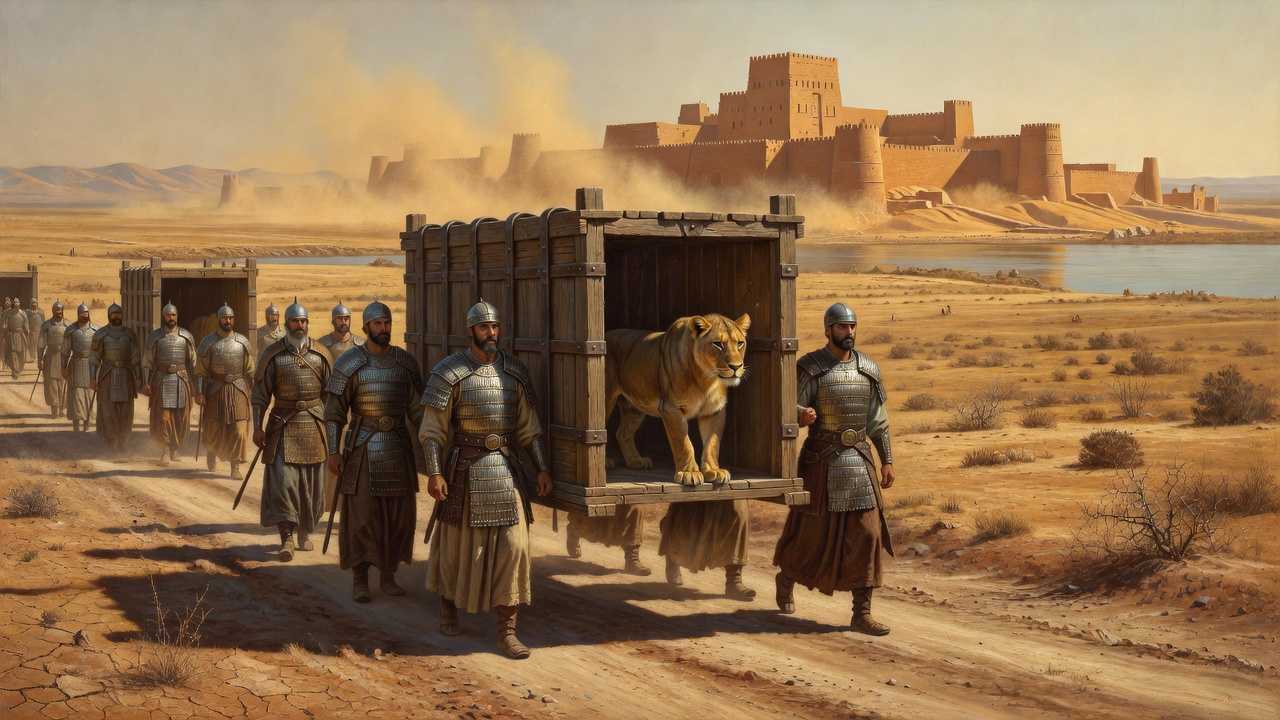
1Moreover, take thou up a lamentation for the princes of Israel, 2and say, What was thy mother? A lioness: she couched among lions, in the midst of the young lions she nourished her whelps. 3And she brought up one of her whelps: he became a young lion, and he learned to catch the prey; he devoured men. 4The nations also heard of him; he was taken in their pit; and they brought him with hooks unto the land of Egypt. 5Now when she saw that she had waited, and her hope was lost, then she took another of her whelps, and made him a young lion. 6And he went up and down among the lions; he became a young lion, and he learned to catch the prey; he devoured men. 7And he knew their palaces, and laid waste their cities; and the land was desolate, and the fulness thereof, because of the noise of his roaring. 8Then the nations set against him on every side from the provinces; and they spread their net over him; he was taken in their pit. 9And they put him in a cage with hooks, and brought him to the king of Babylon; they brought him into strongholds, that his voice should no more be heard upon the mountains of Israel.
10Thy mother was like a vine, in thy blood, planted by the waters: it was fruitful and full of branches by reason of many waters. 11And it had strong rods for the sceptres of them that bare rule, and their stature was exalted among the thick boughs, and they were seen in their height with the multitude of their branches. 12But it was plucked up in fury, it was cast down to the ground, and the east wind dried up its fruit: its strong rods were broken off and withered; the fire consumed them. 13And now it is planted in the wilderness, in a dry and thirsty land. 14And fire is gone out of the rods of its branches, it hath devoured its fruit, so that there is in it no strong rod to be a sceptre to rule. This is a lamentation, and shall be for a lamentation.
Você sabia?
Um Lamento pelos Príncipes de Israel
- Ezequiel estrutura este cântico fúnebre como uma alegoria de uma leoa criando seus filhotes. O primeiro filhote aprende a despedaçar a presa, mas é capturado com ganchos e levado ao Egito, enquanto o segundo é apanhado numa rede, colocado em uma jaula e levado cativo ao rei da Babilônia.Fontes: o próprio texto bíblico · Egypt · Babylon
- A segunda metade do lamento compara a linhagem real a uma videira viçosa plantada junto a muitas águas, que produzia ramos fortes adequados para cetros de governantes. Ela retrata a videira sendo arrancada com furor, ressecada pelo vento oriental, consumida pelo fogo e transplantada para um deserto árido.Fontes: o próprio texto bíblico
Notas escritas com auxílio de IA a partir de fontes abertas (Theographic Bible Metadata, CC BY-SA 4.0; Easton’s Bible Dictionary, domínio público) e revisadas antes de publicar.
Lugares deste capítulo
Só aparecem lugares com identificação de alta confiança (90% ou mais segundo as fontes acadêmicas reunidas pelo OpenBible). Mapa da época: DARE (Digital Atlas of the Roman Empire), CC BY 4.0; mapa atual: © colaboradores do OpenStreetMap; lugares: OpenBible.info (CC BY 4.0).
Créditos e licença desta tradução
American Standard Version (1901)
The American Standard Version of the Holy Bible, first published in 1901.
Public Domain
Language: English
Dialect: Archaic American
This public domain Bible translation is brought to you courtesy of eBible.org.
If you would like to make a donation to help keep free Bible access like this going, please visit https://eBible.org/give.php .
2026-10-02
Títulos de seção adaptados da Berean Standard Bible (domínio público); não fazem parte do texto bíblico desta tradução.
Fonte: http://ebible.org/eng-asv/ · eBible.org