Deuteronômio 24
American Standard Version (1901) · Toque num versículo para ver as referências cruzadas.
Marriage and Divorce Laws
1When a man taketh a wife, and marrieth her, then it shall be, if she find no favor in his eyes, because he hath found some unseemly thing in her, that he shall write her a bill of divorcement, and give it in her hand, and send her out of his house. 2And when she is departed out of his house, she may go and be another man’s wife. 3And if the latter husband hate her, and write her a bill of divorcement, and give it in her hand, and send her out of his house; or if the latter husband die, who took her to be his wife; 4her former husband, who sent her away, may not take her again to be his wife, after that she is defiled; for that is abomination before Jehovah: and thou shalt not cause the land to sin, which Jehovah thy God giveth thee for an inheritance.
5When a man taketh a new wife, he shall not go out in the host, neither shall he be charged with any business: he shall be free at home one year, and shall cheer his wife whom he hath taken.
Additional Laws
6No man shall take the mill or the upper millstone to pledge; for he taketh a man’s life to pledge.
7If a man be found stealing any of his brethren of the children of Israel, and he deal with him as a slave, or sell him; then that thief shall die: so shalt thou put away the evil from the midst of thee.
8Take heed in the plague of leprosy, that thou observe diligently, and do according to all that the priests the Levites shall teach you: as I commanded them, so ye shall observe to do. 9Remember what Jehovah thy God did unto Miriam, by the way as ye came forth out of Egypt.
10When thou dost lend thy neighbor any manner of loan, thou shalt not go into his house to fetch his pledge. 11Thou shalt stand without, and the man to whom thou dost lend shall bring forth the pledge without unto thee. 12And if he be a poor man, thou shalt not sleep with his pledge; 13thou shalt surely restore to him the pledge when the sun goeth down, that he may sleep in his garment, and bless thee: and it shall be righteousness unto thee before Jehovah thy God.
14Thou shalt not oppress a hired servant that is poor and needy, whether he be of thy brethren, or of thy sojourners that are in thy land within thy gates: 15in his day thou shalt give him his hire, neither shall the sun go down upon it (for he is poor, and setteth his heart upon it); lest he cry against thee unto Jehovah, and it be sin unto thee.
16The fathers shall not be put to death for the children, neither shall the children be put to death for the fathers: every man shall be put to death for his own sin.
17Thou shalt not wrest the justice due to the sojourner, or to the fatherless, nor take the widow’s raiment to pledge; 18but thou shalt remember that thou wast a bondman in Egypt, and Jehovah thy God redeemed thee thence: therefore I command thee to do this thing.
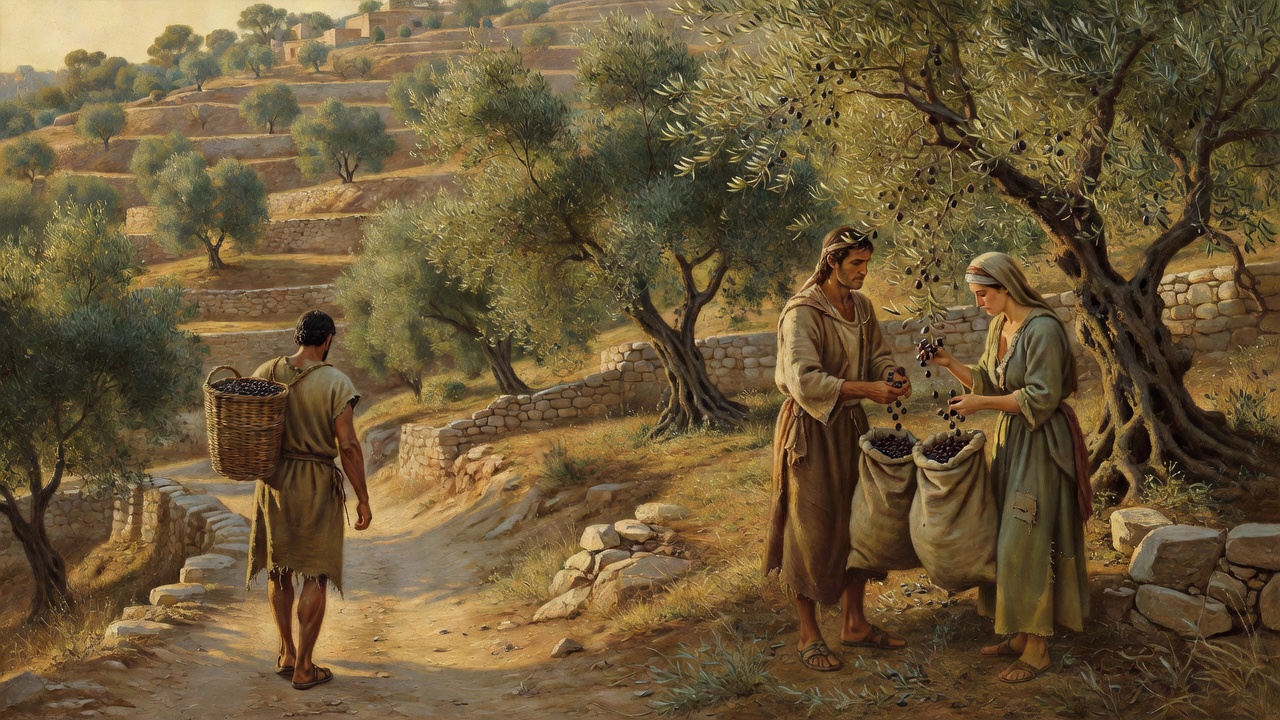
19When thou reapest thy harvest in thy field, and hast forgot a sheaf in the field, thou shalt not go again to fetch it: it shall be for the sojourner, for the fatherless, and for the widow; that Jehovah thy God may bless thee in all the work of thy hands. 20When thou beatest thine olive-tree, thou shalt not go over the boughs again: it shall be for the sojourner, for the fatherless, and for the widow. 21When thou gatherest the grapes of thy vineyard, thou shalt not glean it after thee: it shall be for the sojourner, for the fatherless, and for the widow. 22And thou shalt remember that thou wast a bondman in the land of Egypt: therefore I command thee to do this thing.
Você sabia?
Leis de Compaixão, Justiça e Proteção Social
- As leis de colheita israelitas exigiam que os proprietários deixassem feixes esquecidos de cereais, azeitonas restantes e respigos de uvas para os grupos vulneráveis: o estrangeiro residente, o órfão e a viúva. Esse sistema de assistência apoiava-se na memória coletiva de que os israelitas haviam sido escravos no Egito.Fontes: o próprio texto bíblico · Egypt
- Devedores e trabalhadores assalariados contavam com limites legais explícitos. Os credores eram proibidos de entrar na casa de um devedor para tomar penhores, de reter mós indispensáveis ao sustento diário ou de guardar a capa de dormir de uma pessoa pobre após o pôr do sol, além de deverem pagar os diaristas antes do anoitecer.Fontes: o próprio texto bíblico
- Ao dar instruções sobre doenças infecciosas da pele e as orientações dos sacerdotes levíticos, o texto relembra a aflição que atingiu Miriã, irmã de Moisés e Arão, durante a caminhada pelo deserto após a saída do Egito.Fontes: o próprio texto bíblico · Miriam · Egypt
Notas escritas com auxílio de IA a partir de fontes abertas (Theographic Bible Metadata, CC BY-SA 4.0; Easton’s Bible Dictionary, domínio público) e revisadas antes de publicar.
Lugares deste capítulo
Só aparecem lugares com identificação de alta confiança (90% ou mais segundo as fontes acadêmicas reunidas pelo OpenBible). Mapa da época: DARE (Digital Atlas of the Roman Empire), CC BY 4.0; mapa atual: © colaboradores do OpenStreetMap; lugares: OpenBible.info (CC BY 4.0).
Créditos e licença desta tradução
American Standard Version (1901)
The American Standard Version of the Holy Bible, first published in 1901.
Public Domain
Language: English
Dialect: Archaic American
This public domain Bible translation is brought to you courtesy of eBible.org.
If you would like to make a donation to help keep free Bible access like this going, please visit https://eBible.org/give.php .
2026-10-02
Títulos de seção adaptados da Berean Standard Bible (domínio público); não fazem parte do texto bíblico desta tradução.
Fonte: http://ebible.org/eng-asv/ · eBible.org