Salmos 79
Brenton Septuagint Translation · Toque num versículo para ver as referências cruzadas.
A Prayer for Deliverance
1For the end, for alternate strains, a testimony for Asaph, a Psalm concerning the Assyrian.
2Attend, O Shepherd of Israel, who guidest Joseph like a flock; thou who sittest upon the cherubs, manifest thyself; 3before Ephraim and Benjamin and Manasse, stir up thy power, and come to deliver us. 4Turn us, O God, and cause thy face to shine; and we shall be delivered.
5O Lord God of hosts, how long art thou angry with the prayer of thy servant? 6Thou wilt feed us with bread of tears; and wilt cause us to drink tears by measure. 7Thou hast made us a strife to our neighbours; and our enemies have mocked at us. 8Turn us, O Lord God of hosts, and cause thy face to shine; and we shall be saved. Pause.
9Thou hast transplanted a vine out of Egypt: thou hast cast out the heathen, and planted it. 10Thou madest a way before it, and didst cause its roots to strike, and the land was filled with it. 11Its shadow covered the mountains, and its shoots equalled the goodly cedars. 12It sent forth its branches to the sea, and its shoots to the river. 13Wherefore hast thou broken down its hedge, while all that pass by the way pluck it? 14The boar out of the wood has laid it waste, and the wild beast has devoured it.
15O God of hosts, turn, we pray thee: look on us from heaven, and behold and visit this vine; 16and restore that which thy right hand has planted: and look on the son of man whom thou didst strengthen for thyself. 17It is burnt with fire and dug up: they shall perish at the rebuke of thy presence. 18Let thy hand be upon the man of thy right hand, and upon the son of man whom thou didst strengthen for thyself.
19So will we not depart from thee: thou shalt quicken us, and we will call upon thy name. 20Turn us, O Lord God of hosts, and make thy face to shine; and we shall be saved.
Você sabia?
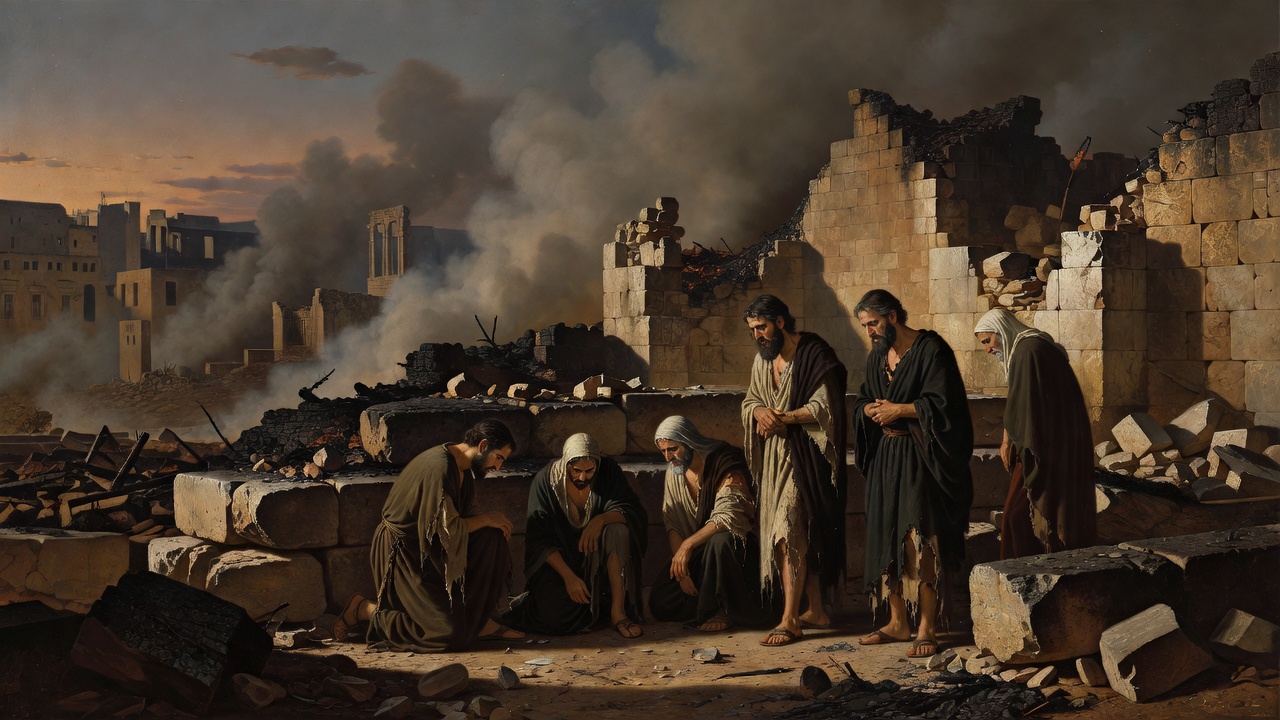
Um lamento pela destruição de Jerusalém
- O Salmo 79 é atribuído a Asafe, inserindo-se na coleção de salmos (Salmos 50 e 73–83) associados ao músico e vidente levita Asafe. No registro bíblico, o título também pode se referir aos filhos de Asafe, uma linhagem ou corporação de cantores e poetas do templo.Fontes: Asaph (Levite) · o próprio texto bíblico
- O salmo lamenta a profanação do santo templo, a redução de Jerusalém a ruínas e os corpos insepultos deixados ao redor da cidade. Jerusalém, conhecida como a cidade santa e uma fortaleza montanhosa, é descrita sofrendo uma invasão devastadora de nações vizinhas.Fontes: Jerusalem · o próprio texto bíblico
- O poema clama pelo socorro divino porque nações estrangeiras devoraram Jacó e devastaram a sua terra. Na tradição bíblica, o nome do patriarca Jacó é frequentemente utilizado de forma poética para designar toda a sua descendência e a sua terra.Fontes: Jacob (Israel) · o próprio texto bíblico
Notas escritas com auxílio de IA a partir de fontes abertas (Theographic Bible Metadata, CC BY-SA 4.0; Easton’s Bible Dictionary, domínio público) e revisadas antes de publicar.
Lugares deste capítulo
Só aparecem lugares com identificação de alta confiança (90% ou mais segundo as fontes acadêmicas reunidas pelo OpenBible). Mapa da época: DARE (Digital Atlas of the Roman Empire), CC BY 4.0; mapa atual: © colaboradores do OpenStreetMap; lugares: OpenBible.info (CC BY 4.0).
Créditos e licença desta tradução
Translation of the Greek Septuagint into English by Sir Lancelot Charles Lee Brenton
Published in 1851, and now in the Public Domain.
If you find errors in the text, please report them so that we can correct them.
Títulos de seção adaptados da Berean Standard Bible (domínio público); não fazem parte do texto bíblico desta tradução.
Fonte: http://ebible.org/eng-Brenton/ · eBible.org