Gênesis 16
Brenton Septuagint Translation · Toque num versículo para ver as referências cruzadas.
Hagar and Ishmael
1And Sara the wife of Abram bore him no children; and she had an Egyptian maid, whose name was Agar. 2And Sara said to Abram, Behold, the Lord has restrained me from bearing, go therefore in to my maid, that I may get children for myself through her. And Abram hearkened to the voice of Sara. 3So Sara the wife of Abram having taken Agar the Egyptian her handmaid, after Abram had dwelt ten years in the land of Chanaan, gave her to Abram her husband as a wife to him. 4And he went in to Agar, and she conceived, and saw that she was with child, and her mistress was dishonoured before her. 5And Sara said to Abram, I am injured by thee; I gave my handmaid into thy bosom, and when I saw that she was with child, I was dishonoured before her. The Lord judge between me and thee. 6And Abram said to Sara, Behold thy handmaid is in thy hands, use her as it may seem good to thee. And Sara afflicted her, and she fled from her face.
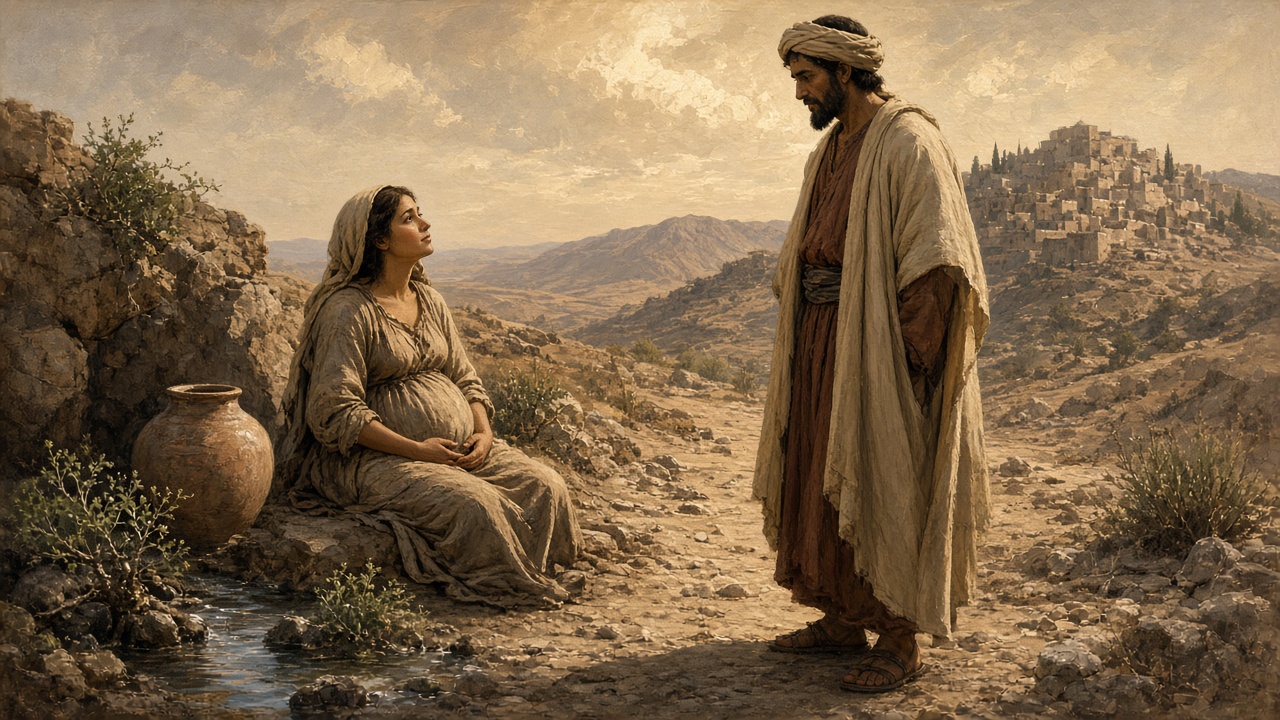
7And an angel of the Lord found her by the fountain of water in the wilderness, by the fountain in the way to Sur. 8And the angel of the Lord said to her, Agar, Sara's maid, whence comest thou, and whither goest thou? and she said, I am fleeing from the face of my mistress Sara. 9And the angel of the Lord said to her, Return to thy mistress, and submit thyself under her hands. 10And the angel of the Lord said to her, I will surely multiply thy seed, and it shall not be numbered for multitude. 11And the angel of the Lord said to her, Behold, thou art with child, and shalt bear a son, and shalt call his name Ismael, for the Lord hath hearkened to thy humiliation. 12He shall be a wild man, his hands against all, and the hands of all against him, and he shall dwell in the presence of all his brethren. 13And she called the name of the Lord God who spoke to her, Thou art God who seest me; for she said, For I have openly seen him that appeared to me. 14Therefore she called the well, The well of him whom I have openly seen; behold it is between Cades and Barad. 15And Agar bore a son to Abram; and Abram called the name of his son which Agar bore to him, Ismael. 16And Abram was eighty-six years old, when Agar bore Ismael to Abram.
Você sabia?
A fuga de Hagar e o nascimento de Ismael
- Hagar, serva egípcia de Sarai, tem um nome entendido como “fuga” ou, segundo outros, “estrangeira”. Depois que Abrão viveu dez anos em Canaã, Sarai a entregou a ele como esposa secundária, na esperança de formar uma família por meio dela.Fontes: Hagar · o próprio texto bíblico
- Quando Sarai a tratou com dureza, Hagar fugiu pela estrada de Sur, pelo deserto que ficava entre ela e o Egito, aparentemente com a intenção de voltar para os parentes. O anjo do Senhor a encontrou junto a uma fonte de água. Sur, que significa “muro”, era um deserto na fronteira nordeste do Egito, provavelmente nomeado por fortificações de fronteira que iam de Pelúsio a Heliópolis.Fontes: o próprio texto bíblico · Hagar · Shur
- Hagar chamou o Senhor que lhe falou de “o Deus que me vê”, e o poço recebeu o nome de Beer-Laai-Roi, “o poço do Deus visível”, entre Cades e Berede, uma cidade no sul da Palestina, no deserto de Sur. Ela voltou à tenda de Abrão, e Ismael, o filho mais velho dele, nasceu em Manre quando Abrão tinha oitenta e seis anos; Abrão deu-lhe o nome que o anjo havia anunciado, porque o Senhor tinha ouvido a sua aflição.Fontes: o próprio texto bíblico · Hagar · Bered · Ishmael (Son of Hagar)
Notas escritas com auxílio de IA a partir de fontes abertas (Theographic Bible Metadata, CC BY-SA 4.0; Easton’s Bible Dictionary, domínio público) e revisadas antes de publicar.
Lugares deste capítulo
- Canaan · 32.767, 35.333 · versículo 3
Só aparecem lugares com identificação de alta confiança (90% ou mais segundo as fontes acadêmicas reunidas pelo OpenBible). Mapa da época: DARE (Digital Atlas of the Roman Empire), CC BY 4.0; mapa atual: © colaboradores do OpenStreetMap; lugares: OpenBible.info (CC BY 4.0).
Créditos e licença desta tradução
Translation of the Greek Septuagint into English by Sir Lancelot Charles Lee Brenton
Published in 1851, and now in the Public Domain.
If you find errors in the text, please report them so that we can correct them.
Títulos de seção adaptados da Berean Standard Bible (domínio público); não fazem parte do texto bíblico desta tradução.
Fonte: http://ebible.org/eng-Brenton/ · eBible.org