Êxodo 3
Brenton Septuagint Translation · Toque num versículo para ver as referências cruzadas.
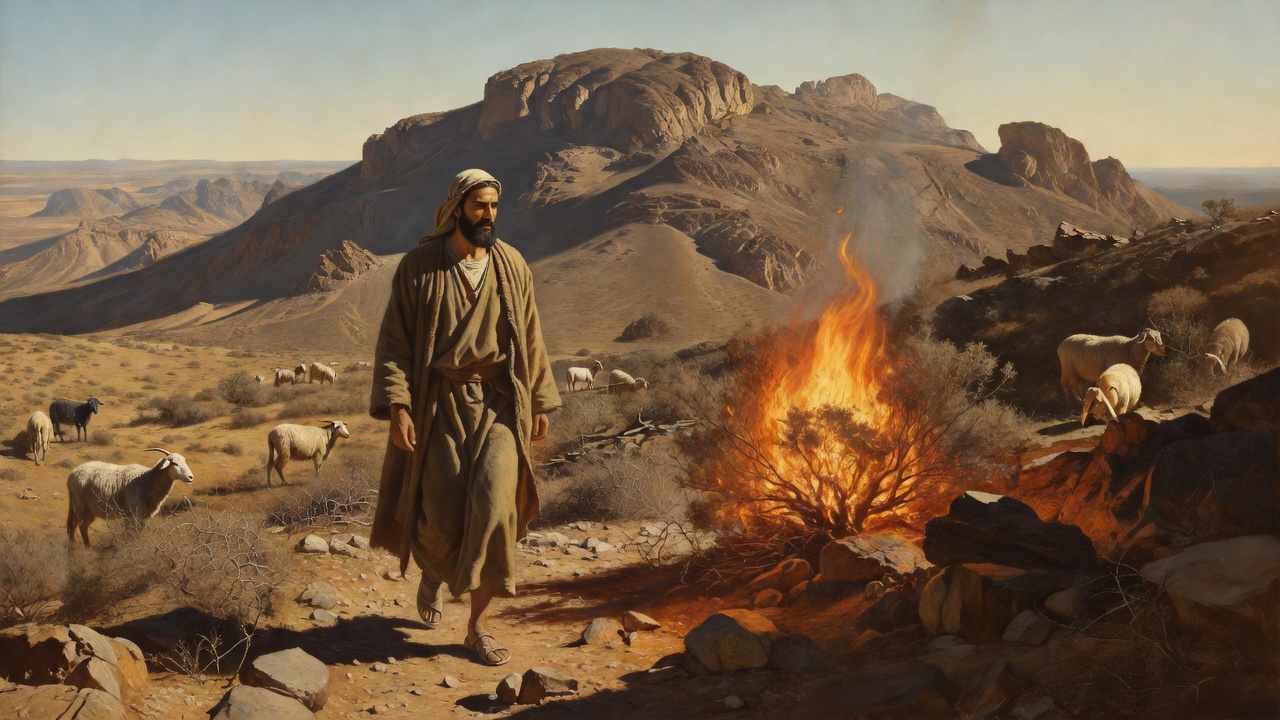
Moses at the Burning Bush
1And Moses was feeding the flock of Jothor his father-in-law, the priest of Madiam; and he brought the sheep nigh to the wilderness, and came to the mount of Choreb. 2And an angel of the Lord appeared to him in flaming fire out of the bush, and he sees that the bush burns with fire,—but the bush was not consumed. 3And Moses said, I will go near and see this great sight, why the bush is not consumed. 4And when the Lord saw that he drew nigh to see, the Lord called him out of the bush, saying, Moses, Moses; and he said, What is it? 5And he said, Draw not nigh hither: loose thy sandals from off thy feet, for the place whereon thou standest is holy ground. 6And he said, I am the God of thy father, the God of Abraam, and the God of Isaac, and the God of Jacob; and Moses turned away his face, for he was afraid to gaze at God. 7And the Lord said to Moses, I have surely seen the affliction of my people that is in Egypt, and I have heard their cry caused by their task-masters; for I know their affliction. 8And I have come down to deliver them out of the hand of the Egyptians, and to bring them out of that land, and to bring them into a good and wide land, into a land flowing with milk and honey, into the place of the Chananites, and the Chettites, and Amorites, and Pherezites, and Gergesites, and Evites, and Jebusites. 9And now, behold, the cry of the children of Israel is come to me, and I have seen the affliction with which the Egyptians afflict them. 10And now come, I will send thee to Pharao king of Egypt, and thou shalt bring out my people the children of Israel from the land of Egypt.
11And Moses said to God, Who am I, that I should go to Pharao king of Egypt, and that I should bring out the children of Israel from the land of Egypt? 12And God spoke to Moses, saying, I will be with thee, and this shall be the sign to thee that I shall send thee forth,—when thou bringest out my people out of Egypt, then ye shall serve God in this mountain. 13And Moses said to God, Behold, I shall go forth to the children of Israel, and shall say to them, The God of our fathers has sent me to you; and they will ask me, What is his name? What shall I say to them? 14And God spoke to Moses, saying, I am THE BEING; and he said, Thus shall ye say to the children of Israel, THE BEING has sent me to you. 15And God said again to Moses, Thus shalt thou say to the sons of Israel, The Lord God of our fathers, the God of Abraam, and God of Isaac, and God of Jacob, has sent me to you: this is my name for ever, and my memorial to generations of generations. 16Go then and gather the elders of the children of Israel, and thou shalt say to them, The Lord God of our fathers has appeared to me, the God of Abraam, and God of Isaac, and God of Jacob, saying, I have surely looked upon you, and upon all the things which have happened to you in Egypt. 17And he said, I will bring you up out of the affliction of the Egyptians to the land of the Chananites and the Chettites, and Amorites and Pherezites, and Gergesites, and Evites, and Jebusites, to a land flowing with milk and honey. 18And they shall hearken to thy voice, and thou and the elders of Israel shall go in to Pharao king of Egypt, and thou shalt say to him, The God of the Hebrews has called us; we will go then a journey of three days into the wilderness, that we may sacrifice to our God. 19But I know that Pharao king of Egypt will not let you go, save with a mighty hand; 20and I will stretch out my hand, and smite the Egyptians with all my wonders, which I shall work among them, and after that he will send you forth. 21And I will give this people favour in the sight of the Egyptians, and whenever ye shall escape, ye shall not depart empty. 22But every woman shall ask of her neighbour and fellow lodger, articles of gold and silver, and apparel; and ye shall put them upon your sons and upon your daughters,—and spoil ye the Egyptians.
Você sabia?
O chamado de Moisés na sarça ardente
- Moisés está pastoreando em Midiã quando este capítulo começa. Os midianitas eram uma tribo árabe nômade, descendente de Midiã, o quarto filho de Abraão com Quetura, cujo nome se explica como contenda. Viviam sobretudo no deserto ao norte da Arábia, e a península do Sinai era pasto para seus rebanhos; foi ali, depois de fugir do Egito, que Moisés se tornou servo e, em seguida, genro do sacerdote.Fontes: o próprio texto bíblico · Midian · Midian
- Seu sogro é Jetro, chamado sacerdote de Midiã. O Dicionário Bíblico de Easton (1897) identifica esse sacerdote com Raguel e diz que, se os dois nomes pertencem ao mesmo homem, Raguel pode ser considerado seu nome pessoal e Jetro, que significa excelência, um título oficial.Fontes: o próprio texto bíblico · Jethro
- Moisés conduz o rebanho até Horebe, o monte de Deus. O nome é explicado como deserto, ou monte, do chão ressecado, um termo geral para toda a cordilheira da qual o Sinai era um dos cumes; o Dicionário Bíblico de Easton (1897) dá à cordilheira o nome moderno de Jebel Musa e a descreve como um enorme bloco de cerca de duas milhas de comprimento por cerca de uma milha de largura, com uma planície muito ampla chamada Er Rahah na extremidade nordeste, onde os israelitas depois acamparam por quase um ano.Fontes: o próprio texto bíblico · Horeb
Notas escritas com auxílio de IA a partir de fontes abertas (Theographic Bible Metadata, CC BY-SA 4.0; Easton’s Bible Dictionary, domínio público) e revisadas antes de publicar.
Lugares deste capítulo
- Midian · 28.495, 35.012 · versículo 1
- Mount Horeb · Hoje: Jebel Musa · 28.540, 33.973 · versículo 1
- Egypt · 30.129, 31.308 · versículos 7, 8, 10, 11, 12, 16, 17, 18, 19, 20, 22
Só aparecem lugares com identificação de alta confiança (90% ou mais segundo as fontes acadêmicas reunidas pelo OpenBible). Mapa da época: DARE (Digital Atlas of the Roman Empire), CC BY 4.0; mapa atual: © colaboradores do OpenStreetMap; lugares: OpenBible.info (CC BY 4.0).
Créditos e licença desta tradução
Translation of the Greek Septuagint into English by Sir Lancelot Charles Lee Brenton
Published in 1851, and now in the Public Domain.
If you find errors in the text, please report them so that we can correct them.
Títulos de seção adaptados da Berean Standard Bible (domínio público); não fazem parte do texto bíblico desta tradução.
Fonte: http://ebible.org/eng-Brenton/ · eBible.org