1 Samuel 21
Brenton Septuagint Translation · Toque num versículo para ver as referências cruzadas.
David Takes the Consecrated Bread
1And David arose and departed, and Jonathan went into the city.
2And David comes to Nomba to Abimelech the priest: and Abimelech was amazed at meeting him, and said to him, Why art thou alone, and nobody with thee? 3And David said to the priest, The king gave me a command to-day, and said to me, Let no one know the matter on which I send thee, and concerning which I have charged thee: and I have charged my servants to be in the place that is called, The faithfulness of God, phellani maemoni. 4And now if there are under thy hand five loaves, give into my hand what is ready. 5And the priest answered David, and said, There are no common loaves under my hand, for I have none but holy loaves: if the young men have been kept at least from women, then they shall eat them. 6And David answered the priest, and said to him, Yea, we have been kept from women for three days: when I came forth for the journey all the young men were purified; but this expedition is unclean, wherefore it shall be sanctified this day because of my weapons.
7So Abimelech the priest gave him the shewbread; for there were no loaves there, but only the presence loaves which had been removed from the presence of the Lord, in order that hot bread should be set on, on the day on which he took them.
David Flees to Gath
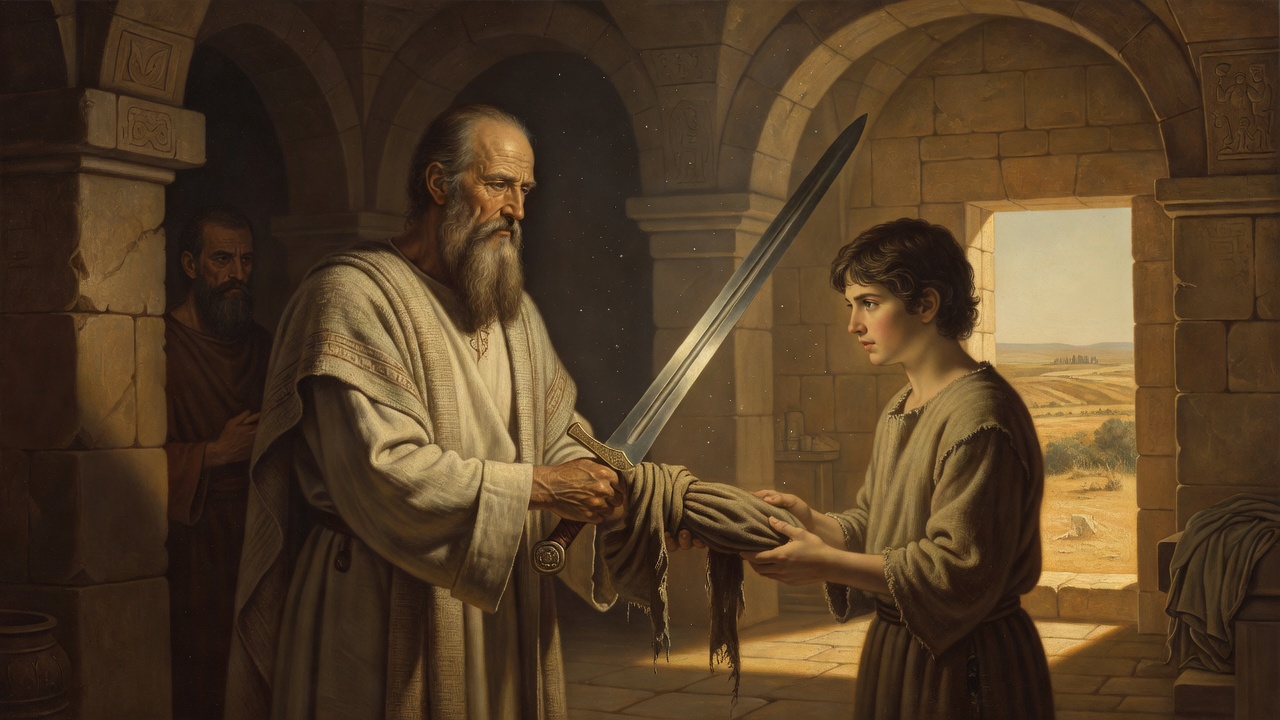
8And there was there on that day one of Saul's servants detained before the Lord, and his name was Doec the Syrian, tending the mules of Saul. 9And David said to Abimelech, See if there is here under thy hand spear or sword, for I have not brought in my hand my sword or my weapons, for the word of the king was urgent. 10And the priest said, Behold the sword of Goliath the Philistine, whom thou smotest in the valley of Ela; and it is wrapt in a cloth: if thou wilt take it, take it for thyself, for there is no other except it here. And David said, Behold, there is none like it; give it me.
11And he gave it him; and David arose, and fled in that day from the presence of Saul: and David came to Anchus king of Geth. 12And the servants of Anchus said to him, Is not this David the king of the land? Did not the dancing women begin the song to him, saying, Saul has smitten his thousands, and David his ten thousands? 13And David laid up the words in his heart, and was greatly afraid of Anchus king of Geth. 14And he changed his appearance before him, and feigned himself a false character in that day; and drummed upon the doors of the city, and used extravagant gestures with his hands, and fell against the doors of the gate, and his spittle ran down upon his beard. 15And Anchus said to his servants, Lo! ye see the man is mad: why have ye brought him in to me? 16Am I in want of madmen, that ye have brought him in to me to play the madman? he shall not come into the house.
Você sabia?
A fuga de Davi para Nobe e Gate
- Nobe era uma cidade sacerdotal perto de Jerusalém onde o tabernáculo estava instalado durante o reinado de Saul. A espada de Golias, a quem Davi havia vencido no vale de Elá, ficava guardada ali, envolvida em um pano atrás do éfode, como um troféu sagrado.Fontes: o próprio texto bíblico · Nob · Goliath
- Ao receber os pães sagrados e a espada de Aimeleque em Nobe, Davi foi observado por Doegue, o edomita, chefe dos pastores do rei Saul, que estava detido perante o Senhor.Fontes: o próprio texto bíblico · Doeg
- Davi buscou refúgio em Gate, uma das cinco cidades reais dos filisteus e terra natal de Golias. Quando os servos do rei Aquis o reconheceram pelos cânticos que celebravam suas vitórias militares, Davi protegeu-se fingindo loucura junto aos portões da cidade.Fontes: o próprio texto bíblico · Achish · Gath
Notas escritas com auxílio de IA a partir de fontes abertas (Theographic Bible Metadata, CC BY-SA 4.0; Easton’s Bible Dictionary, domínio público) e revisadas antes de publicar.
Lugares deste capítulo
- Valley of Elah · 31.675, 34.998 · versículo 9
Só aparecem lugares com identificação de alta confiança (90% ou mais segundo as fontes acadêmicas reunidas pelo OpenBible). Mapa da época: DARE (Digital Atlas of the Roman Empire), CC BY 4.0; mapa atual: © colaboradores do OpenStreetMap; lugares: OpenBible.info (CC BY 4.0).
Créditos e licença desta tradução
Translation of the Greek Septuagint into English by Sir Lancelot Charles Lee Brenton
Published in 1851, and now in the Public Domain.
If you find errors in the text, please report them so that we can correct them.
Títulos de seção adaptados da Berean Standard Bible (domínio público); não fazem parte do texto bíblico desta tradução.
Fonte: http://ebible.org/eng-Brenton/ · eBible.org