Mateus 8
Ekajuk Scriptures Bible Portions · Toque num versículo para ver as referências cruzadas.
Ana Jisos limi nne abili, á nob
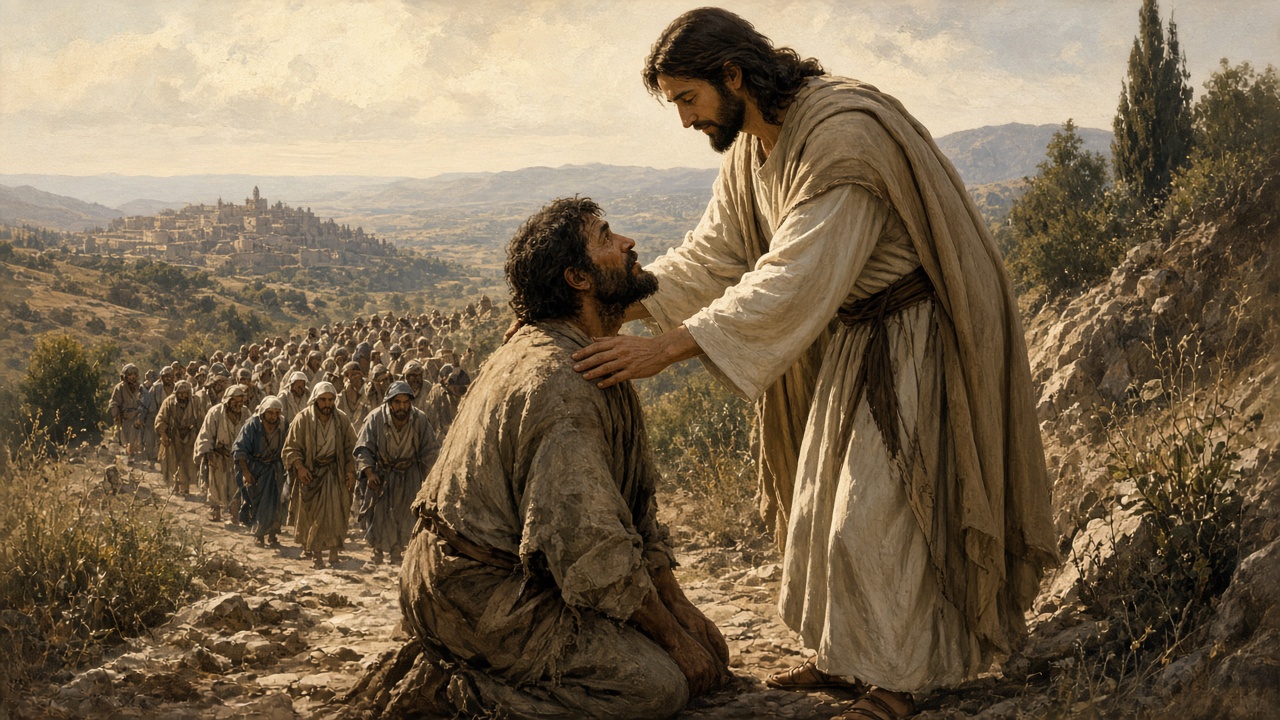
1Jisos kehm badde go ewong jio, ellong ane gbalee tahm toon-e. 2Nne abili kehm lohngo ba go ege, kehm ba jamm-e alahng, kehm bungu re, “Nsoo, lꞌkor-a, a li-m ma lim, n nob.”
3Jisos kehm tanne ebo ebe, koor-e, kehm bungu re, “Kor-m kor, wobnob!” Tvtv ona á kehm soro nob abili enye.
4Owo Jisos kehm-e tongo re, “Ka tiki tong nne awohng awohng, wobwuka? Song goji nlimajom, wo song tib-e elna, fere lim njom nyi Moses tibi no, eji lꞌjol ejum ntianse ka ane.”
Ana Jisos limi nlokeltum awohng, á nob go Kapenium
5Eji Jisos rehnge go Kapenium, ntubesi a nsoja no Rom kehm bake, ba kpir-e, kehm-e gboongo 6re, “Nsoo, nlokeltum ewame noa go etahk, kpꞌyame gꞌga, jol á nehme ma jen.”
7Jisos kehm-e tongo re, “M bahke bake ba lim-e, á nob.”
8Owo ntubesi a nsoja noo kehm-e faange re, “Nsoo, me n fuumem re wo ba yel go egame ekpꞌkpa. Lub bung na bung ellum, nlokeltum ewame bahke nobo. 9Tibre me n li nne no wob nne go elwo. N tob kpi nsoja nyi wob-m go elwo. N lꞌtong noo re, ‘Song!’ á tahm. N lꞌtong noka re, ‘Ba!’ á ba. N lꞌtong nlokeltum ewame re, ‘Lim jia!’ á lim na lim.”
10Eji Jisos wuku ano, kehm-e kpoko esi. Á kehm tongo ane ba jo toon-e re, “Etingitingi, n kp-n tongo re, elkohn eltaame ana nia n ka nyehn a nyehn go Israel. 11N kp-n tongo re, Ane gbalee bahke lohngo go ero nfam, a erede nfam ba ji a Ebraham, a Aisik, go Jekob go ejahbetul Esowo, jo li nsol a bo. 12Wo, abon ntul ba jol lehke etul, bo bahke rodo bo, ro kak edi ji nkom ejannge li no. Owo ane bahke jo ling, fere jo kono amahn.”
13Owo Jisos kehm tongo ntubesi a nsoja noo re, “Song kehnge! Ana a ma taame, ano wo bahke jolo ka-a.” Ngare nyꞌnehm ona nyi nlokeltum ewe nobo eyam ebe.
Ana Jisos limi aneb ayam gbalee, bo nob
14Jisos song rehnge kan etahk Pita, á kehm song nyehn nnyehn nkal a Pita nong kpꞌyame arumbum. 15Á kehm-e kooro go ebo, á kehm soro nob arumbum nyao, kehm soro tahm, kehm-e kehme elloko.
16Eji elgung ba no, ane kehm koko ane gbalee ba bele abi atohko, ba go ege. Á kehm kame bo abi atohko nyao kpee yehke go ege ellum, fere lim aneb ayam kpee, bo nob, 17eji lꞌlohko jol ana Esowo bungu sehng goji nnyehnamahr Aisaya re,
“Á rodo elleenge enahre,
fere sol ayam enyahre.”
Nong, akvne kpa akvne kak
18Eji Jisos nyehne ellong ane gbalee ba ma ba yiimi senng-e kak, á kehm tongo abatꞌtoono ebe re, “Wahr tahmen egbuk jehko!”
19Owo ntꞌtibi atahm awohng kehm bake go ege, ba tong-e re, “Ntꞌtibi, m bahk-a toono rehng edi ajehng ajehng ji a fi no.”
20Jisos kehm-e faange re, “Akpangang kpi abing nya bo kpo woomo. Nruk kpi ntahk nyi bo kpo kang. Wo, Mmon no nne, edi ellohko esi ajehng ajehng á kpimm.”
21Nne noko no jolo ntꞌtoono Jisos kehm-e tongo re, “Nsoo, nong, me n tohko song kpa nsoo kak.”
22Owo Jisos kehm-e faange re, “Tahm toon-m, nong, akvne kpa atem akvne kak!”
Ana Jisos bungu tong nfeb, a ebuku
23Jisos kehm yele go egbang, abatꞌtoono ebe tahm toon-e. 24Owo egburu nfeb nyi nnen a nnen kehm ba kehme ellimi go eto jio, ebuku jo lim, bulu egbang. Ngare nyio Jisos jo lꞌlal. 25Abatꞌtoono ebe kehm jeke go ege, song nyahm-e, kehm-e tongo re, “Nsoo, tahr-r, e kpꞌtane na a!”
26Jisos kehm faange bo re, “Jen ji wahnge ń kpꞌfahle ana, wahn ji kpꞌkahn taame ntiil?” Owo á kehm mehle yiimi, kehm nyame nfeb, a ebuku. Edi kehm naange soom.
27Owo kehm kpoko ane bao esi. Bo kehm bungu re, “Elkohn nne awo anae, no kpo bung tong nfeb, a ebuku, bo wuk-e?”
Ana Jisos limi ane abal ba bele abi atohko, bo nob
28Jisos kehm bake go Gadara ji jolo go egbuk eto jehko. Owo ane abal kehm lohngo edi ji alahm akvne jolo no, ba wan-e. Bo bele abi atohko go bo atahng. Bo jo mennge sehng. Jol nne awohng awohng joom sahb, sehng mbang nyio. 29Owo bo kehm biingi tiim re, “Anv, Mmon no Esowo, jen ji e kpi no me atemtem? Anv, a ba na re wo ba kak-r erema, eji ngare kala biinga?”
30Ellong akuk jolo ona kpidi kpidi, jo li nsol. 31Abi atohko kehm gboongo Jisos re, “A lꞌkehm-r kame yake, nong, wahr song yel akuk nyao go atahng.”
32Owo Jisos kehm tongo bo re, “Songen!” Bo kehm soro lohng, song yel akuk nyao go atahng. Ellong akuk nio kehm soro rehm abahl, song fooro agbunggbung eto jio, yel go alahb tan.
33Ane ba jo baabe akuk nyao, kehm soro be ebo tahm, song rehng go nla ejahbe, song tooro kpee, fere tooro ejum ji ma lim ane ba bele abi atohko. 34Ejahbe jio kpee kehm tahme, song kpiri Jisos. Eji bo song nyehn-e, bo kehm-e gboongo re, á lub tahm ejahbe jio song.
Você sabia?
Curas, fé e o mar
- Cafarnaum, cidade em que Jesus entra neste capítulo, era uma cidade da Galileia que não aparece no Antigo Testamento. O Easton's Bible Dictionary (1897) diz que ela se tornou a “sua própria cidade” depois que ele deixou Nazaré, e inclui o pedido do centurião e a cura na casa de Pedro entre os acontecimentos ali situados.Fontes: Capernaum · o próprio texto bíblico
- Jesus diz que muitos virão do oriente e do ocidente para participar do banquete com Abraão, Isaque e Jacó no reino dos céus. O Easton's Bible Dictionary (1897) apresenta Abraão como filho de Terá e herdeiro das promessas, Isaque como o único filho de Abraão com Sara, e Jacó — também chamado Israel — como o filho gêmeo mais novo de Isaque e Rebeca.Fontes: o próprio texto bíblico · Abraham · Isaac · Jacob (Israel)
- Mateus apresenta as curas daquela noite como cumprimento do que foi dito por meio do profeta Isaías: “Ele tomou as nossas enfermidades e carregou as nossas doenças.” O Easton's Bible Dictionary (1897) identifica Isaías como filho de Amoz, que profetizou nos reinados de Uzias, Jotão, Acaz e Ezequias.Fontes: o próprio texto bíblico · Isaiah
Notas escritas com auxílio de IA a partir de fontes abertas (Theographic Bible Metadata, CC BY-SA 4.0; Easton’s Bible Dictionary, domínio público) e revisadas antes de publicar.
Lugares deste capítulo
- Gadara · Hoje: Umm Qais · 32.656, 35.679 · versículo 28
Só aparecem lugares com identificação de alta confiança (90% ou mais segundo as fontes acadêmicas reunidas pelo OpenBible). Mapa da época: DARE (Digital Atlas of the Roman Empire), CC BY 4.0; mapa atual: © colaboradores do OpenStreetMap; lugares: OpenBible.info (CC BY 4.0).
Créditos e licença desta tradução
Ekajuk Scriptures Bible Portions
Ekajuk: Ekajuk Scriptures Bible Portions (Bible)
copyright © 2024 Luke Initiative for Scripture Translation and The Seed Company
Language: Ekajuk
Contributor: Luke Initiative for Scripture Translation
This translation is made available to you under the terms of the
Creative Commons Attribution Share-Alike license 4.0.
You have permission to share and redistribute this Bible translation in any format and to make reasonable revisions and adaptations of this translation, provided that:
You include the above copyright and source information.
If you make any changes to the text, you must indicate that you did so in a way that makes it clear that the original licensor is not necessarily endorsing your changes.
If you redistribute this text, you must distribute your contributions under the same license as the original.
Pictures included with Scriptures and other documents on this site are licensed just for use with those Scriptures and documents.
For other uses, please contact the respective copyright owners.
Note that in addition to the rules above, revising and adapting God's Word involves a great responsibility to be true to God's Word. See Revelation 22:18-19.
2025-07-02
Fonte: http://ebible.org/eka/ · eBible.org