Gênesis 49
Ekajuk Scriptures Bible Portions · Toque num versículo para ver as referências cruzadas.
Ana Jekob fuulu abon ebe ba nlum
1Owo Jekob kehm lungu abon ebe ba nlum kehm bungu re: <<Ba jiin senng-m wahn kak me n tong-n nsol nyi bahk-n limi go afung nya kpˈbake. 2<<Ba kon-n asi wahn wunngu atung, abon ba nlum ba Jekob; wuungen Isreel nso ewahne atung. 3<<Ruben wo wo li ngbokambang a mmon ewame, eko ejame, ngbokambang elliingi ni nsahm anyame, wob gbal go ekpunu, fere gbal go nsahm. 4Wo wo li alabb ma kil jo yiimi edi ajehng, ekpunu a nehm kpe bel, tibre wob song noongo go edilnong ji nso, wob fili edilnong ji nso rannge. 5Simion abola Levi bo abonanyehn ba. Bo kpo ko akahngkahng ebo jo rannge edi. 6Nong me n kˈwoomo go ebo ellong, nong me n kˈkono asi a bo, tibre bob wul ane tib go ebo erakatahng fere banne efong akpade ana koro bo. 7Nong nkuk jol ka erakatahng ebo ji kpˈsahb sˈsum, nong nkuk jol ka erakatahng ebo ji kil elgbodo. M bahke limi bo yaame, jol go ndi nyi Jekob, fere lim bo jol adi adi go ellong ni anebe Isreel. 8<<Judah, abonanne bahk-a tehke; abo enya bahke jolo go emel anebekv eba. Abon ba nlum ba nso bahke jo gong ka-a. 9Judah, mmon ewame, wo li ana mmona egabe. Wob wul nnyam enya kehnge a nyi, ba rehng go ega elbad. A nong go ndi ana egabe, a kp-e lehke ana nkal egabe. Nne awoo bahke ma nyeenge egabe elkohn ngare ana nyia? 10Ejehm jio ji etul nehm tiki jo lohng go etˈtohngo ji Juda. Abon ebe bahke tiki jo jol atul, tete nfono ejehm noo no etul bahke bake, ye ji ajahbe kpee bahk-e kpunu. 11Juda bahke tohko mbvankang enye go elˈlehke egreb, á bahke kahne mmon a mbvankang go nnobo noba mbˈbo mi greb, á bahke suku akpawobo enye go amahm, esubu eje go akehng greb 12Juda bahke bele amahm elwoko gbalee, bahke wahnge amahr enye bamme, á bahke bele alahbbel ma elwoko gbalee, wahnge amahn enye bahke sahb bˈbar tib esi alahbbel. 13<<Jebulon bahke lene go nkpe aya, edi eje bahke jolo elga ni asohkkahng bahke jo ba tehme, nkonandi enye bahke jolo rehng go Sidon. 14Isaka li ana mbvankang nyi kpˈsahb tˈtahne, á nong go elka elka ni abam nsol. 15Á lˈnyehn ana edi erekekv eje kpˈnobo, fere nyehn ana ndi enye kpˈtob nob, á bahke tahnge akpakebo enye ka go elsol asolo, fere yake elne ka eltum ni bo bahk-e bobo re a lim. 16<<Dan bahke lame ane ebe go nseenga nseenge, ana etˈtohngo ajehng go ellong atˈtohngo nya Isreel. 17Dan bahke jolo nnyo go nkpea nlum mbang, ekumbad go alabmbang, ji bahke jo tokko anyˈnya go aselsel, eji ane ba kun bo bahke jo tuulu gbo feere njahmjahm. 18<<N kpˈsiki eltahre ena O Jehova. 19<<Gad, ellong abanokabohng bahke noko a ne, wo á bahke sehnge go njahm jo nok a bo. 20<<Edi ndi ji Aser, owo nsol alehke nyi nno bahke lohngo, ye wo bahke toobo nsol nyi bahke jo fuumu a ntul. 21<<Naftali li ana mbilikpa nyi bo me-e fannge go ekehd, ye ji kpo jel anobonobo abon. 22<<Josef nlehke egreb mi bahke jo kab, ji yim kohlo elbing alahb, ji ayal enye ma taare kuumu go egbunggbung. 23Go ebiltim wo anebelkv ba nok a ne; bo bahk-e take elban go eblum eblum. 24Wo elban ene bahke sake ano ano, atahntahn abo enye bahke sake kpan yiimi, tib go ebo bi Etahntahn Nne no Jekob, tib esi Mbaabebul: ye ji li Ekpartal ji Isreel. 25Tib esi ji Esowo bi nso, ye ji kak-a ebo, tib esi ji Nne no Gbale Sehng, ye ji ka-a nfuulu nyi lohng go ero, a nfuulu nyi wob go atahng ndi, nfuulu nyi abel a ejˈjele. 26Elfuulu ni nso kpˈgbale sehnge elfuulu ni babnsoo ejame, sehnge rehng go ero egburu ewong ji ma sahb kˈkul. Nong elfuulu nia kpee kuumu Josef go esi, go elka esi ji nne bo m-e ga kpunu go ellong abonanyehn. 27<<Benjamin li ana ejo ji kpo bob atem enyam jaake, efungfu á kpo li nnyam nyi á bobo no, ngare elgung á kpo bak bi á ma da.>> 28Ane baa kpee ba li ewubu etˈtohngo ebbal bi anebe Isreel, a wo li nsol nyi ndea bo tongo bo, á fuulu nne awohng awohng elkohn elfuulu ana ni fuumu a ne.
Elkv ni Jekob
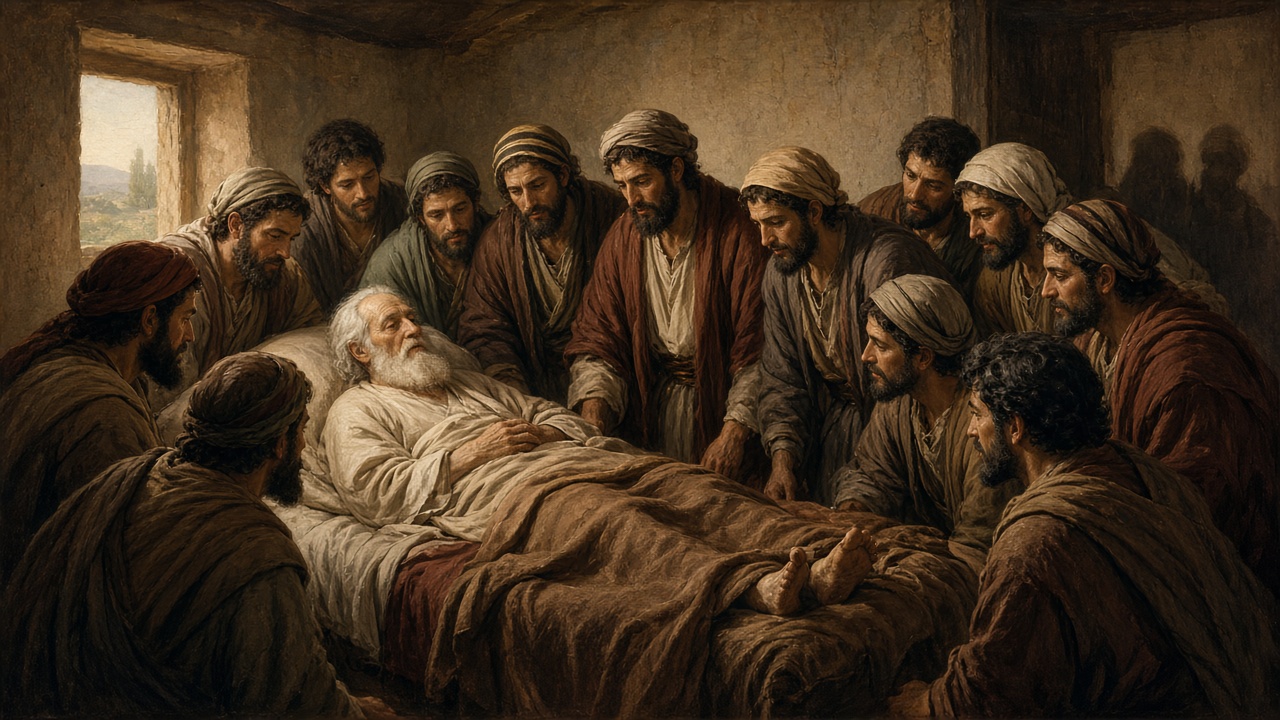
29Owo á kehm tubu bo elle nia re, <<M bahke gulu eltahme song kpiri ane ebame, song kak-m wahn go eyele ji babnsoo wob no, go egohng atal, go ekulugbe ji Efron nnea Hid, 30egohng atal jio li go Makipela kohlo Mamre go Kenan, edi ji Ebraham gunu ekulegbe budu edi eyele akvne goji Efron nne Hid. 31O edi jio wo bo kake Ebraham abola Sara nkal ewe, o edi jio wo bo kake Aisik abola Rebeka nkal ewe, o edi jˈnehm wo n kake Lia. 32Edi egbe jio a egang ji li o bo gunu goji nne a Hid.>> 33Eji Jekob ma tub abon ebe ba nlum elle mal, á kehm fehde akpade enye kunu edilnong soro v esˈkohro elv kpo song kpiri ane ebe.
Você sabia?
Últimas bênçãos às doze tribos de Israel
- As palavras de Jacó exploram o significado dos nomes dos filhos. Judá (em hebraico Yehudah) vem das palavras de Lia, "Agora louvarei" (odeh), e Jacó diz que os irmãos de Judá o louvarão. O nome de Dã ecoa o "Deus me julgou" (dananni) de sua mãe Bila; Jacó diz que Dã julgará o seu povo, ou lhe fará justiça, e o Easton's Bible Dictionary (1897) sugere que isso provavelmente alude a Sansão, um juiz posterior da tribo de Dã.Fontes: Judah (patriarch) · Dan · o próprio texto bíblico
- O capítulo chama cada discurso de bênção, embora alguns sejam severos. Rúben, primogênito de Jacó e Lia, cujo nome significa "Eis um filho!", ouve que não mais se destacará, porque profanou o leito de seu pai. Simeão e Levi, que se vingaram com violência de Hamor e dos siquemitas, ouvem sua ira amaldiçoada e a promessa de que serão dispersos em Jacó e espalhados em Israel; onde a Authorized Version dizia que derrubaram um muro, a Revised Version diz que jarretaram um boi, como este capítulo afirma que eles cortam os jarretes dos bois.Fontes: Reuben · Simeon · Levi (patriarch) · o próprio texto bíblico
- Jacó pede então que o sepultem com seus pais na caverna do campo de Efrom, o hitita, que Abraão comprou como túmulo da família. Macpela, nome entendido como "porção" ou "caverna dupla", ficava na encosta de um monte a leste de Hebrom, de frente para Manre, na terra de Canaã. Abraão e Sara, Isaque e Rebeca, e Lia já estavam sepultados ali.Fontes: Machpelah · Ephron · Mamre · o próprio texto bíblico
Notas escritas com auxílio de IA a partir de fontes abertas (Theographic Bible Metadata, CC BY-SA 4.0; Easton’s Bible Dictionary, domínio público) e revisadas antes de publicar.
Lugares deste capítulo
- Shiloh · Hoje: Khirbet Seilun · 32.056, 35.290 · versículo 10
- Sidon · Hoje: Sandikli archaeological site in Sidon · 33.561, 35.372 · versículo 13
- Canaan · 32.767, 35.333 · versículo 30
- Machpelah · Hoje: Cave of the Patriarchs · 31.525, 35.111 · versículo 30
Só aparecem lugares com identificação de alta confiança (90% ou mais segundo as fontes acadêmicas reunidas pelo OpenBible). Mapa da época: DARE (Digital Atlas of the Roman Empire), CC BY 4.0; mapa atual: © colaboradores do OpenStreetMap; lugares: OpenBible.info (CC BY 4.0).
Créditos e licença desta tradução
Ekajuk Scriptures Bible Portions
Ekajuk: Ekajuk Scriptures Bible Portions (Bible)
copyright © 2024 Luke Initiative for Scripture Translation and The Seed Company
Language: Ekajuk
Contributor: Luke Initiative for Scripture Translation
This translation is made available to you under the terms of the
Creative Commons Attribution Share-Alike license 4.0.
You have permission to share and redistribute this Bible translation in any format and to make reasonable revisions and adaptations of this translation, provided that:
You include the above copyright and source information.
If you make any changes to the text, you must indicate that you did so in a way that makes it clear that the original licensor is not necessarily endorsing your changes.
If you redistribute this text, you must distribute your contributions under the same license as the original.
Pictures included with Scriptures and other documents on this site are licensed just for use with those Scriptures and documents.
For other uses, please contact the respective copyright owners.
Note that in addition to the rules above, revising and adapting God's Word involves a great responsibility to be true to God's Word. See Revelation 22:18-19.
2025-07-02
Fonte: http://ebible.org/eka/ · eBible.org