Gênesis 42
Nǫ̀htsı̨̨ Nı̨̨htł'è · Toque num versículo para ver as referências cruzadas.
Joseph wı̨ı̨de Egypt nèk'e ts'ǫ̀ geède
1Jacob, Egypt nèk'e tł'olà gǫ̀hłı̨ ghǫ ıìkw'o t'à edeza ts'ǫ̀ hadı, “Dànìghǫ ekìı dahkw'e xè ełeghàahda? 2Egypt nèk'e tł'olà gǫ̀hłı̨ı̨ gedı. Ekǫ aahde gà tł'olà gogha nàahdì, hanì-ı̨dè bò dę ełaàts'ede ha-le,” gòhdı.
3Eyıt'à Joseph wı̨ı̨de hoònǫ tł'olà nàgehdı ha Egypt nèk'e ts'ǫ̀ geède. 4Hanìkò Jacob, Joseph wechı Benjamın edeza goxè ayį̀į̀là-le, wets'ǫ̀ t'asanàhòwo ha sǫnı nıwǫ t'à. 5Kanan nèk'e hazǫǫ̀ ts'ǫ̀ bò whìle agòjà t'à, Israel weza tł'olà nàgehdı gha dǫ łǫ xè Egypt nèk'e ts'ǫ̀ geède.
6Ekò k'e Joseph Egypt nèk'e gha k'àowo elı̨ t'à dǫ hazǫǫ̀ ts'ǫ̀ tł'olà weghǫ nàedì. Eyıt'à Joseph wı̨ı̨de eyı nègı̨ı̨de ekò gınì dèè xèedì ts'ǫ̀ gıts'ǫ̀ nàgòı̨hgè. 7Joseph edı̨ı̨de goaɂı̨ ts'ǫ̀et'ıì nàgòhzhį̀, hanìkò gok'èezǫ-le edeetsı̨ t'à yıdaı̨t'e lanì gots'ǫ̀ gode, dagoehke, “Edı̨į̀ gots'ǫ aaht'ı̨?” gòhdı.
“Tł'olà nàts'eehdì ha Kanan nèk'e gots'ǫ jǫ nèts'ı̨ı̨de,” gıìhdı. 8Joseph edı̨ı̨de nàgòhzhį̀, hanìkò wı̨ı̨de nàgeèhzhį̀-le.
9Dànì goghǫ nàwhetı̨ı̨ sìı yenadì. Gots'ǫ̀ hadı, “Nàahɂį̀ı̨-dǫǫ̀ aaht'e! Gonèk'e kexots'ııhdı-le sìı wegòahɂà ha dahwhǫ t'à jǫ nìahde ne,” gòhdı.
10Eyıt'à hagıìhdı, “K'àowo, necheekeè ats'ı̨ı̨t'e ne, tł'olà nàts'eehdì gha jǫ nèts'ı̨ı̨de hǫt'e. 11Goxı̨ hazǫǫ̀ dǫ ı̨łè zǫ weza ats'ı̨ı̨t'e. Nàeɂį̀ı-dǫǫ̀ ats'ı̨ı̨t'e nıìle, ehkw'ı ats'ı̨ı̨wǫǫ dǫǫ̀ ats'ı̨ı̨t'e,” gedı.
12Hagedı kò Joseph gots'ǫ̀ hadı, “Į̀le ne, gonèk'e kexots'ııhdı-le sìı wegòahɂà ha dahwhǫ t'à jǫ nìahde ne,” gòhdı.
13Hanìkò hagedı, “Dǫ ı̨łè gots'ǫ ełechı hoònǫ-daats'ǫ̀-nàke ats'ı̨ı̨t'e, eyı dǫ sìı Kanan nèk'e nàde hǫt'e. Gochı nǫǫdea sìı dıì gotà gà wheda, eyıts'ǫ gochı ı̨łè t'aa ełaı̨wo,” gıìhdı.
14Joseph k'èdaà gots'ǫ̀ hadı, “Dàehsı̨ı̨ sìı k'ę̀ę̀ nàahɂį̀ı̨-dǫǫ̀ aaht'e ne! 15Dıı hanì naxeehdzà ha ne: K'àowocho Faraoh wedahxà dıı hanaxèehsı̨: Naxıchı nǫǫdea jǫ nììtła lenǫsıı jǫ gots'ǫǫ̀ naahdè ha-le. 16Naxıta gots'ǫ ı̨łè naxıchı xàwetła. Eyı gots'ǫ̀ naxı̨ hazǫǫ̀ dǫ-danìı̨laa-kǫ̀ naxık'èhodì ha. Hanì-ı̨dè asį̀į̀ ehkw'ı aahdı wek'èhoedzǫ ha. Ehkw'ı aahdı-le nı̨dè, k'àowocho Faraoh wedahxà nàahɂį̀ı̨-dǫǫ̀ aahłı̨ k'ę̀ę̀ naxısınìyahtı ha!” gòhdı. 17Eyıt'à taı dzęę̀ gots'ǫ̀ gıdanìı̨laà agǫ̀ǫ̀là.
18Taı dzęę̀ k'e nìhǫǫwo ekò Joseph gots'ǫ̀ hadı, “Nǫ̀htsı̨ ts'àehjı̨ t'à dıı yatı k'èaht'e nı̨dè aahda ha. 19Ehkw'ı goahdee dǫǫ̀ aaht'e nı̨dè, naxıts'ǫ dǫ ı̨łè jǫ dǫ-danìı̨laa-kǫ̀ aìdaà aweahłe gà naxı̨ hazǫǫ̀ naxıkǫ̀ ts'ǫ̀ naahdè. Naxèot'ı̨ bò dę geèhkw'ee sìı gıts'ǫ̀ tł'olà naahwha. 20Hanìkò naxıchı nǫǫdea sìı sets'ǫ̀ nìahtè ha hǫt'e. Hanì-ı̨dè ehkw'ı goahde wek'èehsǫ ha, eyıts'ǫ ełaahde ha-le,” Joseph gòhdı. Eyıt'à hagejà.
21Ełets'ǫ̀ hagedı, “Gochı wets'ǫ̀ hoìla hots'èhtsı̨ k'èxa dıì hotıì nàgoekwa hǫt'e. Sıì wegha dìì xè etewets'eèɂı̨ ha goghǫnàdaetì ı̨lè hanìkò wets'eèhkw'ǫ-le ı̨lè. Eyı ts'ıhɂǫ̀ dıì goxè hoìla k'ehokw'o hǫt'e,” hagedı.
22Ruben gots'ǫ̀ hadı, “Eyı cheko wets'ǫ̀ hoìla hoahtsı̨-le naxèehsı̨ ı̨lè, hanìkò aàhkw'ǫ ha dahwhǫ-le ı̨lè! Wedoò k'èxa dıì nàgoekwa hǫt'e,” gòhdı. 23Joseph etaehtıı-dǫǫ̀ t'à gots'ǫ̀ gode ts'ıhɂǫ̀ ełets'ǫ̀ dàgedıı sìı goìkw'o kò wı̨ı̨de gık'èezǫ-le.
24Joseph wegha dìì agòjà t'à ets'èɂǫ̀naɂa gà ı̨tsè, eyı tł'axǫǫ̀ k'achı̨ gots'ǫ̀ gode. Sımeyon goghǫ negıìchì gà gonadąą̀ dawetł'ı̨į̀ ayį̀į̀là.
25Gıɂǫhchì yìı tł'olà dagoòɂǫǫ̀ agele ha Joseph edecheekeè ts'ǫ̀ goı̨de, eyıts'ǫ gıts'ǫ satsǫ̀ą degoo t'à tł'olà nàgeehdì ha ı̨lèe sìı gıɂǫhchì yìı whelaà agį̀į̀là, eyıts'ǫ nageedè gha weghǫ shèts'ezhee sı goghàgı̨ı̨dì. Eyı gıgha hadlà tł'axǫǫ̀ 26wı̨ı̨de ɂǫhchì edetłı̨tsoa k'e dageèwa gà nageèhde.
27To geetè ha nègı̨ı̨de ekò ı̨łè edetłı̨tsoa ghàɂeedı ha edeɂǫhchì ts'ǫdaà xàı̨wa. Ekòet'ıì wets'ǫdaà wets'ǫ satsǫ̀ą degoo whela nǫǫ̀ yaɂı̨. 28Edechı ts'ǫ̀ hadı, “Sets'ǫ satsǫ̀ą degoo seghǫ̀gı̨ı̨wa. Jǫ seɂǫhchì yìı whela,” gòhdı.
Sıì geèhyeh t'à gıts'ehłı̨į̀ lagejà, ełets'ǫ̀ hagedı, “Nǫ̀htsı̨ dàgole gha at'ı̨?” gedı.
29Kanan nèk'e edetà Jacob ghǫ nǫǫ̀gı̨ı̨de ekò gıxè dàgòjàa sìı hazǫǫ̀ edetà ts'ǫ̀ hagedı, 30“Egypt nèk'e k'àowo elı̨ı̨ sìı yıdaı̨t'e lanì gots'ǫ̀ gode. Wenèk'e nàeɂį̀ı̨-dǫǫ̀ ats'ı̨ı̨t'e goı̨hwhǫ k'ę̀ę̀ gots'ǫ̀ gode. 31Hanìkò wets'ǫ̀ hats'edı, ‘Ehkw'ı ats'ı̨ı̨wǫǫ dǫǫ̀ ats'ı̨ı̨t'e, nàeɂį̀ı̨-dǫǫ̀ ats'ı̨ı̨t'e nıìle. 32Ełechı hoònǫ-daats'ǫ̀-nàke ats'ı̨ı̨t'e, dǫ ı̨łè weza ats'ı̨ı̨t'e. Gochı ı̨łè whìle, eyıts'ǫ gochı nǫǫdea Kanan nèk'e gotà gà wheda,’ wèts'edı.
33“Eyıt'à eyı nèk'e k'àowo elı̨ı̨ sìı gots'ǫ̀ dıı hadı, ‘Ehkw'ı aahwhǫǫ dǫǫ̀ aaht'e nı̨dè dıı weghàà wek'èehsǫ ha: Naxıta ts'ǫ dǫ ı̨łè jǫ aìdaà aweahłe gà naxèot'ı̨ gıgha bò whìle sìı tł'olà gıts'ǫ̀ naahwha. 34Hanìkò naxıchı nǫǫdea sets'ǫ̀ nìahtè, hanì-ı̨dè nàeɂį̀ı̨-dǫǫ̀ aaht'e-le hanìkò dǫ ehkw'ı agı̨ı̨wǫǫ dǫǫ̀ aaht'e wek'èehsǫ ha. Hanì-ı̨dè naxıchı naxıghǫ̀ehte ha, eyı tł'axǫǫ̀-ı̨dè gonèk'e t'asìı nàahdì ha dìì-le,’ gòhdı,” Jacob ts'ǫ̀ hagedı.
35Edeɂǫhchì yìı xàgı̨ı̨wa ekò hazǫǫ̀ ełèht'eè gıts'ǫ satsǫ̀ą degoo yìwòa sìı gıɂǫhchì yìı whela nǫǫ̀. Ededı̨ eyıts'ǫ gıtà sǫǫ̀mba yìwòa gıaɂı̨ ekò geejı̨į̀ agejà. 36Gıtà Jacob gots'ǫ̀ hadı, “Naxıt'aa t'à seza seghǫ gıwhìle hǫt'e. Joseph wewhìle, Sımeyon ededı̨ sı wewhìle, eyıts'ǫ dıì Benjamın ededı̨ sı neweàhchı ha dahwhǫ. T'asìı hazǫǫ̀ sek'èch'a k'ehokw'o!” gòhdı.
37Ruben edetà ts'ǫ̀ hadı, “Benjamın nets'ǫ̀ nawèehtı̨-le nı̨dè wek'èxa seza nàke ełaàgede ha dìì-le. Negha nezı̨į̀ wek'èhdì ha, nets'ǫ̀ naweehtè ha,” edetà èhdı.
38Hanìkò Jacob hadı, “Seza nǫǫdea Egypt nèk'e ts'ǫ̀ naxıxè ade ha-le. Wı̨ı̨de ełaı̨wo ne xè ededı̨ zǫ sexè eda hǫt'e. Ekǫ naahdè t'à t'asajà nı̨dè sekwìghàagaà xè sekw'ǫǫ̀ nìtį̀ gots'ǫ̀ sedzeè nànııtì aseahłe ha hǫt'e,” yèhdı.
Você sabia?
Os irmãos vão ao Egito buscar cereal
- Jacó soube que havia cereal no Egito, a terra do Nilo, e enviou de Canaã dez de seus filhos para comprar, a fim de que a família não morresse na fome. Os sete anos de fome são datados com início em 1707 a.C., e a viagem dos irmãos ao Egito, em 1706 a.C.Fontes: o próprio texto bíblico · Egypt · 7 years of famine · Joseph's brothers go to Egypt
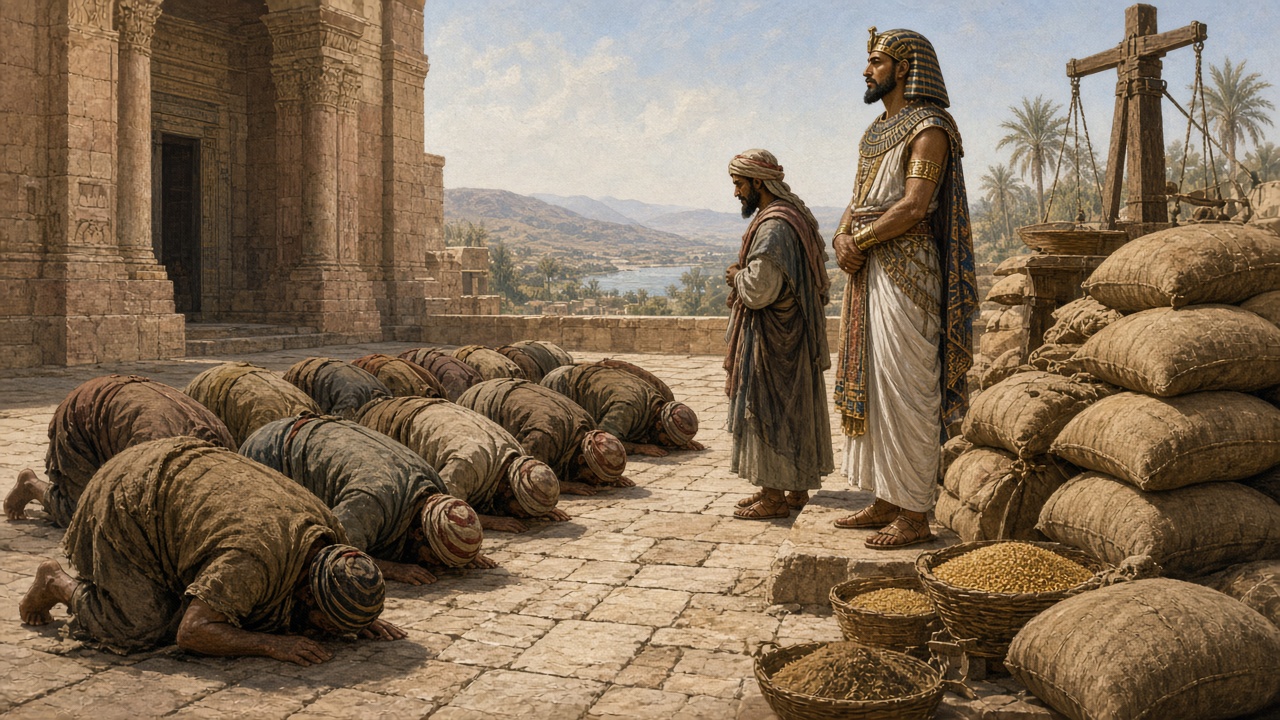
- José, governante da terra e quem vendia cereal ao povo, reconheceu os irmãos quando eles se curvaram diante dele, mas eles não o reconheceram. Havia um intérprete entre eles, de modo que não perceberam que ele entendia o que diziam. Ele se afastou e chorou; depois mandou amarrar Simeão, o segundo filho de Jacó com Lia, diante dos olhos deles, e o reteve como refém.Fontes: o próprio texto bíblico · Simeon
- Benjamim, o filho mais novo de Jacó e Raquel, ficou com o pai; José era o filho mais velho de Raquel, e Jacó acreditava que esse irmão já estava morto. Jacó recusou deixar Benjamim descer ao Egito, dizendo que, se algum mal lhe acontecesse, seus cabelos brancos desceriam ao Sheol em tristeza. Rúben, o filho mais velho de Jacó e Lia, que antes havia salvado José quando os outros irmãos o teriam matado, empenhou a própria vida e a vida de seus dois filhos caso não conseguisse trazer Benjamim de volta.Fontes: o próprio texto bíblico · Benjamin (patriarch) · Joseph (son of Jacob) · Reuben
Notas escritas com auxílio de IA a partir de fontes abertas (Theographic Bible Metadata, CC BY-SA 4.0; Easton’s Bible Dictionary, domínio público) e revisadas antes de publicar.
Lugares deste capítulo
- Egypt · 30.129, 31.308 · versículos 1, 2, 3, 5, 6, 15
- Canaan · 32.767, 35.333 · versículos 5, 7, 13, 29, 32
Só aparecem lugares com identificação de alta confiança (90% ou mais segundo as fontes acadêmicas reunidas pelo OpenBible). Mapa da época: DARE (Digital Atlas of the Roman Empire), CC BY 4.0; mapa atual: © colaboradores do OpenStreetMap; lugares: OpenBible.info (CC BY 4.0).
Créditos e licença desta tradução
Nǫ̀htsı̨̨ Nı̨̨htł'è
Dogrib: Dogrib Genesis & New Testament New Testament & Portions of Old Testament
copyright © 2009 Canadian Bible Society
Language: Dogrib
Translation by: Canadian Bible Society
Tłı̨chǫ Genesis and New Testament
About Tłı̨chǫ
Tłı̨chǫ (Dogrib) is a Na-Dene (Athabaskan) language. It is spoken by the First Nations Tłı̨chǫ people in the Northwest Territories in Canada. It has the largest number of speakers of any of the Aboriginal language communities in the NWT, and is one of the official languages of the Northwest Territories.
About This Translation
This translation includes the book of Genesis and the New Testament in Tłı̨chǫ. The first edition of the Tłı̨chǫ New Testament was published in 2003. It was a historic event, as it was the first time in more than a hundred years that a complete New Testament was published for one of the Dene First Nations in the Territories. The first edition was well received and quickly sold out. In the meantime the book of Genesis had been completed. Consequently, the 2008 reprint of the Tłı̨chǫ New Testament included Genesis.
Though this translation of the New Testament and Genesis took a total of ten years, the people who worked on it built on years of labor invested by the Tłı̨chǫ people, elders, priests and missionaries, translators, educators, and linguists. The material contained in this book was checked and approved by consultants from Wycliffe Bible Translators and the Canadian Bible Society.
If you are interested in obtaining a printed copy of this Bible, please contact the Canadian Bible Society at http://www.biblescanada.com .
Copyright Information
Dogrib Genesis and New Testament © 2003, 2008 Canadian Bible Society
The text of the Bible in Tłı̨chǫ that appears in this electronic format or website is for personal use only.
Up to five hundred (500) verses of the Bible text in any form (written, visual, electronic or audio) may be quoted without permission. The quoted verses may not be more than 50% of a complete book of the Bible, or more than 25% of the total text of the work in which they are quoted. Prior written permission must be obtained for any other use of the text. Copyright acknowledgement must in all cases appear on the title or copyright page.
For more information on copyright conditions or to apply, visit http://www.biblesociety.ca/copyright .
This translation is made available to you under the terms of the
Creative Commons Attribution-Noncommercial-No Derivatives license 4.0.
You may share and redistribute this Bible translation or extracts from it in any format, provided that:
You include the above copyright and source information.
You do not sell this work for a profit.
You do not change any of the words or punctuation of the Scriptures.
Pictures included with Scriptures and other documents on this site are licensed just for use with those Scriptures and documents.
For other uses, please contact the respective copyright owners.
2014-04-22
Fonte: http://ebible.org/dgrDOGNT/ · eBible.org