Gênesis 38
Yak'usda Ooghuni · Toque num versículo para ver as referências cruzadas.
Judah 'ink'ez Tamar
1'Et owhuya whudizulh whe Judah dudulhutsin bughu tizya 'ink'ez dune Adullam whut'en-un, Hirah huyulhni, 'en yughu hato ts'e whenya.
2'Et nyo Judah Canaan whut'en-un, 'ilhoghun ootse', 'en yunilh'en, Shua huyulhni, 'ink'ez yughusda 'ink'ez yuchant'inte'.
3'Et ulchan 'ink'ez duneyaz sulhtsi 'ink'ez boozi' Er yulhni.
4Doo cha za ulchan 'ink'ez doo cha za dune ooyaz suli'. 'Et boozi' Onan yulhni.
5'Et doo cha za ulchan 'ink'ez duneyaz ooyaz suli'. 'En boozi' Shelah yulhni. Chezib keyoh huwhutni-un, 'et nyoon ooba 'et 'ut'en whe yulhtsi.
6'Et Judah duyaz 'udetso-un, 'en ba ts'eke yughu tidalh ha yilhchoot. Ndun ts'eke boozi' Tamar huyulhni.
7'Et hoonts'i Judah ooye' 'udetso Er, 'en Moodihti (Yahweh) bunalh whe ninta' 'ut'ih, 'ink'ez Moodihti (Yahweh) 'en Er yuzilhghi.
8'Ink'ez Judah 'en Onan 'uyulhni, “Nyulhutsin oo'at ilhchoot 'ink'ez ooghu sinda, 'ink'ez nyulhutsin yuk'edutiyalh-un oole' sih.”
9'Et Onan t'eooninzun 'et ndun-un ts'oodun hotileh de, 'en 'aw didut ooyaz lhiloh. 'Ink'ez Er ndai yut'i 'i 'aw oogha ílhtaskulh. 'Et huwa 'et njan duhooja whe hukw'elh'az dulhutsin oo'at ts'un daninya whe yuchantinte'. 'Ink'ez ooch'a 'uhooja, 'i yun k'uz ts'e whenluz, dulhutsin yuba ts'oodun tit'elh whuch'a.
10'Ink'ez njan 'et duja-un, Moodihti (Yahweh) tube whuts'u dutni 'inka 'en cha yuzilhghi.
11'Et Judah duyas'at Tamar 'uyulhni, “Mbá ooyoh 'et sinda 'ink'ez tsandilh za inli, ndun sye' Shelah untiyeh whuts'un.” 'Ink'ez 'utni, “Doo ka sih dulhutsinke k'un'a daootsah.” 'Ink'ez Tamar dubá ooyoh ts'e whuz whutitelh ha whenya.
12'Et whe nduhooja hukw'elh'az Shua ootse', 'en Judah oo'at, 'en dazsai 'ink'ez Judah k'enahinu'ah. 'Ink'ez be 'usbai hat'asne buts'un keyoh Timnah 'et, didut 'ink'ez yulh dune Hirah, 'en Adullam whut'en, 'en bulh, ndo whuz whe han'az.
13'Et Tamar hiyulh nahoolnuk, 'uhuyulhni, “Whunilh'en nzaz, Timnah ts'e tiyalh 'usbai hatit'us wheni.”
14'Et nyoo tsandilh naih ye dune unli-i, ye hanaja 'ink'ez ne'dilbal, 'ink'ez kha'osduz. 'Ink'ez ts'et, Timnah ts'uwhuti-un, 'et usda. Shelah 'awet nizyai yunilh'en 'ink'ez 'awhuz oo'at tileh wheni yugha lhiyulhti 'inka.
15'Et Judah yutilh'en, 'ul'en-un 'unt'oh yuninzun, dunin k'e'nilhbal 'et huwa.
16'Et yughu ninya 'ink'ez 'utni, “Nzih ooste'.” 'Aw nyoon duyas'at 'unt'oh 'aw t'eoonuszun. 'Et ts'eke 'utni, “Di sgha tan'alh 'et de szih tantelh?”
17'Ink'ez 'utni, “Dúbe ntsool-i 'ilho 'i nts'o tl'atistelh.” 'Ink'ez ts'eke 'utni, “Sts'u nahitanyeh eh, sts'otl'atalhtelh whuts'un?”
18'Et Judah 'utni, “Di suba 'et ngha oos'alh be nts'un nahitasyeh-i?” 'Et nyoon ts'eke 'utni, “Nyoo latult'o nyoozi' be, 'ink'ez nyoo tuz nintun-i cha.” 'I ts'iyawh yugha ininla 'ink'ez yuzih inte' 'ink'ez ulchan.
19'Et dudinya 'ink'ez 'uts'un whenya. Dunin k'einizbal-i cha k'unaitilhbalh, 'ink'ez doo cha tsandilh unli-i naih ye naja.
20'Ink'ez Judah dúbe ntsool-i dut'eke Adallam whut'en-un, 'en whuz yuts'u wheyalhti ts'eke 'ink'ez ye yuts'u nahizya-i cha 'et hoonts'i 'aw nayolhtelh ait'oh.
21'Et nyoonne 'et whudune'ne buboodulhkut, “Nyoon 'ul'en-un, nyoo ti whuzih usda-un, nts'e whenya?” 'Et 'uhuyulhni, “'Aw njan 'aw 'ul'enne hooloh whe' hoont'oh.”
22'Ink'ez Judah ts'un naoosja 'ink'ez 'uyulhni, “'Aw naoostelh ait'oh 'ink'ez nyo 'et whut'enne 'enne 'uhutni, ‘'Aw nyo 'ul'enne hooloh,’ hutni.”
23'Et Judah 'utni, “Whute, duba yoolhchoot, ndi doo ka sih yooya ts'oole'. Ndi dúbe oots'otl'ayisti 'ink'ez 'aw nalhilhtel.”
24'Et whudizulh whutoh ta sanun inle' at'en, 'et Judah hiyulh nawhulnuk, “Tamar nyas'at 'ul'en-un na'dudalhtsi 'ink'ez 'ul'en whe ulchan.” 'Et Judah 'utni, “Tenulhtih 'ink'ez hidolhk'un!”
25'Et tenhinilhti whe 'et duzaz yuts'o tl'ahunin'ai, “Ndi mbe dune oowuzchan-un, 'en ooch'e' 'unt'oh, ndi latult'oh, boozi' be tl'oolhyaz 'ink'ez tuz cha.”
26'Et Judah 'utni, “A, sch'e' 'unt'oh. Sanus ts'ih'un ne'ut'en, 'aw sye' Shelah oogha lhuyustel 'et huwa.” 'Ink'ez 'on 'at 'aw t'enalhinidzil.
27'Et 'awet whudizulh whe 'awet 'ulhtsi whe nane ts'oodunne bulhtsi.
28'Et nyo 'awet whe bulh utiltsut whe ilhoghun 'en oola cho iltsai. 'I nyoo ts'eke yughunli-un 'ugha batse' dulk'un-i, 'i yulasga ye yulchuz 'ink'ez 'utni, “Ndun 'en 'udechoo whuzdli.”
29'Et 'uhooja dulayaz 'udun nenadilni whe bulhutsin ookwatselhuhoodli whe 'en cha whuzdli. 'Et nyoon ts'eke 'utni, “Dainja whe 'inja! Whuzinli nyunch'oh za mba 'uhoont'oh!” 'Et huwa 'en boozi' Perez huyulhni.
30Hukw'elh'az bulhutsin whuzdli, 'et nyoon gha batse' dulk'un-i oolasga be yulchuz, 'en Zerah huyulhni.
Você sabia?
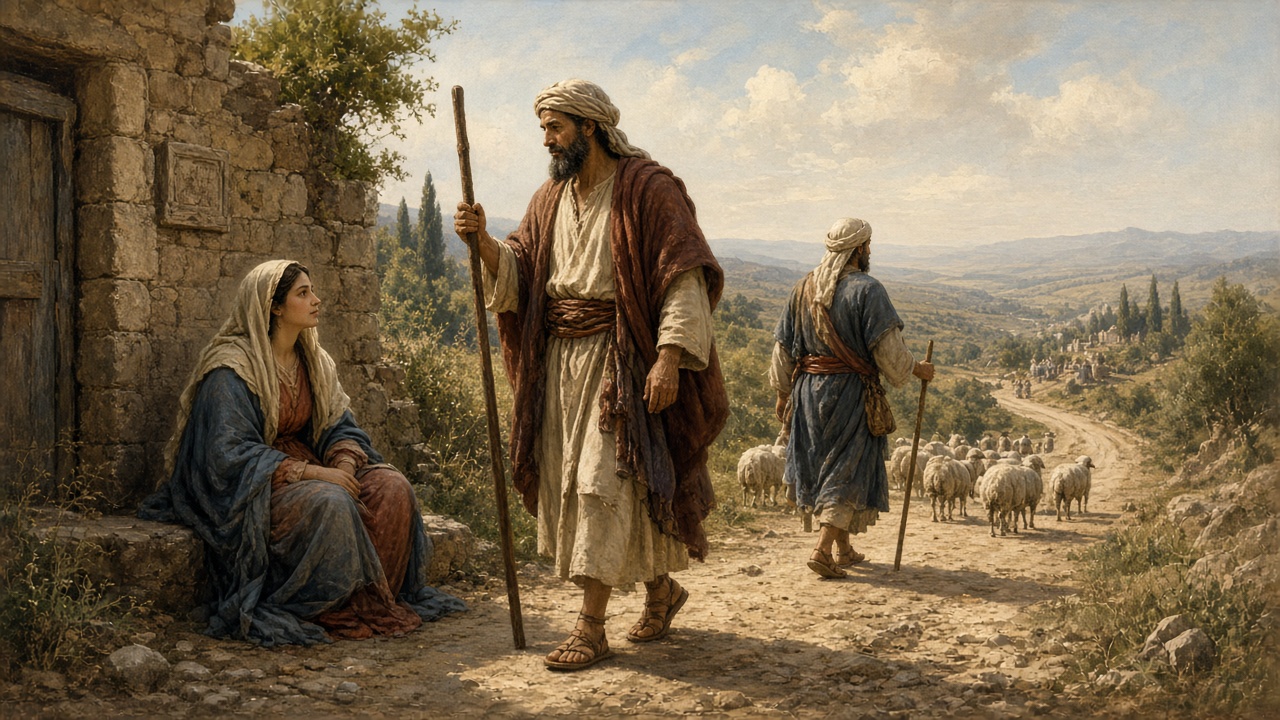
Judá e Tamar
- Pouco depois de José ser vendido aos ismaelitas, Judá deixou os irmãos e foi morar perto de Hira, um adulamita, e casou-se com a filha de Sua, um cananeu. Ela lhe deu Er, Onã e Selá; Selá nasceu em Quezibe, cujo nome significa enganoso e provavelmente é o mesmo lugar que Aczibe.Fontes: Judah (patriarch) · Shuah · Chezib · o próprio texto bíblico
- Judá tomou Tamar por esposa para o seu primogênito, Er. Depois que Er morreu, disse a Onã que se deitasse com ela, cumprisse o dever de cunhado e suscitasse descendência a Er, mas Onã derramava a semente na terra para que o filho não lhe pertencesse. O Dicionário Bíblico de Easton (1897) compara esse episódio com Deuteronômio 25:5 e Mateus 22:24; Onã morreu antes de a família de Jacó descer ao Egito, e Judá nunca deu Tamar a Selá, como havia prometido.Fontes: Tamar · Onan · o próprio texto bíblico
- Depois que a filha de Sua morreu, Judá e seu amigo Hira subiram até os seus tosquiadores em Timna, que o Dicionário Bíblico de Easton (1897) descreve como uma cidade de Judá a cerca de vinte milhas a oeste de Jerusalém. Tamar cobriu o rosto com um véu e esperou em Enaim, no caminho para Timna — provavelmente Enam, uma cidade da planície ou Sefelá —, e Judá pensou que ela era uma prostituta porque tinha o rosto coberto. Mais tarde ela teve gêmeos, e o menino que irrompeu primeiro recebeu o nome de Perez, nome que significa brecha.Fontes: Timnah · Enaim · Pharez · o próprio texto bíblico
Notas escritas com auxílio de IA a partir de fontes abertas (Theographic Bible Metadata, CC BY-SA 4.0; Easton’s Bible Dictionary, domínio público) e revisadas antes de publicar.
Créditos e licença desta tradução
Yak'usda Ooghuni
New Testament in Carrier (CA:crx:Carrier)
copyright © 2011 Wycliffe Bible Translators, Inc.
Language: Carrier
Translation by: Wycliffe Bible Translators, Inc.
Carrier
crx
Canada
Copyright Information
© 2011, Wycliffe Bible Translators, Inc. All rights reserved.
This translation text is made available to you under the
terms of the Creative Commons License: Attribution-Noncommercial-No Derivative Works.
( http://creativecommons.org/licenses/by-nc-nd/3.0/ )
In addition, you have permission to port the text to different file formats, as long as you
do not change any of the text or punctuation of the Bible.
You may share, copy, distribute, transmit, and extract portions
or quotations from this work, provided that you include the above copyright
information:
You must give Attribution to the work.
You do not sell this work for a profit.
You do not make any derivative works that change any of the actual words or punctuation of the Scriptures.
Permissions beyond the scope of this license may be
available if you contact
us with your request.
The New Testament
in Carrier
© 2011, Wycliffe Bible Translators, Inc. All rights reserved.
This translation is made available to you under the terms of the
Creative Commons Attribution-Noncommercial-No Derivatives license 4.0.
You may share and redistribute this Bible translation or extracts from it in any format, provided that:
You include the above copyright and source information.
You do not sell this work for a profit.
You do not change any of the words or punctuation of the Scriptures.
Pictures included with Scriptures and other documents on this site are licensed just for use with those Scriptures and documents.
For other uses, please contact the respective copyright owners.
2014-04-22
Fonte: http://ebible.org/crxNTpo/ · eBible.org