Mateus 7
U Chʼuʼul Tʼan Dios · Toque num versículo para ver as referências cruzadas.
No juzguen a otros
1’Mach a päpä' äle' que a lot mach u che tu toja, uc'a mach älbintiquet täcä que ane mach a che tu toja. 2Uc'a ca' chich a cherben a lot, che' chich a xe tä cherbinte täcä. Ca' chich a p'isän cua' chichca a wäc'ben a lot, che' chich a xe tä p'isbinte täcä. 3¿Cua' uc'a a wäle' que mach utz cua' u chen a lot jinq'uin mäx tz'ita' u säte'ba, y ane mach a wäc'be aba cuenta que ayan a noj q'uenel tanä? Es ca' a wälä ya'an yoc p'i' p'os tan u jut y noj gran te' tan a jut aneba. 4Mach u ch'ä a wäle': “Cä lot, la'ix cä pa'säbenet ni p'os tan a jut” si aneba ya'an noj gran te' tan a jut. 5¡Ane ajsusuccheriajet! Pa'sen najtäcä ni noj te' ya'an tan a jutba, uc'a u ch'e' a chänen tuba a pa'säben ni p'os tan u jut a lot.
6’Jini que ch'u'ul chere uc'a Diosba, mach a wäc'ben ni gente ajmalujle ca' a wälä wichu'jobba, mach xic u jule' ubajob ta'wac'ola. Jini tä' choj u valor que u te tu c'äb Diosba, mach a wäc'ben ni gente ca' a wälä chitamobba, mach me'ixto xic u xac'äjteq'ue'.
Pedir, buscar y tocar a la puerta
7’C'atbenla Dios t'oc c'änti'ya cua' chichca jini, y a xe chich tä äc'bintela. Sacänla jini u yäq'ue' Diosba, y a xe chich a pojlenla. Pecänla Dios y u xe chich u yubin a t'anla y u yäc'benetla lo que c'änä ac'ala. 8Uc'a upete machcatac u c'atän, u yäc'binte chich. Machcatac u sacän, u pojlen chich. Machcatac u pecän, u xe chich tä ubcan u t'an y u yäc'binte lo que c'änä uc'a.
9’Caba winic de anelaba, si a wajlo' u c'atbenet waj, ¿a xe quira a wäc'ben ump'e ji'tun? 10Si u c'atbenet untu u pa' buch', ¿a xe quira a wäc'ben untz'it chan? 11Anelaba, que ajcherajtanäjetla, si a paq'uin äc'benla a bijch'oc cua' chichca utz, ¿mach quira cä Papla tä cielo täcä más u xe u yäc'ben cua' chichca utz machca chichca u c'atben?
12’Bada jiq'uin, ca' chich a wo que a lot u chen upete tu toja t'oc ane, che' chich täcä c'änä a chen t'oc unejob. Ca' jini chich u ye'benonla cä chenla ni ley taj Moisés y ni u tz'ibi ajt'anob ta Diosba.
La puerta angosta
13’Ya'an chatz'it bij. Untz'it bij u bisanonla tä cielo y untz'itba u bisanonla tä sätiba. Ochenla bajca p'i' u tan ni ochibaba. P'i' u tan ni ochiba y p'i' u tan täcä ni bij que u bisan untu bajca u ch'e' paq'uin cuxlec untu, y mäx tz'ita' machcatac u ch'e' ni bij jini. Uc'a noj u tan ni ochiba y noj u tan täcä ni bij que u bisan untu tä sätibaba, y q'uen machcatac u ch'e' ni bij jini.
El árbol se conoce por su fruto
15’Iran que mach u sucpecänetla jini ajt'anob que u te u päpä' ye'e' cua' chichca t'an que mach jin ta Diosba. Unejobba u xe tä te bajca anetla ca' a wälä tä' utz u c'ajalin t'oc anela ca' u mansu'an oveja, pero tan u pixanobba tä' cäräxjob ca' ajlobo. 16T'oc lo que u chenobba, a xe a wina'tanla caxcatac une. Ca' chich ni uva mach utuq'uinti tuyac'o te' chäcch'ix, che' chich täcä u jut tzajäla u c'aba' higoba mach utuq'uinti tuyac'o bäläna. 17Ca' jini täcä upete ni te' utzba, utz chich u jut u chen. Ni te' mach utzba, mach utz u jut u chen. 18Untec te' utzba mach u ch'ä u yäq'ue' u jut que mach utz. Untec te' mach utzba mach u ch'ä u yäq'ue' u jut utz. 19Upete te' que mach u yäc'ä u jut utzba, u tzepcan une y u julcan tan c'ac' tä pule. 20Jin uc'a cälbenetla que uc'a lo que u chenobba a xe a wina'tanla caxcatac une.
No todos entrarán en el reino de los cielos
21’Jini machca u yälbenon ca'da: “Cajnoja, Cajnoja”, mach upete u xe tä ochejob bajca u chen manda ni Dios ya'an tä cieloba. Ni u xe tä ochejobba sec' jini machca u chen ca' chich yo ni cä Pap ya'an tä cieloba. 22Jimba q'uin jiniba q'uen chich machca u xe u yälbenon ca'da: “Cajnoja, Cajnoja, ¿mach quira a t'an chich ni cä ye'i t'ocob? ¿Mach quira t'oc u poder a c'aba' cä pa'si t'ocob tzuc pixan tuyac'o machcatac u tz'ibajtesan? ¿Mach quira t'oc u poder a c'aba' cä chi t'ocob q'uen milagro?” 23Jinq'uinba, no'on cä xe cä p'albenob ca'da: “Mach bay cä chet conocela. Tz'eje abala t'oc no'on, anela que mach utz cua' a chila”.
Las dos bases
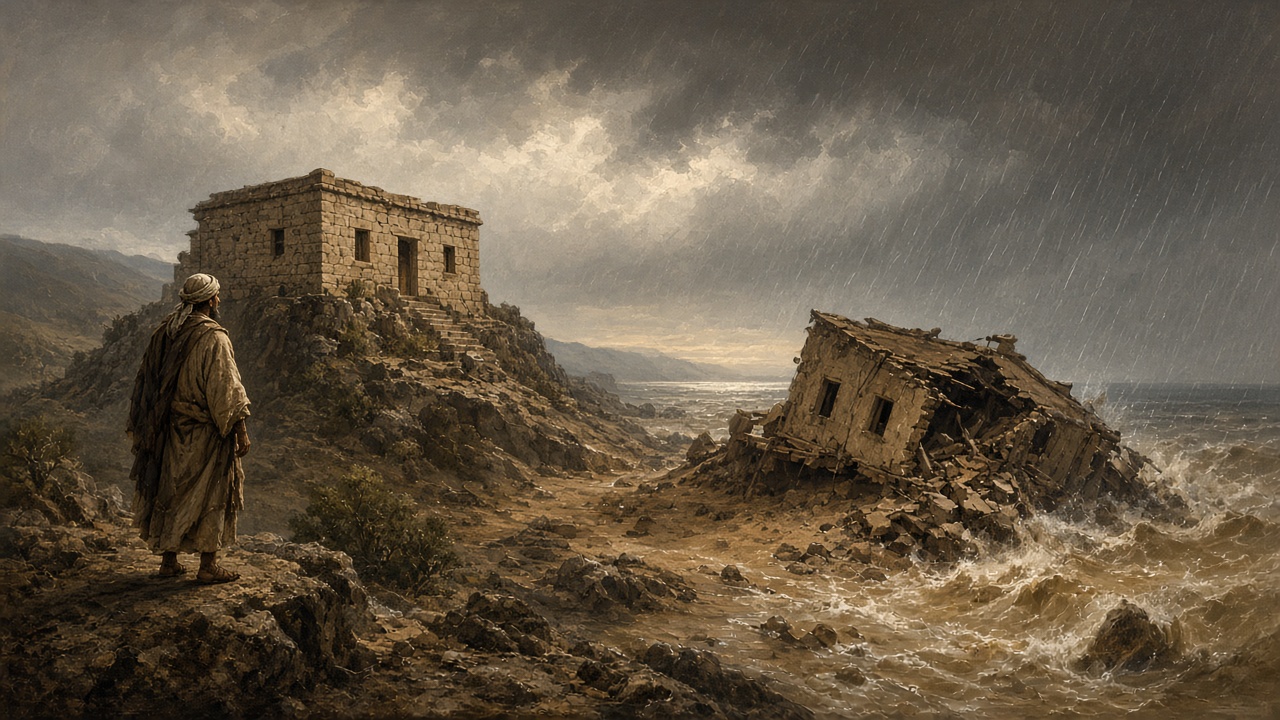
24’Machca chichca jiq'uin que u yubin upete ni t'anda que mu' cäle'ba y u chen ca' chich cäli, ca'da ayan une: Es ca' untu winic que an u c'ajalin. Une u chi yotot tu pam ji'tun. 25De ya'i u yäc'bi noj ja', c'ac'a' but'i. U yusti noj gran ic', y u jätz'i uba tuyac'o jini otot. Mach u chi trebe ni noj ic' ni ja' u yäsen tä cab uc'a jini otot ya' uti une tu pam ji'tun. 26Machca chichca que u yubin upete ni t'anda que mu' cäle'ba y mach u che ca' chich cäli, ca'da ayan une: Es ca' untu winic que mach totoj an u c'ajalin. U chi yotot tu pam ji'. 27De ya'i u yäc'bi noj ja'. C'ac'a' but'i. U yusti noj gran ic', xi u jätz'e' uba tuyac'o ni otot jini. T'oc noj quiricne yäli tä cab.
28Jinq'uin u tzupsi aj Jesús u yäle' ni t'anda, taj coli ni gente tä ch'ictä u jutob uc'a jini t'an que u yäliba. 29Uc'a uneba cheque chich cache' Dios chich u yäc'bi poder tuba u ye'e' ni t'an jini, uc'a u c'alin ye'e' une y mach ca' u ye'e' jini machcatac yuwi ni ley taj Moisés.
Você sabia?
O juízo, o caminho estreito e um alicerce firme
- O registro do evento data o início do Sermão da Montanha em 28 d.C. e sua duração em um dia. Este capítulo termina com as multidões admiradas com o ensino de Jesus, porque ele ensinava como quem tem autoridade, e não como os escribas deles.Fontes: Sermon on the Mount · o próprio texto bíblico
- Jesus adverte que o juízo que alguém pronuncia, e a medida que essa pessoa usa, voltarão sobre ela. Ele descreve alguém que repara no cisco no olho do irmão, mas não percebe a trave no próprio olho, e diz que a trave precisa ser removida primeiro.Fontes: o próprio texto bíblico
- O capítulo chama de essência da Lei e dos Profetas fazer aos outros o que se gostaria que lhe fizessem. Ele contrasta uma porta larga e um caminho espaçoso que leva à destruição, pelo qual muitos entram, com uma porta pequena e um caminho estreito que leva à vida, que poucos encontram, e compara ouvir essas palavras e praticá-las a uma casa construída sobre a rocha, e não sobre a areia.Fontes: o próprio texto bíblico
Notas escritas com auxílio de IA a partir de fontes abertas (Theographic Bible Metadata, CC BY-SA 4.0; Easton’s Bible Dictionary, domínio público) e revisadas antes de publicar.
Créditos e licença desta tradução
U Chʼuʼul Tʼan Dios
New Testament in Chontal, Tabasco (MX:chf:Chontal, Tabasco)
copyright © 1977 Wycliffe Bible Translators, Inc.
Language: Chontal, Tabasco
Translation by: Wycliffe Bible Translators, Inc.
Chontal, Tabasco [chf], Mexico
Copyright Information
© 1977, Wycliffe Bible Translators, Inc.
This translation text is made available to you under the
terms of the Creative Commons License: Attribution-Noncommercial-No Derivative Works.
( http://creativecommons.org/licenses/by-nc-nd/3.0/ )
In addition, you have permission to port the text to different file formats, as long as you
do not change any of the text or punctuation of the Bible.
You may share, copy, distribute, transmit, and extract portions
or quotations from this work, provided that you include the above copyright
information:
You must give Attribution to the work.
You do not sell this work for a profit.
You do not make any derivative works that change any of the actual words or punctuation of the Scriptures.
Permissions beyond the scope of this license may be
available if you contact
us with your request.
The New Testament
in Chontal, Tabasco
© 1977, Wycliffe Bible Translators, Inc.
This translation is made available to you under the terms of the
Creative Commons Attribution-Noncommercial-No Derivatives license 4.0.
You may share and redistribute this Bible translation or extracts from it in any format, provided that:
You include the above copyright and source information.
You do not sell this work for a profit.
You do not change any of the words or punctuation of the Scriptures.
Pictures included with Scriptures and other documents on this site are licensed just for use with those Scriptures and documents.
For other uses, please contact the respective copyright owners.
2014-04-22
Fonte: http://ebible.org/chfNT/ · eBible.org